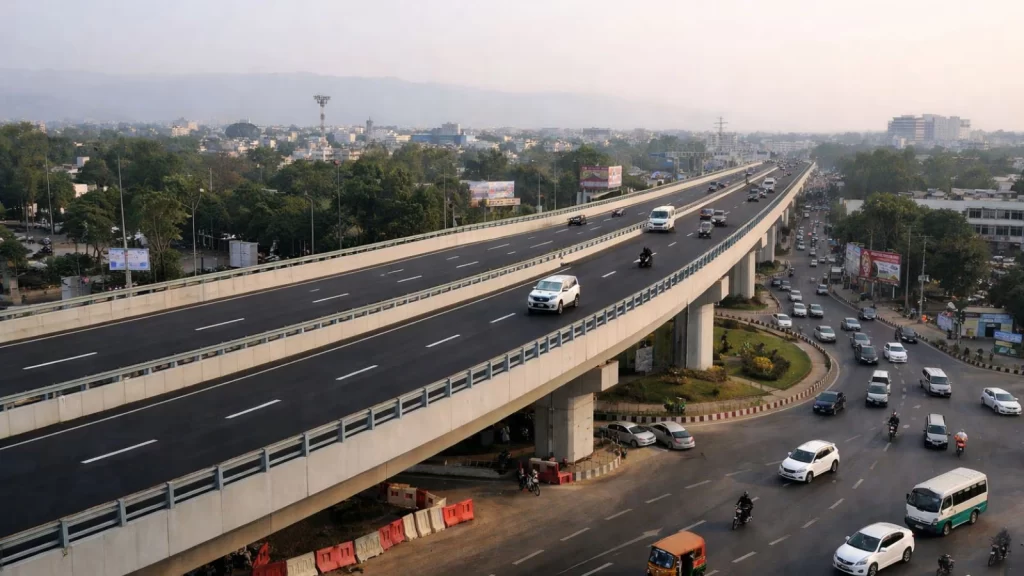
Punjab and Haryana High Court puts the brakes on Chandigarh’s Rs 247-crore flyover push, demanding that pedestrians, cyclists, and public transit — not speeding cars — define the city’s urban future.
—
There is a question that has been hanging over Chandigarh’s most contentious infrastructure project for years now, and the Punjab and Haryana High Court finally put it in plain terms: can a city sacrifice its heritage, its trees, and its very identity just to unsnarl traffic at one roundabout?
The proposed six-lane flyover at Tribune Chowk on NH-05 — a project nearly a decade in the making — has become far more than a traffic management exercise. It has turned into a referendum on what kind of city Chandigarh wants to be as it moves deeper into the 21st century. And right now, the High Court appears to be in no mood to let the concrete pour without some very hard answers.
—
## A Project That Refuses to Stay Still
The Tribune Chowk flyover project has had more lives than most infrastructure schemes in India. It was first conceived in 2016, when the Union Ministry of Road Transport and Highways approved a consultant to find a permanent solution to the chowk’s chronic gridlock. The roundabout sits at the entry point of one of Chandigarh’s busiest corridors, with over 1.5 lakh vehicles crossing it every single day.
A proposal was approved in 2019 at an estimated cost of Rs 183.74 crore, the foundation stone was laid in March that year, and tenders were awarded in November. Then everything ground to a halt. The Punjab and Haryana High Court granted a stay on the project in November 2019, triggered by a PIL filed by a city-based social organisation, the RUN Club, which challenged the felling of nearly 700 fully grown trees along Dakshin Marg and Purv Marg.
For close to five years, the project sat in legal limbo. The stay was finally vacated in April 2024, costs had ballooned to Rs 247.07 crore by August 2025, fresh tenders were floated in October 2025, and financial bids were opened on May 7, 2026. In a move that raised eyebrows across the city, the Chandigarh Administration awarded the work to Chandigarh-based Singla Constructions Ltd — at a quoted bid price of Rs 147.98 crore, roughly 31 per cent below the estimated bid cost — on the very evening before the High Court was scheduled to hear a fresh petition challenging the project.
The timing did not go unnoticed.
—
## The Court’s Pointed Questions
When the matter came up before a Bench headed by Chief Justice Sheel Nagu, the court’s skepticism was unmistakable. “The Master Plan is screaming no flyover. How are you going in for it?” the Chief Justice asked pointedly, setting the tone for what has become one of the more charged urban planning disputes in the region in recent years.
The court’s concern was not just procedural. It went to the philosophical heart of what Chandigarh is. “Chandigarh’s uniqueness is only because of the heritage concept,” the Bench observed at an earlier hearing. “If that goes, everything goes. The uniqueness goes… it’ll be like any other city.” The court then posed what is perhaps the most honest framing of the dilemma: “The concept of the city is pitted against traffic congestion. Now, which one do we give more prominence to and why?”
That is not a throwaway rhetorical question. It is, in fact, exactly the question that urban planners, residents, and policymakers across India’s heritage cities have been wrestling with for decades — and rarely answering well.
Advocate Tanu Bedi, assisting the Bench as amicus curiae, laid out the legal and planning argument with precision: the Chandigarh Master Plan 2031, a legally binding document notified in 2015 after the High Court’s own intervention, does not envisage flyovers anywhere within city limits. It was never amended. “Chandigarh is not a city for luxury SUVs but meant for slow-moving vehicles, cycles and pedestrians,” she told the court, adding that the Master Plan explicitly prioritises public transportation on longer routes and pedestrian and cycling movement for shorter ones.
The Bench sought clarity on whether the Master Plan had been duly notified and whether proper procedure had been followed for any amendment. The administration’s position — that the stay was vacated in 2024 and Supreme Court challenges were dismissed in September 2024 — has not, so far, settled the court’s concerns about the planning framework.
—
## Seven Hundred Trees and a Heritage Grade Question
At the centre of this legal battle is a number: 700. That is the approximate count of mature trees slated to be felled along the Tribune Chowk corridor to make way for the 1.6-km flyover structure. Many of these trees are decades old. Some have grown into the very texture of the neighbourhood.
Among them, petitioners have pointed out, are 17 mango trees belonging to an orchard carrying Heritage Grade 1 status. The administration’s standard response — that three saplings would be planted for every tree felled — has not convinced the court or the petitioners. Architects Pearl Ahluwalia and Aashray Ahuja, directors of the city-based Urban Research and Architecture Practice (URap), perhaps put it best: “Treating this as adequate compensation is like putting a band-aid on a bullet wound.”
Their argument goes beyond sentiment. Chandigarh’s tree-lined avenues are not decorative. They are integral to Le Corbusier’s original urban vision, designed to regulate the microclimate, define spatial character, and create the human-scale environment that makes the city walk-able. Strip the trees and you do not just lose shade. You begin losing the city.
The petitioners have urged the court to restrain authorities from cutting trees until the matter is decided, and to make any contract awarded subject to the final verdict. “Please don’t cut the trees,” advocate Bedi told the Bench. “And if any tender is allotted, that should be subject to the outcome of this petition.”
—
## ‘Myopic’ Solutions and the Overloop Alternative
Former Chandigarh Chief Architect Sumit Kaur, a member of the Heritage Conservation Committee, has been among the most vocal opponents of the flyover. She has called it a “myopic” solution — and a “30th-century response to 21st-century problems.” Her argument is that a 1.6-km concrete structure does not solve Chandigarh’s mobility challenges; it shifts them further down the road, creating new bottlenecks while permanently disfiguring an irreplaceable urban landscape.
Kaur has instead advocated for a combination of approaches: strengthening public transport, developing a Mass Rapid Transit System, and building a ring road to divert through-traffic away from the city core. These are not radical ideas. They are, in fact, the approach that most progressive cities globally are now adopting — moving people, not just vehicles.
The architectural counter-proposal that has attracted the most attention is called “The Overloop.” Designed by Pearl Ahluwalia and Aashray Ahuja after three years of work on a comprehensive master plan for Chandigarh’s next 50 years, it envisions an elevated rotary constructed directly over the existing Tribune Chowk roundabout. The structure would separate traffic across two levels, enabling continuous signal-free movement and — according to its designers — increasing traffic capacity by close to 50 per cent. Critically, it would require the felling of only 65 trees, compared to the 700 under the current flyover plan. The total cost remains within the same Rs 247-crore ballpark.
The architects claim the Overloop proposal was presented to the UT Administration in 2019 and was shortlisted as one of two competing designs. What happened next, they say, raised serious questions. The evaluation was allegedly conducted by the same party that was eventually awarded the tender. “Our engagement has been guided not by opposition, but by the need for a more informed and inclusive consideration of alternatives,” they said. The High Court has been asked to look into these transparency concerns.
—
## Administration Holds Its Ground — For Now
To be fair, the Chandigarh Administration has a legitimate case on one level. Tribune Chowk is genuinely one of the worst traffic bottlenecks in the Chandigarh-Mohali-Panchkula tricity region. Over 1.5 lakh vehicles passing through a single intersection every day is not a small problem. Commuters who deal with the daily crawl through that stretch are not wrong to want something done.
Union Minister Nitin Gadkari, speaking after the project was awarded, described it as part of a broader signal-free corridor vision for NH-05, linked to the Zirakpur bypass and a proposed tricity ring road. UT Administrator Gulab Chand Kataria called the award of work a “major milestone” and said the administration was committed to completing the project within the stipulated timeframe.
What the administration has been less forthcoming about is why the Master Plan provisions appear to have been bypassed, who evaluated competing designs and on what basis, and whether any serious cost-benefit analysis was conducted for the alternative proposals. These are not anti-development questions. They are the minimum that residents and courts should be asking before 700 trees come down and a billion-rupee concrete structure reshapes a UNESCO-recognised heritage city.
—
## A Verdict Reserved — And a City Watching
On May 13, 2026, as the High Court heard final arguments in the case, advocate Tanu Bedi took an unexpected turn. Amid maps, master plan clauses, and traffic data, she quoted Mirza Ghalib: “Umr bhar Ghalib yahi bhool karta raha, dhool chehre pe thi aur aaina saaf karta raha.” The courtroom fell briefly silent. The couplet — about spending a lifetime polishing the mirror while the dust sat on the face — was aimed squarely at the flyover proposal. It landed.
The Punjab and Haryana High Court has reserved its verdict. The project contract has been awarded. The trees still stand. And Chandigarh waits.
What happens next will not just determine the fate of a roundabout. It will signal whether Indian cities are willing to have an honest conversation about urban mobility — one that does not default to concrete and tarmac the moment traffic gets bad. The broader question — about whether Indian cities can build infrastructure that respects their identity and their people, not just their vehicles — is one that goes well beyond Chandigarh.
But Chandigarh, more than almost any other city in India, has both the legal framework and the institutional heritage to get this right. The High Court’s sharp scrutiny, the architects’ creative alternatives, and the vocal pushback from the planning community suggest that at least some of the city’s stakeholders are determined to ensure the answer is not simply the path of least resistance.
The verdict, when it comes, will be watched closely — not just in Chandigarh, but in every Indian city where a flyover is waiting in a planner’s drawer.
—
Chandigarh’s Tribune Chowk Flyover Row: When Concrete Ambition Meets a City’s Soul