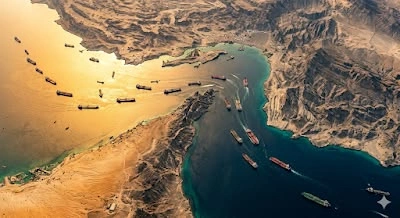
The Strait of Hormuz — a sliver of water barely 33 kilometres wide at its narrowest point — has long been described as the world’s most critical oil chokepoint. Today, it is something else entirely: the pressure point around which the entire architecture of global energy trade, Middle Eastern geopolitics, and U.S.-Iran relations is dangerously balanced. Iran has placed a conditional offer on the table: reopen the strait to all international shipping, but only if Washington ends its naval blockade and rolls back its crippling economic sanctions. The United States, so far, is not biting.
The standoff that began on February 28, 2026 — when U.S. and Israeli forces launched surprise air strikes on Iran, killing Supreme Leader Ali Khamenei — has since spiraled into something the world has not seen in modern history: a near-complete shutdown of the waterway through which, until recently, roughly 25 percent of the world’s seaborne oil trade and around 20 percent of global liquefied natural gas supplies passed every single day.
—
## The Chain of Events that Locked the Straits The chain of events that locked the straits has been fast-moving and deeply consequential. Within hours of the February 28 strikes, Iran’s Islamic Revolutionary Guard Corps (IRGC) transmitted warnings to vessels via VHF radio, effectively declaring that no ships would be permitted to pass. The closure was not legally formalised as a blockade, but it didn’t need to be. The threat alone was enough. Ship-tracking data quickly showed a 70 percent reduction in traffic through the waterway.
What followed was a cascade of dangerous incidents at sea. On March 1, the oil tanker *Skylight* was struck by a projectile north of Khasab, Oman, killing two Indian crew members and injuring three others. A drone boat hit the MKD Vyom, killing another Indian sailor. The message from Tehran was blunt: enter these waters without permission, and pay the price.
By mid-March, Iran had shifted from outright closure to something more calculated — selective access. Reports emerged that Iran was allowing certain vessels through the strait in exchange for transit tolls of up to $2 million per ship, with passage granted to ships from China, Russia, India, Iraq, Pakistan, and a handful of other nations. It was a revenue mechanism, yes, but also a geopolitical instrument.
The U.S. responded with its own counter-blockade on April 13, 2026. More than 10,000 American personnel, backed by over a dozen warships and dozens of aircraft, began enforcing a prohibition on all ships seeking to reach Iranian ports. The USS Abraham Lincoln carrier strike group, 11 destroyers, and the USS Tripoli amphibious group were all deployed in the region. In the first 24 hours of the blockade, six commercial ships complied with U.S. orders and were turned back toward Iranian ports.
—
## The Offer — and America’s Cold Shoulder
Iran’s foreign minister Abbas Araghchi announced on April 17 that the strait was fully open to all commercial shipping for the duration of a ceasefire in Lebanon. Oil prices dropped sharply — an 11 percent fall in the immediate aftermath. Markets exhaled. The relief, however, lasted barely a day.
President Trump responded by posting on Truth Social that while the strait was “completely open,” the U.S. naval blockade would remain in place until negotiations with Iran concluded. Tehran called this unacceptable. On April 18, Iran shut the strait again.
The Iranian position, as communicated through back-channel sources familiar with the discussions, is straightforward: Washington must end its naval blockade and provide meaningful sanctions relief before Tehran reopens the waterway on a sustained basis. Iran’s newly created Persian Gulf Strait Authority (PGSA) has since imposed a formal application process on all transiting vessels — a “Vessel Information Declaration” that requires ships to submit detailed voyage plans and receive IRGC approval before entering. Analysts note that compliance with this process could expose shipping companies to U.S. sanctions, creating a no-win scenario for the global maritime industry.
Trump, for his part, called Iran’s response to America’s peace proposal a “piece of garbage” in an Oval Office briefing to reporters, and said the ceasefire was on “life support.” He has repeatedly threatened massive strikes on Iranian infrastructure if the strait remains blocked.
—
## A Shock Without Historical Precedent
The scale of what this closure has done to global energy markets is difficult to overstate. As described in the International Energy Agency’s Oil Market Report for May 2026, the current situation is the biggest disruption of oil supplies in the history of the global market. Gulf countries affected by the strait closure have seen oil output fall nearly 14.4 million barrels per day below pre-war levels. Global oil supply has declined by a further 1.8 million barrels per day in April alone, taking total losses since February to a staggering 12.8 million barrels per day.
Brent crude, trading at roughly $70 per barrel before the war erupted, has surged to around $102 a barrel. In the United States, gas prices crossed $4.50 per gallon for the first time in four years. The International Energy Agency’s 32 member countries, including the United Kingdom, have collectively released 400 million barrels from strategic reserves in an attempt to ease the pressure. Even with that intervention, the numbers remain alarming.
War-risk insurance premiums for Hormuz transits have jumped from 0.125 percent to between 0.2 and 0.4 percent of ship insurance value per voyage — a seemingly modest shift that translates into millions of additional dollars per tanker and is already being passed down the supply chain to consumers worldwide.
—
## India’s Soft Underbelly
This crisis is not an abstraction for India. It is visceral. India imports approximately 85 percent of its crude oil requirements, and nearly 45–50 percent of that crude — from Iraq, Saudi Arabia, Kuwait, and the UAE — passes through the Strait of Hormuz. About 60 percent of India’s natural gas imports also move through the same corridor.
The implications are serious. Research firm ICRA had warned earlier that a $10 per barrel rise in crude prices could increase India’s net oil import bill by $13–14 billion in a fiscal year and widen the current account deficit by 0.3 percent of GDP. With Brent now trading well above $100 a barrel, those estimates look conservative.
MUFG Research has noted that every $10 per barrel increase in oil prices widens India’s current account deficit by 0.4–0.5 percent of GDP. If oil were to remain above $100 a barrel, the current account deficit could push toward 3 percent of GDP, against a pre-crisis baseline of around 1.5 percent. That kind of deterioration would place significant downward pressure on the Indian rupee, with knock-on effects for inflation, household purchasing power, and corporate margins.
India has been threading a genuinely difficult needle in the diplomatic fallout. It has a trade deal with the United States, surging Russian crude imports (which rebounded sharply once Gulf supplies collapsed), and a formal dialogue with Iran — which briefly granted India passage rights through the strait before firing on Indian-crewed vessels in April. For New Delhi’s energy planners, February 28 is a date that has fundamentally changed how India thinks about supply chain risk.
—
## A Diplomatic Maze With No Easy Exit
Pakistan has been attempting to mediate between the two sides in talks held in Islamabad. Those negotiations have so far failed to produce an agreement. The UK and France have hosted separate conferences aimed at exploring sanctions relief, diplomatic pathways, and insurance provision to encourage resumption of safe passage. President Macron has called for a “peaceful multinational mission” aimed at restoring freedom of navigation.
China and Russia, meanwhile, vetoed a UN Security Council resolution in early April that encouraged member nations to work toward reopening the strait. Both countries have their own stakes in the outcome — China is one of Iran’s largest oil customers and a significant beneficiary of the selective transit arrangements currently in place.
Trump briefly launched “Project Freedom” — a U.S. initiative to assist vessels through the strait — only to pause it within 48 hours, reportedly at the request of Pakistani mediators who feared it would further inflame the situation. Shipping industry sources confirm that the announcement did little to calm Iranian behaviour. The IRGC has now declared a new maritime control area extending west and east of the strait, stretching deep into the Gulf of Oman.
So here is the question that governments and markets are struggling to answer: if both sides have drawn red lines, who moves first?
—
## The Longer Risk: Structural Fragility Exposed
Beyond the immediate crisis, the Hormuz standoff has exposed something that decades of financial engineering and supply chain optimisation have quietly papered over — global energy security remains fundamentally anchored to physical geography. No derivatives instrument, no strategic reserve, no alternative routing arrangement fully hedges the loss of 25 percent of the world’s seaborne oil supply.
The IEA’s May 2026 report assumes that flows through the strait will gradually resume from June onward. That assumption is fragile. As of mid-May, there is no signed agreement, no verified ceasefire with teeth, and no clear indication that either Washington or Tehran is prepared to offer the other what they are demanding. Iran wants the blockade lifted and sanctions removed before it commits to a sustained reopening. The U.S. wants the strait open before it discusses concessions. Neither side is blinking.
Refinery crude throughputs are forecast to plunge by 4.5 million barrels per day in the second quarter of 2026. Global observed oil inventories drew down by 129 million barrels in March and a further 117 million barrels in April. The longer this drags on, the more structural damage gets done — to supply chains, to national fiscal positions, to the fragile recovery of post-pandemic emerging economies.
—
## What Comes Next
The path out of this crisis, if one exists, almost certainly runs through a sequenced negotiation — some form of partial concession by both sides that allows face-saving while opening the waterway incrementally. Pakistan’s mediators, the UK, France, and quietly perhaps China, are all understood to be pushing for exactly this kind of phased approach.
But the personalities involved make progress difficult. Trump has publicly humiliated Iran’s diplomatic overtures. Tehran’s new leadership, under Khamenei’s son and successor, has framed the closure of the strait as a strategic asset — not just a tactical retaliation. In a recent message attributed to the new supreme leader, he spoke of using “the leverage of closing the strait” as one tool toward building a “new regional and global order under the strategy of a strong Iran.” That is not the language of a government looking for a quick exit.
For the world’s energy importers — India, Japan, South Korea, the European Union — the wait is costly and growing costlier by the day. For the shipping industry, the insurance industry, and the millions of people whose livelihoods depend on affordable energy, the stakes could hardly be higher.
The Strait of Hormuz is 33 kilometres wide. Right now, it feels like the entire world is holding its breath inside those 33 kilometres.
—
Iran’s Hormuz Offer: Will Washington Blink First in the World’s Most Dangerous Shipping Lane?