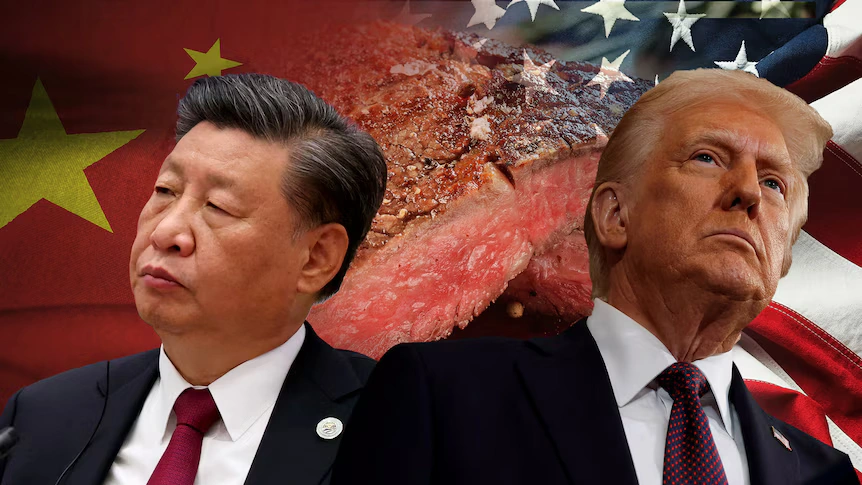
When U.S. and Chinese officials sat down for high-level trade talks, hundreds of American beef processing plants had been quietly locked out of one of the world’s most lucrative meat markets — not with loud tariff announcements or dramatic headlines, but by simply letting paperwork expire.
It sounds kind of bureaucratic. But it is certainly true that the loss of export registrations of more than 400 U.S. beef businesses in China is one of the biggest agricultural trade actions of the decade and it is costing American cattle ranchers billions of dollars a year.
— ## A Market Built And Dismantled
To get a sense of the stakes, it is worth going back a decade. U.S. beef shipments to China had been almost non-existent for 14 years after a 2003 prohibition over fears about mad cow disease. When the market eventually reopened in 2017, a hard-won victory under the Trump administration’s 100-Day Action Plan in its first term, all that changed.
What was a little $63 million commerce in 2018 has blossomed into a billion dollar enterprise. Demand has been spurred by China’s expanding middle class and evolving eating habits, particularly in cities where demand for premium grain-fed beef is on the rise. That sent U.S. beef exports to China to a record $2.1 billion in 2022. Even more accelerated by the Phase One trade agreement struck in January 2020, under which China agreed to recognize U.S. food safety control of American processing facilities, paving the way for hundreds of beef plants to acquire export eligibility.
By 2024 China ranked as the second largest foreign market for U.S. beef, with total sales to mainland China and Hong Kong approaching $2 billion. It wasn’t just a supplementary market for ranchers in Texas, Nebraska and Kansas, it was a lifeline, particularly as the U.S. cow herd has already plummeted to its smallest size in 74 years because of protracted droughts and expensive feed expenses.
Then, in early 2025, Beijing discreetly started to cut off the tap.
— ### The licensing trap: a non-tariff weapon
The registrations for 489 U.S. facilities that are allowed to export beef into China expired at the end of March 2025. China’s customs body, the General Administration of Customs (GACC), just didn’t renew them. Under the Phase One deal, the five-year registrations would automatically be retained as long as the facilities passed USDA food safety regulations. The industry groups said China’s move to let them expire was a flagrant violation of that agreement.
More than 415 U.S. beef facilities have not had their registrations renewed by China, meaning they are not permitted to export to China as of January 2025. “It’s a huge market loss for the U.S. that Brazil and other nations have wanted to fill,” said the Meat Institute.
What makes this more bitter is that it is not a tariff. Tariffs are visible, negotiable and more likely to attract media scrutiny. Licenses expired? Those can be disguised up as normal administrative matters. But the effect is the same, and in some ways worse, because it is harder to dispute at the World Trade Organization and simpler for Beijing to pull back at a politically expedient moment.
This action, which was viewed as a non-tariff barrier, created uncertainty and shattered confidence in the reliability of U.S. beef exports. And that uncertainty, once it takes root in an industry, doesn’t evaporate the minute there’s a political handshake.
— ### The brutal story of the numbers
The devastation has been rapid and hard.
U.S. beef exports to China decreased 69% in 2025. Indeed, in the second half of 2025, overall beef exports to China were just $48 million, a 95% decline from the $924 million exported in the second half of 2024.
Let that just sink in. From close to a billion dollars in six months to $48 million. It’s not a deceleration. It’s a near total shut down.
Lost beef sales in the Chinese market last year were $1.1 billion and the bill for 2026 is on pace to reach $1.5 billion against 2024.
And who is going to step in and fill that void? The countries who have seen this trade war evolve from the sidelines.
In 2024, the U.S. accounted for around 9% of China’s beef import market. By the third quarter of 2025, the U.S. share fell to below 1%, with Brazil and Australia accounting for 59% and 13%, respectively.
This is not a passing blip. Brazil has not only replaced American beef, it has completely redesigned its export strategy to focus on the Chinese market. China imported 948,000 tons of Brazilian beef from January to August 2025, up 19.6% on the year, accounting for more than half of Brazil’s total beef exports. These imports rose in value by 48.1%
— ## How This Became a Tool of the Trade War
So why beef of all things? And why now?
The timing was intentional. China’s move to let U.S. beef plant registrations lapse came virtually in lockstep with the escalation of the wider tariff battle in early 2025, when Washington slapped a large new round of penalties on Chinese imports. Beijing, for its part, responded with tariffs and a slew of what trade specialists call ‘administrative instruments’ — the very sort of quiet, deniable measures that are toughest to fight.
Analysts say China’s decision to temporarily halt beef imports from the U.S. is likely a bargaining tool that will be used to reach a wider trade agreement and not a permanent ban. That reading got some credibility when Chinese Vice Premier He Lifeng reportedly signaled “openness” to renewing the trade licenses in a Paris meeting with Treasury Secretary Scott Bessent in March 2026 – before those talks stalled.
One trade negotiator put it bluntly: Beijing is holding a golden ticket it may choose to hand back whenever it gets political credit for doing so. The question is what the U.S. has to provide in exchange.
Will this be the one bargaining tool that determines the fate of the Trump-Xi summit in May 2026, or will beef once again be off the table as it has been in previous framework discussions?
— ## The Summit and Its Stakes
U.S. cattle producers pushed the White House to make the problem a priority in the high-level negotiations. Justin Tupper, president of the National Cattlemen’s Beef Association, said administration officials told him the issue would be on the agenda for the summit, raising optimism for a possible breakthrough in U.S.-China agricultural trade relations.
American beef exports to China hit a record $1.7 billion in 2022 before being caught up in the tariff war between Beijing and Washington. More than 400 U.S. beef processing units have been stripped of their export eligibility during the last year, accounting for almost 65% of registered facilities.
But the road to recovery will not be easy, even with licenses back in place. American beef is now subject to tariffs that are 10% higher than Australian meat and therefore less competitive. China also adopted a quota system for beef imports in late 2025, imposing a 55% tariff on imports above quota amounts.
The surge in imported beef “seriously affected China’s domestic industry,” China’s commerce ministry said, implementing quota measures following an examination into whether the rise of imports was hurting local producers. In other words, even as Beijing potentially prepares to return those expired licenses as a diplomatic gesture, it has simultaneously raised additional structural barriers aimed at limiting how much imported beef can actually enter the market.
— ### A Shrinking Window
But there is another part of this dilemma that does not get much attention, and that is the health of America’s own cattle supply.
The U.S. is facing its smallest cow herd in decades, the result of years of drought conditions throughout key ranching regions. This has pushed U.S. beef prices to record levels and made it harder for processors to boost exports and even led to greater U.S. purchases of beef from Brazil and Argentina to fill domestic gaps. The irony of that latter point is particularly sharp — the same Brazilian beef that Beijing is buying by the millions of tons is now progressively finding its way into American dinner tables.
“The limited Chinese market, plus a squeezed domestic supply, make for a pressure cooker,” industry groups say. Restoring export access to China is not only about revenue – it’s about keeping the pipeline alive that justifies investment in processing capacity and herd restoration.
U.S. beef exports are down 10% in volume and 8% in value through mid-2025. But business leaders say the biggest problem is not weakening demand from tariffs. It’s the lack of access to facilities. China’s demand, especially for high-end premium cuts sold through retailers such as Sam’s Club, remains strong, according to reports. The stuff just can’t get there legally.
— ## The End Game
Beijing has proved, with striking consistency, that it employs food and agricultural commerce as a geopolitical tool. Nothing new here. China has put import bans and license limitations on Australian wine, barley and coal; Canadian canola; and South Korean consumer goods in the past. Each time the “administrative” rationale was carefully devised to preserve deniability.
The playbook is running again with beef – but the extent of the exposure of the American industry makes this chapter especially relevant. Unlike some agricultural commodities, premium beef has few other export destinations at the numbers China represents. “While Japan and South Korea are important markets, they do not have the same upside development potential as a country of 1.4 billion people that is quickly growing its protein intake.
China has become the third largest destination for American grain-fed cuts over the years, particularly offal cuts which were considered ideal in local Chinese dishes. The fundamental issues that have defined the past decade, from access constraints to changing consumer preferences, continue to dictate the road forward.
The American beef industry spent years cultivating relationships with Chinese buyers, chefs, grocers and cold chain distributors. That market information and brand presence doesn’t carry over when you’re away a long time. Brazilian frozen beef is apparently already accounting for over 60% of China’s mid- to high-end beef segment, which means U.S. producers are facing the painful reality that even a diplomatic breakthrough may not convert swiftly into regained market share.
— ## What’s Next
If the May 2026 summit generates meaningful agricultural concessions, the most likely near-term result is a partial restoration of export licenses — just enough to signal goodwill and make headlines, but implemented in a way that keeps the U.S. within China’s new quota framework and below the threshold for the punishing 55% over-quota tariff.
But analysts warn the competitive landscape has transformed. Brazilian manufacturers have modified their cutting and packaging to meet Chinese consumer tastes. Australian exporters have developed stronger ties with Chinese importers and retail chains. That terrain will require continued effort to re-claim, and it can’t be assumed just because the legal obstacles are taken down.
The beef licensing controversy has made it crystal clear that the future of U.S. agricultural trade with China is not something to be assumed or taken for granted — not by ranchers, not by trade negotiators, and especially not by politicians. The Phase One deal was previously hailed as a blueprint for prying open China’s economy. Five years later, it’s a cautionary tale of how rapidly that access can be reversed when geopolitical winds change.
The licenses can still be renewed. The question is whether the trust – and the market position – can be reestablished with them.
—
The Vanishing Licenses – How China’s Quiet Ban on U.S. Beef Became a Flashpoint in the Trade War