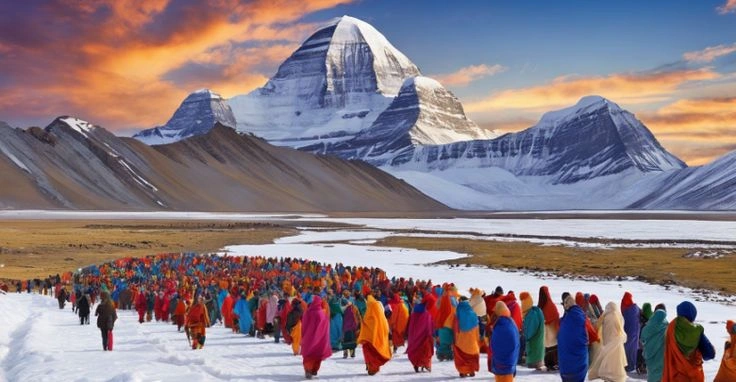
For thousands of Indian believers, the term ‘Kailash Mansarovar’ still reverberates like a whispered promise spoken across the Himalayas. And now, in a display of diplomacy and dedication, China has agreed to accommodate 1,000 Indian pilgrims for the Kailash Mansarovar Yatra this year, the largest restart of the hallowed pilgrimage in many years. The ruling is being seen not just as a religious concession but also a tentative link between New Delhi and Beijing following years of frigid relations between the two sides.
A coordinated plan between the Chinese government and India’s Ministry of External Affairs has been worked out for Indian pilgrims to proceed in stages over two land routes, Lipulekh in Uttarakhand and Nathu La in Sikkim, between June and August 2026. For many families that have waited years for an opportunity to undertake the yatra, the reopening is emotionally very difficult to put into policy documents. Is there a spiritual path to be found to gently restore confidence between two nuclear-armed giants despite all the border disputes and geopolitical jostling?
What the 1,000‑pilgrim quota means China’s statement that it will facilitate travel for 1,000 Indian pilgrims in 2026 is not just a number; it is a calculated signal that limits on people‑to‑people exchanges are being eased. Over the last five years, the Kailash Mansarovar Yatra has either been canceled or severely reduced, initially due to the pandemic and later in the after-math of the eastern Ladakh stand-off that froze many cross-border engagements. The 2026 allotment reverses that trend, and some reports say it is also an increase from the previous year’s allocation, signaling a readiness in Beijing to extend religious access gradually.
Each batch will have roughly 50 pilgrims and there will be ten batches through the Lipulekh route and ten through Nathu La, thereby sharing the thousand-pilgrim cap between the two corridors. The phased introduction will permit authorities to control the logistics, security and medical readiness in what is still one of the most high-risk travel situations in the world. Selection of Indian applicants will be through an online portal of the MEA with a cut-off date and an option to indicate the preference of route, keeping in mind the growing demand from senior citizens, working class families and middle-income aspirers who have long considered the yatra as a once-in-a-lifetime spiritual milestone.
Two paths, two stories from the Himalayas
“The political and physical complexity of the Kailash corridor is reflected in the decision to reopen both the Lipulekh (Uttarakhand) and Nathu La (Sikkim) routes. The Lipulekh route is defined as the traditional and arduous way, starting from the Kumaon region, passing through Dharchula, crossing Lipulekh Pass to Tibet, reaching Taklakot, and finally Kailash–Mansarovar. It is a preferred route for experienced high-altitude trekkers and those who want a longer and more challenging itinerary; treks usually take 22 to 25 days.
The Nathu La route, which starts from Sikkim and passes over at the Nathu La Pass, has comparatively greater vehicle support and is generally touted as a more realistic option for elderly pilgrims. This route is longer in terms of calendar days – roughly three weeks or more. The rebirth of both lanes also underscores New Delhi’s determination to spread the burden across several sections of the Indian Himalayas, balancing security sensitivities with local economies dependent on border tourism and pilgrimage services. But the route decision is not just logistical; it also sparks discussions on territorial views and sovereignty, especially as Nepal has at times raised concerns about the Lipulekh route passing through territory it claims as its own.
Why Kailash Mansarovar is significant for India
For Hindus, Jains, Buddhists, and followers of the Bon school, Mount Kailash is not merely a distant peak, but a cosmic axis, a mythical home of gods, and a place that is said to erase lifetimes of karma with a single circumambulation. In the Hindu cosmology, Kailash is the abode of Lord Shiva and the water of the adjoining Mansarovar Lake is said to wipe away sins and bring mental tranquility to those who bathe in it or even drink it. The Jains worship the mountain as Ashtapada, where Lord Rishabhdev obtained moksha while the Buddhists consider the region as a sacred axis of the cosmos, associated with the mandala of deities and the quest for enlightenment.
In this regard, the Kailash Mansarovar Yatra has long held a symbolic space in India’s national psyche, spanning sectarian divisions. It has become a barometer for India-China ties and its suspension or restoration is seen as a stress test of confidence and goodwill. The pilgrimage stopping post 2019-2020, was not just a travel disturbance but severing of a spiritual relationship maintained across ages, for many Indian families. As the yatra resumes in 2026, the issue that many are privately wondering is: can shared faith and pilgrimage help engender a deeper, more robust understanding between residents of two very different societies?
India–China relations: a soft-power shift
There is more to the 1,000-pilgrim bargain than religion and culture. It appears to be a confidence-building measure, deliberately chosen for a relationship that is still strained but increasingly “managed.” After years of military stand-offs, trade restrictions and strategic competition, both sides have started talking more about “normalising” ties through people-centric programs including student exchanges, cultural festivals and pilgrimages. The Kailash decision is part of a bigger trend of Beijing and New Delhi trying to build islands of cooperation — tourism, medical, education — even as competition bubbles up elsewhere.
Chinese officials have referred to it officially as “a bridge of faith, brotherhood and people-to-people bonds” between two ancient civilisations to facilitate 1,000 Indian pilgrims. On the Indian side, the Ministry of External Affairs has called the yatra a major people-oriented endeavor, as opposed to the customary border talks and defence drills. The move implies both governments know that stable relations can’t be built on military signals and tariff discussions alone; they must also cultivate the softer, everyday connections that make geopolitical tension feel less personal to ordinary populations.
But optimism is cautious. Medical and security regulations are nevertheless strictly enforced on the yatra, a sign of Beijing’s sensitivity over movement in Tibet and India’s own concerns about safety in border areas. Pilgrims will be put through fitness tests, have to carry emergency oxygen and adhere to strict schedules, reminders that even spiritual travel is a heavily controlled affair when it crosses contested frontiers.
Who may attend and what is the charge?
For many potential yatris, the main drama is not so much geopolitics but whether their name will figure in the final list. The government has opened the window for applications and is likely to give priority to age, medical fitness and past attempt record, though the exact weightage given to each element is obscure. With over 1,000 seats divided into 20 batches, competition is stiff, and the process frequently appears to be a lottery dressed up as a merit-cum-equity exercise.
Also, the financial and physical load is tremendous. Even on government-organised routes, the expense of the trek per person, including transport, gear and medical preparations, can run to tens of thousands of rupees. For middle-class families all over India, from rural communities in UP and Bihar to the aspirations in Maharashtra and Bengaluru, the cost can be a saving goal for several years. This poses a sensitive question: as India and China improve religious access, will they cooperate to make the yatra genuinely affordable and inclusive or will it remain a pilgrimage mainly for those who can afford to stomach hefty prices and health risks?
A frail but promising window
In one sense, the return of 1,000 Indian pilgrims to Kailash Mansarovar in 2026 is a minor step: a limited quota, a brief timeframe and a strictly managed route network. But in the context of India-China relations, it holds outsized symbolism. After all, pilgrimage is one of the oldest kinds of migration across borders. Older than commercial lines, older than contemporary diplomacy. If even a portion of those 1,000 yatris return with stories of hospitality, shared humanity and mutual respect, they may quietly contribute more to peace-building than volumes of official declarations.
But the road ahead is not a certain. Another border flare-up, a shift in domestic politics, or a security event in Tibet might again bring the yatra to a halt. The issue for both administrations is to see this holy corridor not as a bargaining tool but as a collective legacy that belongs to the people as much as it does to the states. Will repeated pilgrimage encounters finally humanize the “other” in the eyes of millions of Indians and Chinese, or will they remain a fragile exception in an otherwise contentious relationship?
As application forms are filled, medical forms signed and families gather photos and prayers for their elders preparing for the Himalayas, the 2026 Kailash Mansarovar Yatra offers a quiet hope – that even in an age of rivalry, faith and friendship can sometimes find a narrow path across the mountains. And that, just for a few weeks, the towering peaks themselves may become the most neutral ground between two giants.
China to Allow 1,000 Indian Pilgrims for Kailash Mansarovar Yatra – A ‘Bridge of Faith’ Amidst Uneven Ties