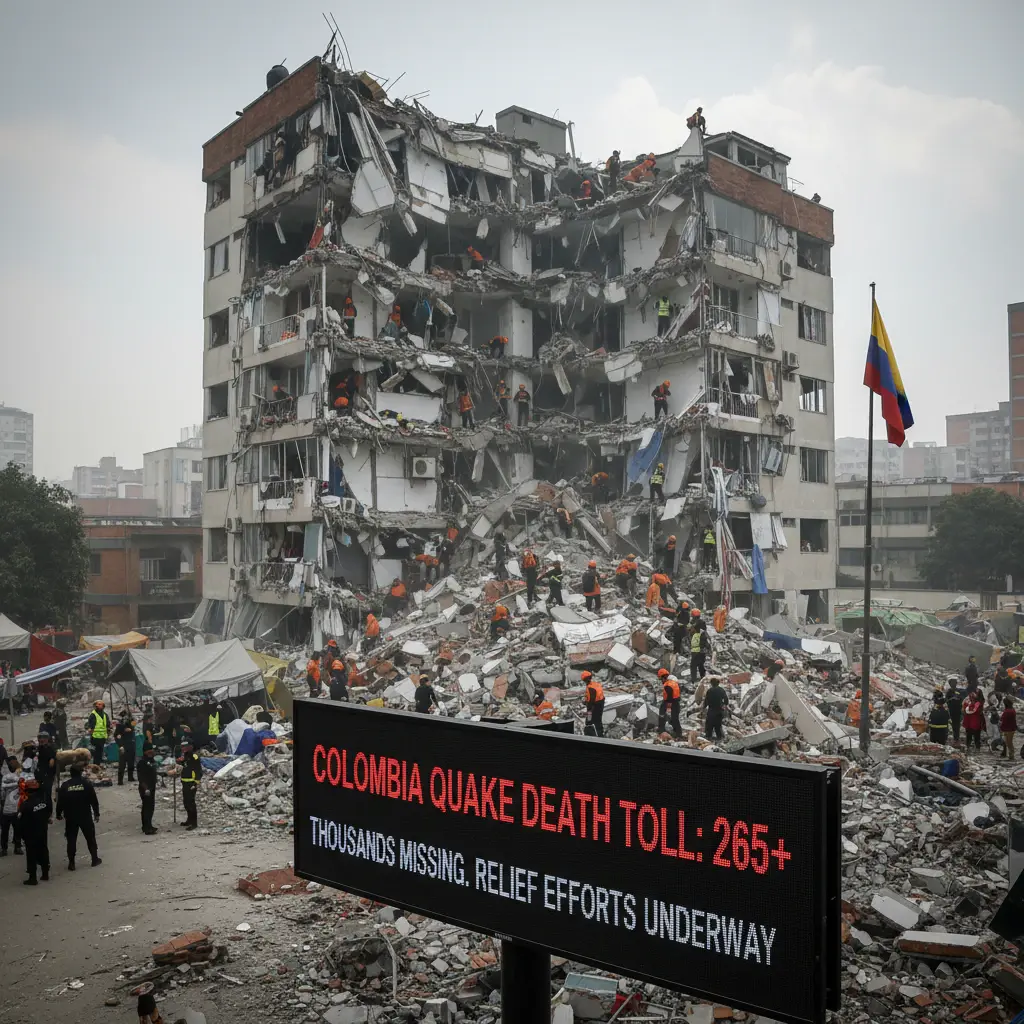
Colombia faces its deadliest quake in decades after a powerful 7.4 magnitude tremor hit the country’s western region on August 10, levelling whole neighbourhoods and leaving communities searching for answers. As search-and-rescue teams push into their third day of operations, the numbers keep climbing: at least 265 people are confirmed dead, more than 3,700 have been injured, and upwards of 4,000 people remain unaccounted for. Officials warn that both figures are likely to rise as crews dig deeper into the rubble.
The earthquake struck near the town of San José del Palmar in Chocó, one of Colombia’s poorest and most isolated regions, with a depth of roughly 100 kilometers. According to Colombia’s Geological Service, it’s the strongest quake to hit the country this century. The shaking wasn’t confined to Chocó, though — it rippled outward hard enough to be felt across the border in Ecuador and Panama, and rattled buildings as far away as the capital, Bogotá, where sirens reportedly sounded as aftershocks continued through the night.
Some of Colombia’s biggest cities took the brunt of the damage. Cali, Pereira, Quibdó, Manizales and Armenia have all reported major destruction, with hospitals, schools and homes among the structures that gave way. In Cali, patients had to be evacuated after sections of a university hospital partially collapsed, with several people reportedly still trapped in the wreckage. Local authorities in the Coffee Axis region — the heart of Colombia’s coffee industry — say dozens of people died there as well, even though the area sits well outside the earthquake’s immediate epicenter.
The scale of the destruction is staggering by any measure. More than 1,500 homes have been damaged, some completely destroyed, according to local officials, and close to 90 buildings have collapsed outright. Seven airports were forced to suspend operations in the aftermath, and basic infrastructure — roads, water systems, power and telecommunications — has been knocked out across the hardest-hit areas, complicating everything from evacuations to the delivery of aid.
Adding to the chaos, this disaster arrived at an unusually tense political moment. Abelardo de la Espriella had been sworn in as Colombia’s president just three days before the quake hit, meaning his administration is now managing a full-blown national emergency before it’s even had time to settle into office. De la Espriella declared a state of national disaster within hours of the tremor and has been personally overseeing the response, traveling to Quibdó — the Chocó departmental capital — to assess the damage firsthand. He’s said preliminary injury and fatality figures are climbing by the day as rescue teams reach areas that were previously cut off.
Rescue efforts are being hampered by the terrain itself. Chocó is thick jungle, sparsely populated and difficult to access even in normal conditions, and the quake’s aftermath has only made things worse — landslides, damaged roads and unstable buildings are slowing crews trying to reach survivors near the epicenter. Colombia’s Geological Service has also recorded dozens of aftershocks since Monday, some measuring in the high 4-magnitude range, and has cautioned that this kind of seismic activity can persist for days, weeks or even months before the region fully stabilizes.
There’s also a grim complication specific to this part of the country: Chocó has seen a rise in landmine injuries in recent years, a legacy of paramilitary activity in the region. Local officials say residents in some areas are wary of moving through unfamiliar terrain even during the crisis, for fear of triggering unexploded devices — a factor that could further slow rescue and rebuilding efforts in the weeks ahead.
International support has started pouring in. Aid groups and governments from the United States, Europe and neighboring South American countries have pledged assistance, and organizations like the International Rescue Committee have teams monitoring conditions near the epicenter, where they report damage to hospitals and clinics is compounding the crisis. World Central Kitchen has also mobilized its emergency food network to get meals to displaced families.
For now, the priority remains simple but urgent: finding survivors. With thousands still missing and the death toll almost certain to grow, rescue workers are racing against time, unstable ground and difficult terrain to reach anyone who might still be alive under the debris. Colombia’s newly formed government, barely a week into its term, now faces the enormous task of not just leading the emergency response, but eventually rebuilding entire cities that were leveled in a matter of seconds.
As the search continues, the human toll of this disaster is still coming into focus — and for many families in Chocó, Cali, Pereira and beyond, the wait for news of missing loved ones is far from over.
Colombia quake death toll tops 265, thousands missing.