
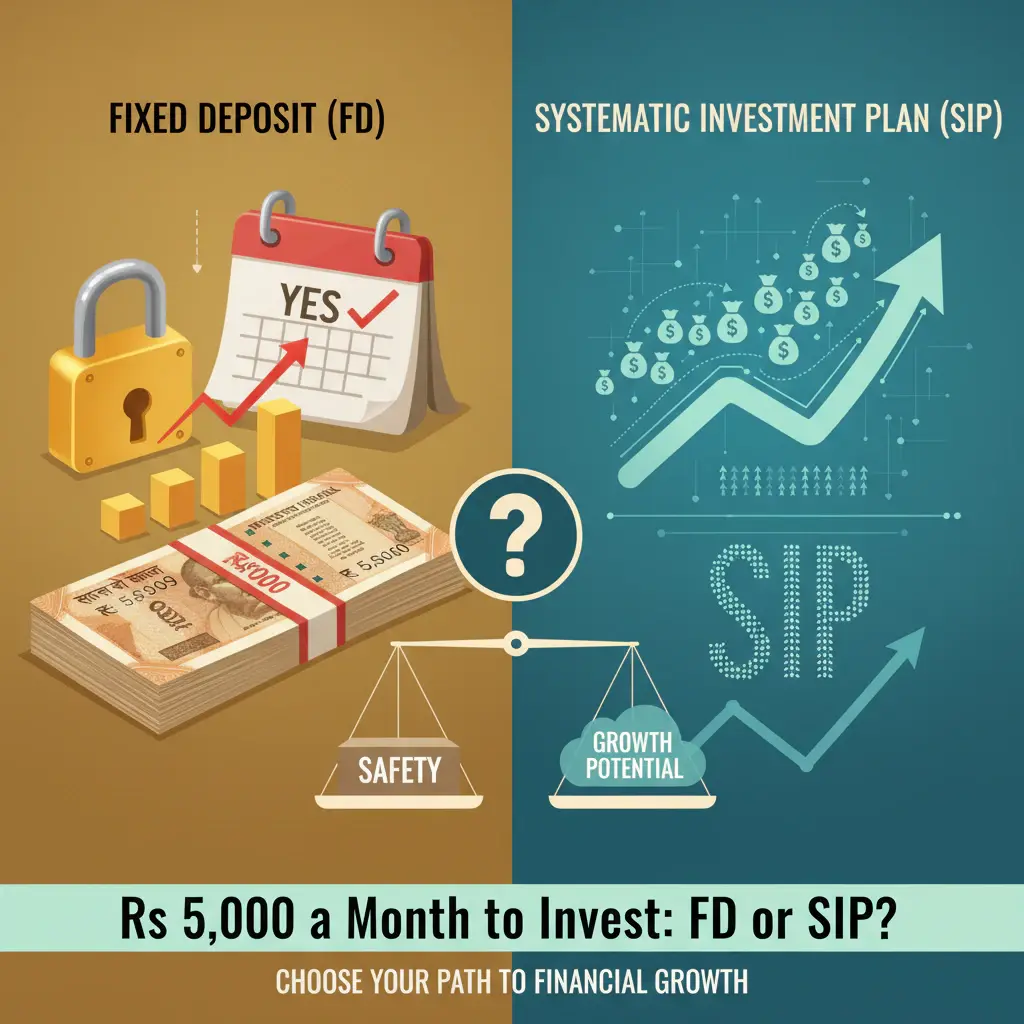
It’s one of the most common questions first-time investors in India ask, and for good reason. You’ve got Rs 5,000 you can set aside every month, and you want it to actually grow into something meaningful, not just sit around losing value to inflation. So, what is the better option? Fixed Deposit (FD) or Systematic Investment Plan (SIP) in mutual funds?
The honest answer is that it depends on what you’re saving for and how long you’re willing to stay invested. But once you look at the numbers side by side, one option tends to pull ahead for most people with a reasonably long time horizon.
The Basic Difference
A Fixed Deposit is about as simple and safe as investing gets. You hand your money to a bank, it locks in a fixed interest rate for a chosen tenure, and at the end of that period you get your principal back along with the promised interest. Rates on FDs currently range roughly between 6.5% and 9% a year depending on the bank and tenure, and deposits up to Rs 5 lakh per bank are insured by DICGC, a subsidiary of the RBI. There’s essentially no market risk involved. The trade-off is that your returns are capped and, once inflation and taxes are factored in, the real growth on your money can end up fairly modest.
A SIP, on the other hand, isn’t an investment product itself but a method of investing a fixed sum regularly, typically monthly, into a mutual fund. Most people using SIPs for long-term wealth building put their money into equity mutual funds, which invest in a diversified basket of stocks. Returns aren’t guaranteed and can swing quite a bit year to year, but over the long run, equity-oriented SIPs have historically delivered annualized returns somewhere in the 10% to 15% range, comfortably ahead of what FDs typically offer.
Running the Numbers on Rs 5,000 a Month
Numbers make this comparison much easier to picture. If you invested Rs 5,000 every month for ten years, you’d put in a total of Rs 6 lakh either way. In an FD earning around 6% to 7% annually, that corpus would grow to somewhere in the region of Rs 8 to 8.5 lakh by the end of the decade. In a SIP earning a historical average of around 12% CAGR, the same monthly investment could realistically grow to somewhere between Rs 11.5 and 12 lakh over the same period, purely because compounding works harder when the underlying growth rate is higher.
Stretch that timeline to fifteen or twenty years, and the gap widens even further. This is the core reason financial planners so often nudge younger investors toward SIPs for long-term goals: compounding rewards patience, and the difference between a 7% and a 12% return, compounded monthly over two decades, isn’t a small one.
Where FDs Still Make Sense
None of this means FDs are pointless. If your goal is less than three years away, say you’re saving for a wedding, a down payment, or an emergency fund, an FD is usually the better fit. Markets can dip 20% to 30% in any given year, and you don’t want money you’ll need soon sitting in something that could be down right when you need to withdraw it. FDs also suit people who simply can’t stomach volatility and would rather sleep easy with guaranteed, if smaller, returns.
There’s also a tax angle worth knowing. FD interest is added to your income and taxed at your regular income slab rate every year, which can eat into returns for people in higher tax brackets. SIP gains in equity mutual funds, by contrast, are taxed as long-term capital gains at 12.5% once you’ve held them for more than a year, and only on gains above Rs 1.25 lakh in a financial year, which tends to be more tax-efficient for long-term investors.
So, Which Should You Pick?
A reasonable rule of thumb that financial advisors often use: if your goal is less than three years out, lean toward an FD. If it’s five years or more away, a SIP tends to come out ahead more often than not. For anything in between, a mix of both isn’t a bad idea; you get some guaranteed stability from the FD portion while letting the rest of your money chase higher long-term growth through the SIP.
For someone investing Rs 5,000 a month with a genuinely long runway, retirement, a child’s education, or simply building wealth over ten-plus years, a SIP in a well-diversified equity mutual fund is generally the stronger option. Just be prepared for the ride to feel bumpier along the way, since unlike an FD, your monthly statement won’t always be moving in a straight line upward.

