Skywatchers across Spain got something today that hasn’t happened on mainland Europe in 27 years: a total solar eclipse. And as if the sky wanted to make sure nobody put their telescopes away too soon, that same darkened new moon is setting up what astronomers are calling one of the best Perseid meteor shower peaks in a generation, arriving in the very same 24-hour window.
Totality Returns to Europe
The solar eclipse on August 12, 2026, traced a path starting over a remote stretch of Siberian Russia before sweeping across the Arctic, eastern Greenland, the west coast of Iceland, and finally northern Spain and a small corner of Portugal. For Spain, this was historic: it marked the first total solar eclipse visible from mainland Spain since 1905, and the first total eclipse anywhere in mainland Europe since 1999.
Totality lasted up to two minutes and eighteen seconds at its longest point along the path, though viewers in western Spain experienced closer to 110 seconds as the Moon’s shadow raced across the peninsula in the evening hours, arriving in Spain shortly before sunset local time. The path of totality across Spain was unusually wide, roughly 290 kilometers across, giving around 15 million people a front-row seat without needing to travel far. Cities like Madrid and Barcelona sat just outside the band of totality, but millions elsewhere in the country and across Western Europe caught at least a partial eclipse, with nearly one billion people worldwide able to see the Sun partly covered in some form.
The European Space Agency marked the occasion with public events in León, live broadcasts from an observatory in Teruel, and messaging that leaned heavily into the rarity of the moment — a chance for people across the continent to look up together. Spain isn’t done yet, either: this is the first of three eclipses visible from the country between now and 2028, with another total eclipse due in 2027 and an annular eclipse in 2028.
Why the Timing With the Perseids Isn’t a Coincidence
Here’s the part that’s got astronomers especially excited this week: the same new moon that made today’s eclipse possible is also about to hand skywatchers unusually dark skies for the Perseid meteor shower, which peaks overnight on August 12 into the early hours of August 13.
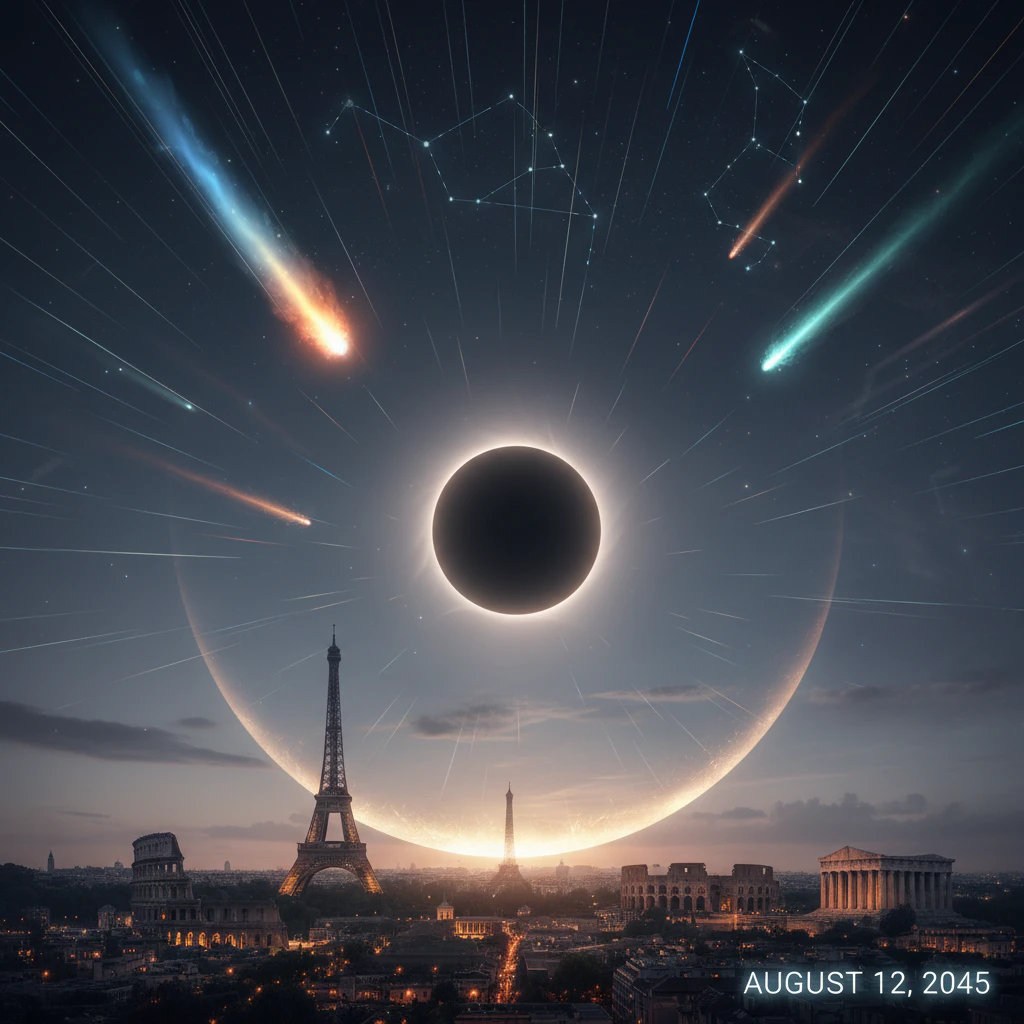
That’s not some cosmic accident — a solar eclipse can only happen during a new moon, since the Moon has to sit directly between the Earth and the Sun. And a new moon is exactly the condition meteor watchers dream about, because it means zero moonlight washing out the sky during the shower’s peak. This particular alignment, a new moon landing precisely on the Perseids’ peak night, won’t happen again until 2045, making 2026 a genuinely rare year for skywatching in Europe and well beyond.
What to Expect From the Perseids
The Perseid meteor shower has been active since mid-July and runs through late August, but the real show builds toward its peak in the pre-dawn hours between roughly 2 a.m. and dawn on August 13. Under dark, rural skies with no moonlight interference, forecasters expect anywhere from 30 to 100 meteors per hour, depending on location and local conditions — a wide range, but even the conservative end of that estimate is a strong night by most years’ standards.
The Perseids get their name from the constellation Perseus, which is where the meteors appear to radiate from when traced backward across the sky. To find the radiant, skywatchers are advised to look toward the northeast after 10 p.m. local time, using the distinctive “W” shape of Cassiopeia as a guide, with Perseus sitting just below it. The shower’s source is debris left behind by Comet 109P/Swift-Tuttle, tiny fragments burning up roughly 60 miles above Earth’s surface as they streak into the atmosphere at high speed. Occasionally, larger fragments produce dramatic, longer-lasting fireballs bright enough to cast faint shadows.
No telescope or binoculars are needed to watch the Perseids — in fact, the naked eye tends to work best, since it takes in the widest possible swath of sky. The main requirements are patience, a dark location away from city lights, and a clear view of the horizon.
A Rare Double Bill for Stargazers
Taken together, this stretch of celestial events, among the most talked-about astronomy news of the year, has turned mid-August 2026 into something of a marathon for skywatchers across Europe and beyond. Few years offer a total solar eclipse and a moonless Perseid peak within the same day, and astronomers have been quick to note that the pairing is unlikely to repeat for decades.
For those who missed totality in Spain, the eclipse offered at least a partial view across much of Western Europe and North Africa. And for anyone who didn’t make it outside during eclipse hours, the Perseids offer a second chance to be part of this year’s celestial spectacle — no travel to the path of totality required, just a clear night sky and a bit of patience after midnight.