
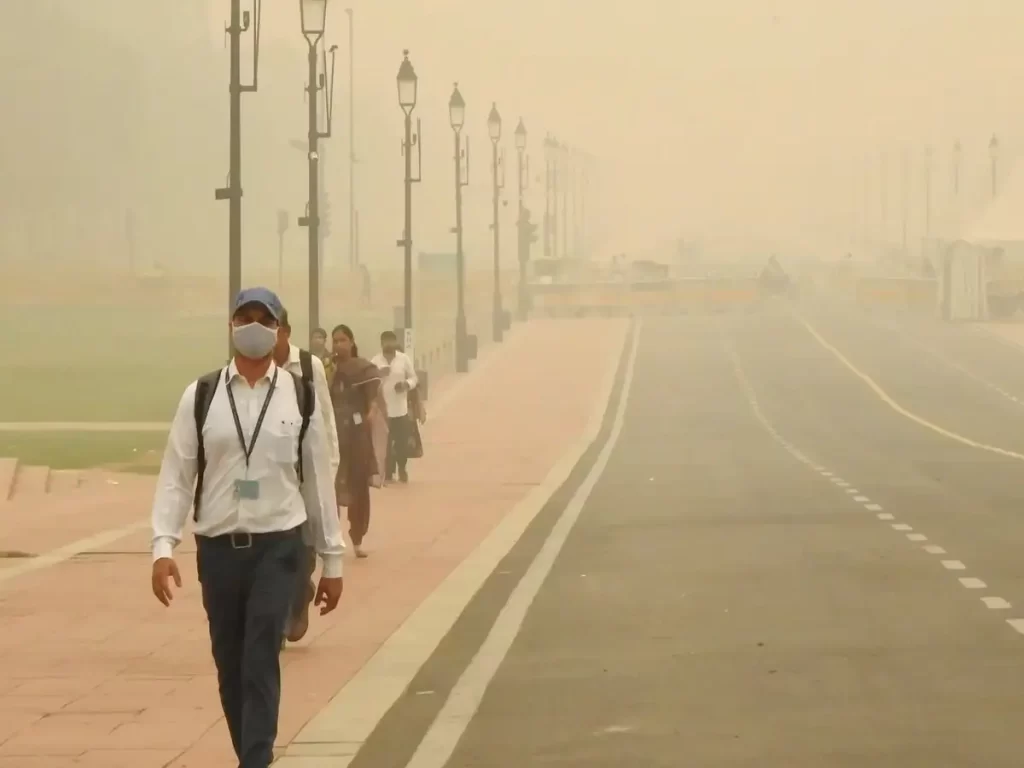
Amid one of the season’s worst air quality episodes, the Delhi government has enforced a mandatory 50% work-from-home (WFH) rule for both public and private offices. The decision, issued under Stage III of the Graded Response Action Plan (GRAP), follows a dramatic spike in the city’s Air Quality Index (AQI), which hovered between 396 and 400 on November 24, with several neighbourhoods crossing the hazardous 400 mark.
Escalation of Air Pollution and Government Response
Delhi’s air pollution crisis intensified sharply this week, triggering emergency-level restrictions under GRAP Stage III. With smog blanketing the city and visibility reduced across major corridors, authorities ordered all offices to operate at a maximum of 50% staff strength on-site. The remaining workforce has been instructed to work remotely until further notice.
The stringent measure aims to reduce vehicular emissions—one of the city’s major pollution contributors—by significantly cutting daily commuter volumes.
Implementation and Exemptions
The mandate applies uniformly to all government departments, autonomous bodies, and private organisations within Delhi. Senior administrative officials, including departmental heads and essential decision-making personnel, must continue physical attendance to ensure smooth governance.
Essential services such as healthcare, public transport, sanitation, police, and emergency response teams remain fully operational and are exempt from the 50% cap. Private organisations have been encouraged to implement staggered shifts, smaller workgroups, and digital collaboration tools to maintain productivity.
Why Pollution Levels Spiked
Meteorologists and environmental experts attribute the sharp deterioration in air quality to a combination of stagnant wind speeds, winter inversion, and an accumulation of fine particulate matter. Vehicular emissions, construction dust, industrial activities, and seasonal stubble burning across neighbouring states have collectively contributed to the dangerous pollution load.
The shallow boundary layer during winter prevents pollutants from dispersing, trapping toxic air close to the ground and exacerbating health risks for millions of residents.
Health Concerns and Public Advisory
Medical professionals have expressed deep concern over the severe AQI levels, warning that prolonged exposure can lead to respiratory distress, aggravated asthma, bronchitis, reduced lung function, and cardiovascular complications.
Citizens have been advised to stay indoors, use N95 masks outdoors, limit physical exertion, run air purifiers where possible, and adhere strictly to WFH protocols.
Impact on Work Culture and Urban Mobility
The forced shift to remote work marks another pivotal moment in Delhi’s evolving work culture. While many organisations have already adopted hybrid models post-pandemic, the new directive reinforces the role of remote operations during environmental emergencies.
With fewer vehicles on the roads, the mandate is expected to contribute to a temporary drop in transport-related emission loads, although experts caution that sustained improvement will require long-term structural reforms.
Key Highlights:
- AQI crossed 400 in several parts of Delhi, entering the “severe” category.
- GRAP Stage III restrictions include a mandatory 50% WFH order for offices.
- Essential services continue operating at full capacity.
- Pollution surge attributed to weather inversion, stubble burning, construction dust, and vehicular emissions.
- Residents urged to avoid outdoor activities and use protective masks.

