
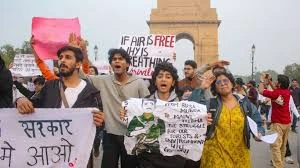
The Delhi Police have invoked Section 197 of the Bharatiya Nyaya Sanhita (BNS)—a provision dealing with “imputations and assertions prejudicial to national integration”—in the FIR against a group of protesters detained during an air-pollution demonstration at India Gate. The move significantly escalates the legal consequences for those involved and places the protest under the lens of national security and public order.
According to police officials, the charges were added after some demonstrators allegedly raised slogans hailing slain Maoist leader Madvi Hidma, a figure long associated with violent insurgency. The protest, initially organized to highlight Delhi’s severe air-quality crisis, took an unexpected turn when a faction reportedly shouted slogans glorifying the Maoist commander. Police claim these chants went beyond legitimate dissent and entered the realm of promoting divisive and extremist ideology.
Section 197 of the BNS criminalizes statements—verbal, written, or symbolic—that undermine India’s sovereignty, unity, or integrity. The offense is cognizable and non-bailable, with punishments extending up to three years of imprisonment, a fine, or both. The provision is designed to curb speech or actions perceived as threatening national cohesion.
The police report further alleges multiple acts of misconduct. Officials stated that the protesters used pepper spray on police personnel, blocked traffic, breached barricades, and created obstruction at Kartavya Path. A total of 22 individuals were detained following the incident. The FIR already includes charges related to public disorder, assault of government officials, and obstruction of duty, with Section 197 now adding a national-integration dimension to the case.
The inclusion of this charge has sparked wider discussion about the intersection of civic protest and ideological extremism. While many participants insist the event was solely aimed at demanding urgent action on Delhi’s pollution crisis, authorities argue that the presence of slogans glorifying a Maoist figure indicates an attempt to “ideologically hijack” a civic demonstration. Police officials maintain that such acts, even if carried out by a subset of participants, cannot be taken lightly due to their potential implications for public order and internal security.
Legal experts suggest that applying Section 197 indicates the seriousness with which authorities view the incident. They note that under the BNS framework, the state is empowered to act swiftly against any expression perceived as divisive or capable of triggering unrest. However, civil-rights advocates caution that such provisions must be used judiciously to avoid blurring the lines between dissent and sedition-like offences.
The broader implications of the case may be significant. The action could influence how future protests—especially those involving students and activist groups—are policed and interpreted. Some analysts warn of a potential chilling effect on civic demonstrations if national-integration laws are invoked too readily. Others argue that the rise of provocative slogans in public gatherings necessitates stronger enforcement to prevent radicalization or glorification of extremist violence.
As investigations proceed, the case is expected to test the boundaries of India’s new criminal-law regime and raise crucial questions about free expression, public safety, and the limits of protest in a democratic society.

