
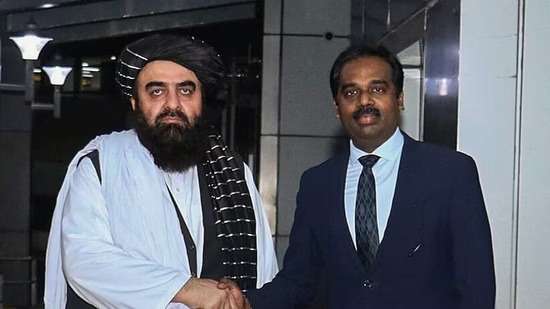
New Delhi — As Afghanistan’s Taliban Foreign Minister Amir Khan Muttaqi begins his first official visit to India since 2021, New Delhi finds itself navigating a sensitive diplomatic dilemma. The central issue revolves around whether to display the Taliban flag alongside the Indian tricolour during official meetings. Since India has not formally recognised the Taliban regime, the flag has become a powerful symbol of recognition—or the lack thereof.
Flag Diplomacy in Focus
According to standard diplomatic protocol, when a visiting foreign minister or head of state arrives in another country, their national flag is typically displayed alongside that of the host nation. However, India’s refusal to officially recognise the Taliban government complicates this custom.
The Afghan Embassy in New Delhi still flies the flag of the former Islamic Republic of Afghanistan, led by the ousted President Ashraf Ghani, rather than the Taliban’s white banner inscribed with the shahada. In earlier informal interactions between Indian diplomats and Taliban representatives abroad, such as in Dubai, India reportedly avoided using any national flags at all.
Now, with a senior Taliban official visiting India, Delhi is weighing whether to display the Taliban flag in a restricted or neutral manner—or avoid displaying it entirely. The government’s decision could carry significant diplomatic implications, signalling either a cautious opening or continued distance from Kabul’s rulers.
Muttaqi’s Visit: Significance and Constraints
Amir Khan Muttaqi’s visit marks a turning point in India–Afghanistan relations. It is the first time a senior Taliban leader has visited India since the group returned to power in August 2021. The trip was made possible after the United Nations Security Council granted a temporary travel exemption, allowing Muttaqi to engage in diplomatic outreach.
During his stay, Muttaqi is expected to meet External Affairs Minister S. Jaishankar, National Security Advisor Ajit Doval, and key Indian business leaders. The agenda reportedly includes discussions on trade cooperation, humanitarian aid, consular services, and regional security matters.
India, while maintaining humanitarian ties and limited engagement through its technical mission in Kabul, continues to refrain from extending formal diplomatic recognition to the Taliban regime. The visit, therefore, represents an attempt to balance national interest with international caution.
Analysis: Balancing Symbolism and Strategy
The flag controversy is more than ceremonial—it reflects India’s careful diplomatic balancing act. Allowing the Taliban flag at official meetings could be interpreted as implicit recognition of the regime, a move that might unsettle strategic partners and raise domestic concerns. On the other hand, refusing to display it could be perceived as an affront by Kabul, potentially straining future cooperation on trade and security.
Experts believe India may opt for a middle-ground approach—permitting the Taliban flag in limited or background settings without endorsing formal recognition. This would maintain protocol while signalling continued caution. Others suggest India could replicate its earlier “no-flag” stance to avoid political optics altogether, though that may appear diplomatically awkward during an official state-level meeting in the capital.
Conclusion
As Amir Khan Muttaqi’s visit progresses, India’s handling of the flag protocol will be closely watched by regional and global observers. The decision, while procedural on the surface, carries deeper geopolitical meaning. It will not only reflect India’s approach toward Afghanistan’s current rulers but also indicate how New Delhi intends to manage its strategic interests in a region undergoing rapid change.
In the world of diplomacy, even a flag can speak volumes—and India’s next move could redefine the subtle art of statecraft in South Asia.

