
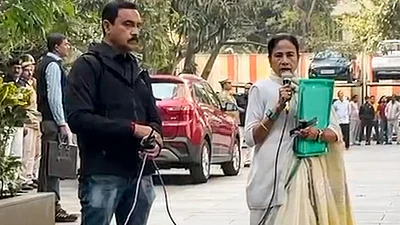
A major political confrontation erupted in West Bengal on January 8, 2026, after the Enforcement Directorate (ED) conducted raids at the Kolkata offices of the Indian Political Action Committee (I-PAC) and the residence of its director, Pratik Jain. The high-profile operation immediately ignited sharp political reactions, intensifying the ongoing debate over the alleged misuse of central agencies in opposition-ruled states.
A Raid That Sparked Statewide Reactions
According to officials, the ED action was carried out as part of an ongoing financial investigation, with teams arriving early in the day at multiple locations linked to I-PAC, a political consultancy known for shaping election strategies across India. The raid at Pratik Jain’s residence further heightened attention, given his prominent role in political campaign management.
While the ED maintained that the operation followed due process under existing laws, the development quickly escalated into a political flashpoint. Senior leaders of the ruling Trinamool Congress (TMC) accused the central government of weaponizing investigative agencies to intimidate political strategists and suppress dissent ahead of crucial electoral milestones.
Opposition vs Centre: War of Words Intensifies
The confrontation led to heated exchanges between state and central political actors. TMC leaders staged protests in Kolkata, alleging “political vendetta” and “selective targeting.” In response, leaders from the Bharatiya Janata Party (BJP) dismissed the accusations, asserting that the law must take its course and that no individual or organization is above scrutiny.
Political analysts noted that the ED raids on I-PAC have broader implications beyond West Bengal, as the organization has worked with multiple political parties across states. The incident has therefore reignited a national conversation on the autonomy of investigative agencies and their role in India’s federal political structure.
Key Developments at a Glance
| Aspect | Details |
|---|---|
| Agency Involved | Enforcement Directorate (ED) |
| Locations Raided | I-PAC Kolkata offices, Pratik Jain’s residence |
| Date | January 8, 2026 |
| Core Allegation | Financial irregularities (as per officials) |
| Political Response | Allegations of political targeting |
Why the I-PAC Raid Matters
The controversy has drawn attention for several reasons:
- Political Consulting Under Scrutiny: I-PAC’s influence in shaping electoral narratives makes the raid politically sensitive.
- Federal Tensions: The episode adds to growing friction between opposition-led states and the central government.
- Public Perception: Allegations of agency misuse risk undermining public trust in investigative institutions.
Experts suggest that such developments could have a chilling effect on political consulting firms and campaign strategists, potentially altering how parties approach elections in the future.
Broader Implications and the Road Ahead
As the investigation continues, the ED raids in Kolkata are likely to remain a central issue in West Bengal’s political discourse. The episode underscores the fragile balance between law enforcement and political neutrality, especially in a charged electoral environment. Whether the probe results in concrete legal outcomes or remains a symbol of political confrontation will significantly shape public and political reactions in the months ahead.
For now, the I-PAC raid has firmly placed the spotlight on the intersection of politics, governance, and investigative authority—an issue that continues to resonate far beyond the borders of West Bengal.

