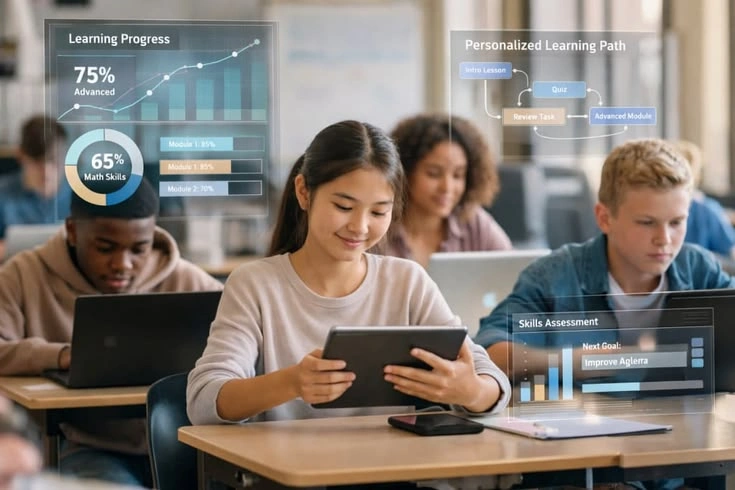
India’s edtech business has gone through a pendulum swing over the last five years: from the excitement of epidemic times to a hard financial winter, and now to a quieter, more realistic groove. With investors pulling back on chequebooks and values correcting, several once-hyped education tech companies have been forced to reexamine their underlying assumption that “online-only” would always be the future. 2025 and 2026. The big story in the industry is no longer about moving entirely digital but combining the positives of offline classrooms with the flexibility of online technologies. Hybrid learning or “phygital” as it is known in India is now the default playbook for survival, development and profitability.
Online rush to adjustment in funding
India’s edtech firms rode a wave of extraordinary demand during the height of the outbreak. With physical classrooms locked out, parents and schools turned online platforms such as BYJU’S, Vedantu, Unacademy and others for live classes, test-prep and school-support information. Funding came in at unprecedented levels as valuations rocketed into the billions seemingly overnight. The sector became a symbol of India’s tech-driven, aspirational middle class.
But by 2022-2023, the mood shifted. Schools and coaching centres have opened and kids have started coming back to classrooms. Demand for pure-online tuition fell, revenues stalled and market mood deteriorated substantially. The “growth-at-all-costs” global rationale that justified costly marketing, aggressive discounts, and rapid expansion no longer made sense.
Funding into India’s K–12 edtech has dropped by close to 90 percent YoY between 2021 and 2023, and the broader sector has entered what analysts now call a “correction phase”. Several high-profile players announced layoffs, restructuring and debt talks. For a period it was less an evolution of education than a hangover from a speculative boom.
Why hybrid made commercial sense:
But when the funding pipe tightened, edtech CEOs had to face tougher questions: Who is truly paying for these services? How sticky are your users? And can the business be profitable without burning through millions on ads? The most plausible answer began to appear in the shape of hybrid models – where a platform mixes offline facilities, in-person classrooms or school partnerships with online education.
The economics are straightforward:
Hybrid arrangements typically have greater rates than pure-online subscriptions, as parents consider in-person touch to be ‘premium’ or ‘more reliable’.
Brick-and-mortar centers and school embedded smart classrooms have ongoing revenue streams from institutional contracts, not simply from individual parents.
Better personalization and more defensible pricing, by marrying online data (attendance, performance, engagement) with real instruction.
Take BYJU’S for example. The poster child of pure online learning, the firm has gradually scaled up its BYJU’S Tuition Centers and other offline learning hubs, thereby changing its brand into a hybrid network instead of a solitary app. In a similar vein, Vedantu has entered the smart-classroom integrations and school-collaboration models. Players like PhysicsWallah, Imarticus and Cuemath have extended or established out offline footprints.
That means a move from “unicorn hunting” to “unit economics hunting” for investors. VCs remain leery of top line growth without genuine profit margins and numerous conversations with founders in 2025 and 2026 reveal hybrid leaning models are now the ones that attract serious attention.
Hybrid in Indian classrooms: Beyond a fad
Corporate balance sheets have not been the exclusive driver for the migration to hybrid in India. It also represents the way schools and parents are actually using technology. As per a survey-based projection in 2025, over 82 percent of Indian educational institutions had embraced some type of hybrid learning approach, including classroom teaching, digital platforms, applications, and online exams.
In practice this looks vary across geographies:
Many private and semi-private schools in tier-1 cities are conducting “flipped” classes where students view recorded lectures or solve quizzes online at home and use classroom time on doubt clearing, projects and group discussions.
Schools in tier-2 and tier-3 towns are more likely to use smart-class solutions and recorded content from huge platforms, but they still depend on in-person teachers for most of the instruction.
However, the K-12 category continues to be the largest and fastest expanding vertical for edtech in the country with digital-support goods constituting over 40 percent of the market share. This is not surprising, as parents in India worry about performance in board exams and entrance exams for engineering and medicine, and are prepared to pay for structured, measurable learning support whether that’s through a physical tutoring centre or a tablet-based app.
What does it mean for a student in Nagpur, Bengaluru or Patna? For the most part, it is a combination of WhatsApp groups for home-work reminders, video lectures recorded for revision and live doubt clearing sessions. The ‘hybrid classroom’ is not so much a single format as it is overlaying digital tools on top of an established educational ecosystem.
Global pattern: India part of wider wave India’s tilt to hybrid not unique. The global edtech market is expected to increase from over USD 280 billion in 2025 to over USD 760 billion by 2034, at a compound annual growth rate of around 11-12 percent, according to the latest estimates. Here, blended and hybrid learning models are frequently cited as a key development driver, particularly in the higher education and professional learning segments.
Universities and corporate training providers in the US and Europe have been blending lecture rooms with online LMS systems, AI-driven analytics, and self-paced modules for years. The same rationale is now filtering down into the school and testprep ecosystems in India, albeit at a different speed and with a greater emphasis on affordability and regional languages.
One of the most important concerns for the next several years is whether India becomes a “hybrid laboratory” for the rest of the developing world. With its scale, diversity of languages and inconsistent but improving internet connection, India’s edtech experience might give vital insights about how to develop hybrid models that work for students in semi-urban and rural areas, not just city elites.
What a hybrid really looks like on the ground.
In theory, “hybrid learning” is a great marketing phrase. In practice this might come in a number of various configurations, depending on the supplier and the student section.
Some of the common patterns in India nowadays are:
Offline‑first, online‑support: Coaching institute style businesses still have actual classrooms but include practice test portals, recorded lectures and AI driven feedback dashboards.
Online-first, offline-add-on: Mass-market apps bring out tiny tuition centers or work with local coaching-shop owners to run “live + in-person” sessions.
School-embedded hybrid: Platforms are integrated with school infrastructure, providing smart-class content, worksheet banks and evaluation tools that teachers can employ with their usual syllabus.
Take for example Vedantu’s WAVE platform that integrates live online tutoring with interactive classroom capabilities. Some institutions run hybrid batches where a part of the cohort is physically present while others join remotely. BYJU’S Future School, which also offers live online sessions mixed with hands-on projects, is targeting a “phygital” experience for its computing, maths and creative-thinking courses.
But this flexibility is not just a convenience. It is a hedge against policy and market risks. In an environment where the rules around private coaching, data privacy and edtech-school relationships are still being written, several revenue and delivery channels enable organizations to be more nimble.
Cost, access and equity the big challenges that lie ahead
With hybrid models gaining traction, edtech operators still confront three main questions: Can they keep pricing accessible for middle and lower middle-income households? Can they dependably reach pupils in rural and semi-rural areas? And can they verify that learning outcomes are really superior than old-school rote tuition?
Research in 2025 shows blended-learning programs in India have enhanced student engagement and helped to close some of the learning gaps that emerged during the pandemic. At the same time, longstanding worries about digital disparities persist—students without steady internet, low‑end cellphones, or a quiet location to study cannot fully benefit from online‑heavy models.
Hybrid appeals to many families only if it seems like “additional support for not much more money.” This forces companies to be creative on pricing – modular plans, regional language packages and cheaper bundles that include a handful of offline lessons with unlimited online content.
Edtech’s Pivot to Hybrid Learning Models After Funding Corrections