
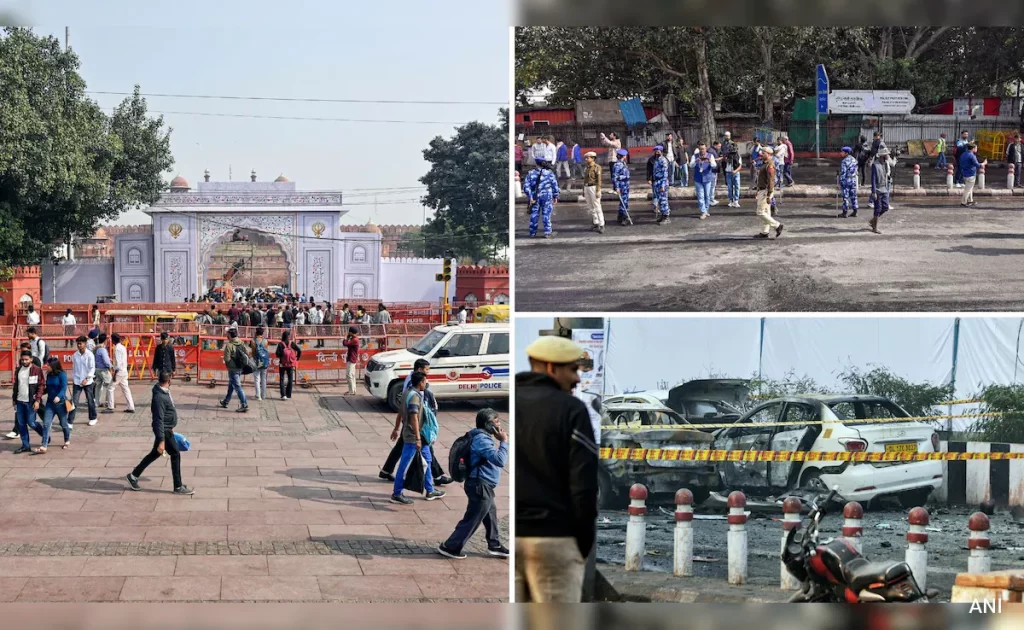
In a chilling development from the investigation into the November 10 Red Fort car blast in Delhi, security agencies have uncovered that a suspected foreign terror handler sent as many as 42 bomb-making tutorial videos to a co‑accused doctor via encrypted apps. The probe has further revealed that the terror network planned to exploit hospitals in Kashmir as clandestine weapons depots, drawing on tactics used by Hamas — a strategy that underscores the sophistication and ideological reach of the module.
Investigators from the National Investigation Agency (NIA) have identified three foreign handlers — using the aliases “Hanzullah”, “Nisar”, and “Ukasa” — believed to have played a central role in guiding the terror module. Among them, “Hanzullah,” reportedly based in Pakistan, is alleged to have sent over 40 bomb-making instructional videos to Dr. Muzammil Ahmad Ganai.
Ganai, employed at Al‑Falah Medical College in Faridabad, is suspected to have helped store explosive material used by the network. Authorities arrested Ganai days before the blast, and at his residence, they recovered more than 2,500 kg of explosive material, including approximately 350 kg of ammonium nitrate. The encrypted communications reportedly took place via apps such as Signal, Telegram, and Session, a modus operandi that mirrors earlier DIY bomb-making plots in India.
The handlers under scrutiny are not unfamiliar to Indian agencies. One prominent figure, named Mohammed Shahid Faisal, also known by pseudonyms like “Colonel,” “Laptop Bhai,” and “Bhai,” has previously featured in terrorist investigations in Karnataka and Tamil Nadu. Faisal is believed to have orchestrated remote radicalisation, using encrypted platforms to distribute bomb-making instructions in prior terror modules.
Hamas‑Style Hospital Weapon Storage Plot:
In a startling similarity to tactics used by Hamas in Gaza, investigators say the Jaish-e-Mohammad-linked module had evaluated hospitals in Kashmir — particularly in Anantnag, Srinagar, Baramulla, Budgam, and Nowgam — as potential hideouts for arms and toxic weapons. Sources suggest that the group may have received technical or operational guidance from Hamas, further deepening concerns about cross-border ideological and tactical cooperation.
These revelations emerged during the questioning of Dr. Adil Rather, one of the doctors arrested in the terror module. Another chilling aspect of the investigation is the dissemination of suicide-bombing or martyrdom videos by these handlers. More than three dozen videos glorifying “martyrdom operations” were reportedly sent to the accused medical professionals to prime them psychologically.
Network and Radicalisation:
Investigators trace the radicalisation chain back to Kashmir cleric Maulvi Irfan Ahmed, believed to be a key conduit between the Jaish leadership and the doctor‑terror module. The doctors under investigation were reportedly recruited in a structured manner; their professional credentials and access to medical infrastructure made the plot far more insidious.
Security agencies are reviewing whether this network has operational parallels with past terror modules in Karnataka, Tamil Nadu, Delhi, and Pune, given similarities in encrypted communications, DIY bomb-making instructions, and the use of pseudonymous handlers.
The emerging narrative from the Red Fort blast probe paints a disturbing picture: a white-collar terror network, guided by foreign handlers, that combined online radicalisation with real-world violence. The sharing of 42 bomb-making tutorials and the plan to covertly store weapons in civil hospitals demonstrates a new level of planning and ideological sophistication. As agencies deepen their investigation into cross-border terror links and Hamas-inspired strategies, the wider implications for national security and counterterrorism policy are profound. If proven, this module could represent a dangerous evolution in how terror networks recruit, radicalise, and operate — leveraging education, professional cover, and medical infrastructure to carry out their designs.

