
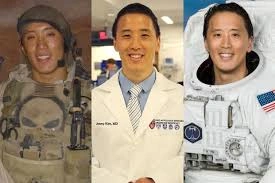
U.S. Navy Lieutenant Commander Jonny Kim, a former Navy SEAL and Harvard-trained physician who later became one of NASA’s most distinguished astronauts, has safely returned to Earth after an eight-month mission aboard the International Space Station (ISS). Kim landed in the Kazakh steppe near Jezkazgan on December 9, 2025, concluding a 245-day orbital expedition marked by advanced scientific work and high-precision engineering operations.
A Remarkable Journey from Special Operations to Spaceflight
Jonny Kim’s career represents one of the most extraordinary trajectories in modern American service history. After enlisting in the U.S. Navy in 2002, Kim completed over 100 combat missions as a Navy SEAL before pursuing higher education. He earned a mathematics degree from the University of San Diego and later completed his Doctor of Medicine at Harvard Medical School. His unique blend of military, medical, and aviation expertise led to his selection as a NASA astronaut in 2017, where he completed training in 2020.
With qualifications spanning naval aviation, flight surgery, and specialized combat operations, Kim stands among an elite group of multi-disciplinary astronauts in the history of the U.S. space program.
Mission Soyuz MS-27: Scientific Breakthroughs and Precision Operations
Kim launched to the ISS on April 8, 2025, aboard the Soyuz MS-27 spacecraft, alongside two Russian cosmonauts. After a rapid ascent and docking, he served as Flight Engineer for Expeditions 72 and 73.
During the mission, Kim contributed to a wide array of research areas crucial to future deep-space exploration. These included microgravity plant cultivation, robotics testing, materials science experiments, and extensive human physiology studies. His medical background was instrumental in conducting health monitoring assessments designed to understand how long-duration spaceflight affects the brain, eyes, cardiovascular system, and immune responses.
Throughout the mission, the crew completed approximately 3,920 Earth orbits, covering nearly 104 million miles—a distance that underscores the complexity and endurance required for prolonged orbital operations.
Key Research Focus Areas
- Human physiological changes during long-duration missions
- Medical monitoring and diagnostic procedures in microgravity
- Robotic systems evaluation for future lunar and Martian missions
- Plant growth experiments supporting sustainable life-support systems
- Technology demonstrations relevant to the Artemis exploration program
Impact on Future Space Exploration
Kim’s mission holds significant implications for the future of human space travel. By combining his medical expertise with real-time spaceflight experience, he contributes vital data on astronaut health—information that will shape mission planning for journeys beyond low-Earth orbit.
His work directly supports NASA’s upcoming Artemis missions, which aim to establish long-term human presence on the Moon and prepare for eventual crewed missions to Mars.
Looking Ahead
As Jonny Kim begins post-mission recovery and debriefings, NASA scientists and medical teams will analyze data collected from his time aboard the ISS. These findings will play a critical role in strengthening long-duration spaceflight protocols, advancing scientific understanding, and guiding the next era of exploration.
Kim’s return marks not only the successful completion of a mission but also the continuation of a legacy—one defined by service, resilience, and groundbreaking contributions to both national security and human spaceflight.

