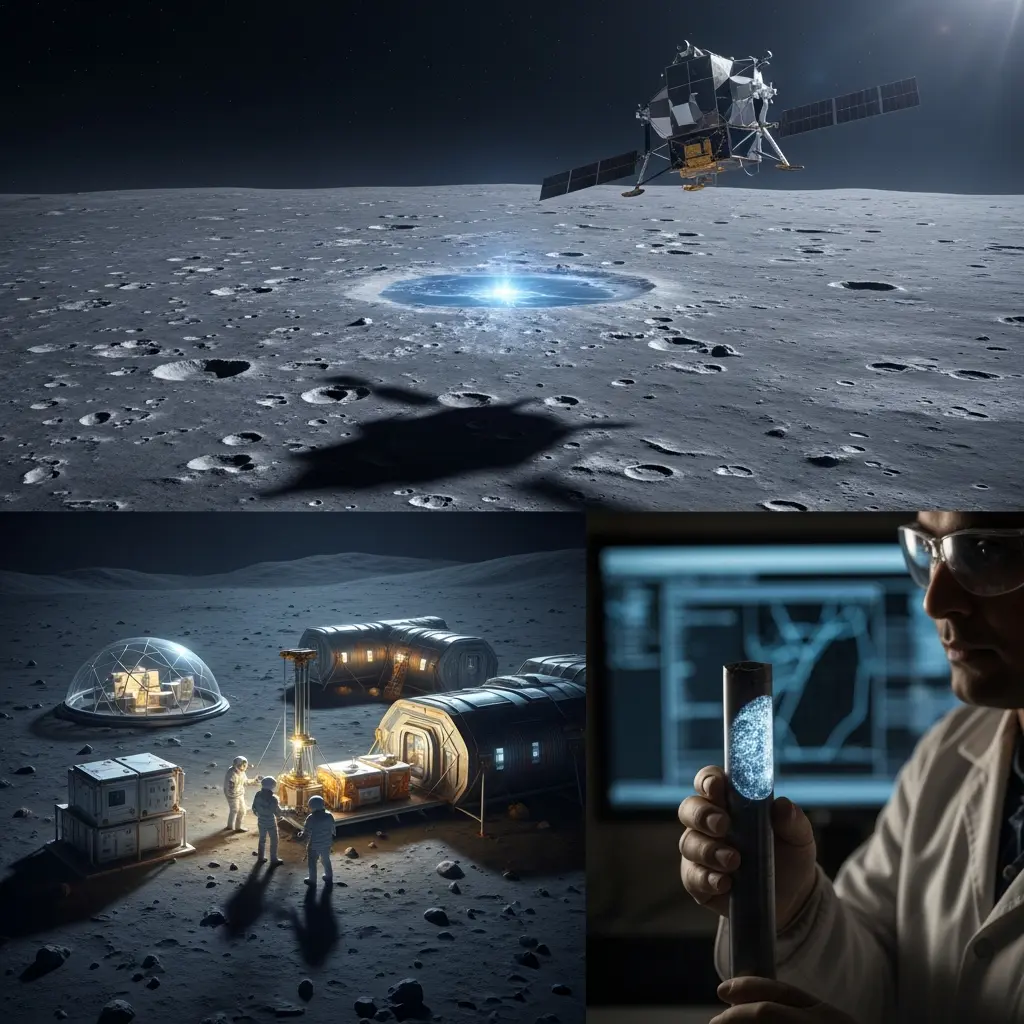
New findings from Indian scientists analyzing Chandrayaan-2 data point to subsurface water-ice near the lunar south pole — and the implications stretch far beyond India’s space programme.
2019 Year Chandrayaan-2 orbiter reached lunar orbit
90°S Lunar south pole — focus of new water-ice findings
~100km Orbital altitude of the Chandrayaan-2 orbiter
ome of the most consequential scientific discoveries do not arrive with a bang. They come through years of patient data analysis, quiet peer review, and the kind of methodical work that rarely makes for dramatic headlines — until, suddenly, it does. The latest findings from Indian scientists working with Chandrayaan-2 data belong to exactly that category. New evidence suggesting the presence of subsurface water-ice deposits near the Moon’s south pole has emerged not from a single dramatic moment, but from the slow, careful unpacking of information that India’s orbiter has been gathering since it slipped into lunar orbit in 2019. And what that data is now telling us is remarkable.
The findings, which strengthen earlier indications of water presence in the lunar polar regions, point specifically to ice buried beneath the surface — shielded from the Sun’s radiation by the perpetual shadow of deep craters and the Moon’s own geology. This is not water as we find it on Earth: flowing, accessible, blue. This is water locked in ancient ice, tucked away in one of the most inhospitable environments in the solar system. But for scientists and space strategists alike, it is potentially among the most valuable substances in the known universe — and the Moon water discovery being reported now adds an important new layer to our understanding of exactly how much of it may be there.
“Water on the Moon is not a curiosity. It is infrastructure — the raw material from which fuel, oxygen, and long-term human presence can all be built.”
Why subsurface ice changes everything
Surface water-ice on the Moon has been suspected — and in parts confirmed — for years. But subsurface deposits are a different proposition entirely. Ice buried beneath the lunar regolith is better protected from solar radiation and micrometeorite bombardment, making it more stable and, crucially, more likely to be accessible in meaningful quantities over extended timescales. For the planning of future lunar missions — whether crewed outposts, resource extraction operations, or the kind of permanent scientific stations that space agencies around the world are beginning to sketch out — subsurface ice is far more strategically useful than surface frost alone.
This is precisely why ISRO news of this nature carries weight well beyond India’s borders. The global race back to the Moon — driven by NASA’s Artemis programme, China’s lunar ambitions, and a growing constellation of commercial space ventures — has the lunar south pole at its centre. Every credible data point about what lies beneath that terrain, and where, feeds directly into mission planning decisions that will shape human activity on the Moon for decades to come. India, through Chandrayaan-2, has just contributed a significant piece to that puzzle.
Why the lunar south pole matters — key facts
Permanently shadowed craters trap water-ice over billions of years, shielded from solar radiation
Water-ice can be split into hydrogen and oxygen — usable as rocket fuel and breathable air
South pole regions receive near-continuous sunlight on elevated ridges, ideal for solar power generation
NASA Artemis, China’s ILRS, and ISRO’s Chandrayaan-3 all targeted the south polar region
Subsurface ice is more stable and mission-relevant than surface frost deposits
ISRO’s quiet triumph
It is worth pausing on what this moment represents for ISRO and for Indian space science more broadly. Chandrayaan-2’s lander did not survive its descent to the lunar surface in 2019 — a setback that was felt deeply, and publicly, across the country. But the orbiter did. And in the years since, it has continued doing science with a thoroughness that has not always received the attention it deserves. The data being analyzed now is the fruit of that persistence: a reminder that in science, as in exploration, the journey rarely ends where you expect it to, and the most meaningful contributions are sometimes made not by the loudest moments, but by the longest ones.
The Chandrayaan-2 orbiter carries eight scientific instruments designed to study the Moon’s surface, subsurface, and exosphere. Among them, the Dual Frequency Synthetic Aperture Radar (DFSAR) has proven particularly valuable in probing beneath the lunar surface — and it is this kind of instrument that has enabled the new Moon water discovery findings. Indian researchers have been publishing incrementally on Chandrayaan-2 data for several years, but the accumulating picture is now compelling enough to draw global attention and, according to space experts, to meaningfully advance the field of lunar exploration.
“Chandrayaan-2’s orbiter didn’t make the headlines Chandrayaan-3 did. But quietly, patiently, it has been doing some of the most important science on the Moon.”
The road ahead
For India, the findings carry both scientific and strategic significance. As nations negotiate the terms of future lunar cooperation — access to resources, landing site agreements, the frameworks under which the Moon’s water will one day be used — having credible, peer-recognized scientific contributions to the conversation matters enormously. ISRO news of this calibre does not just advance knowledge; it advances standing. It signals that India is not merely a participant in the new era of lunar exploration, but one of its primary architects.
The Moon has been cold and silent for four billion years. But beneath its southern craters, in ice that has never seen sunlight, something has been waiting. Chandrayaan-2 just brought us a little closer to understanding what it is — and what it could mean for every human being who one day looks up and imagines going there.
Frozen in the Dark: What Chandrayaan-2 Just Told Us About Water on the Moon.