A familiar name is back in health agency briefings. But the global response infrastructure surrounding Ebola today looks very different from the chaos of a decade ago — and that difference matters enormously.
hen Ebola surfaces in the news, something shifts in the public’s relationship with health risk. It is one of the few disease names that carries its own psychological weight — a word that conjures images of isolation wards, hazmat suits, and the particular dread that comes with knowing a pathogen can be both rare and devastating. The current global health alert around Ebola activity in parts of Africa has, predictably, revived that anxiety. What is less predictable — and genuinely worth understanding — is how profoundly the world’s capacity to detect, contain, and respond to Ebola outbreaks has changed since the catastrophic West Africa crisis of 2014 to 2016, which infected more than 28,000 people and killed over 11,000.
11,000+ deaths in the 2014–16 West Africa Ebola outbreak
50% average case fatality rate without medical care
2 approved Ebola vaccines now in global stockpiles
Understanding the current situation
Health authorities — including the World Health Organization, regional Africa CDC units, and national health ministries — are in active monitoring mode. That phrase deserves unpacking, because it is neither panic nor complacency. Active monitoring means enhanced surveillance at key transit points, accelerated sharing of case data between countries, prepositioning of medical supplies in at-risk regions, and direct engagement with communities in affected areas. It is the kind of coordinated, anticipatory response that was largely absent in 2014.
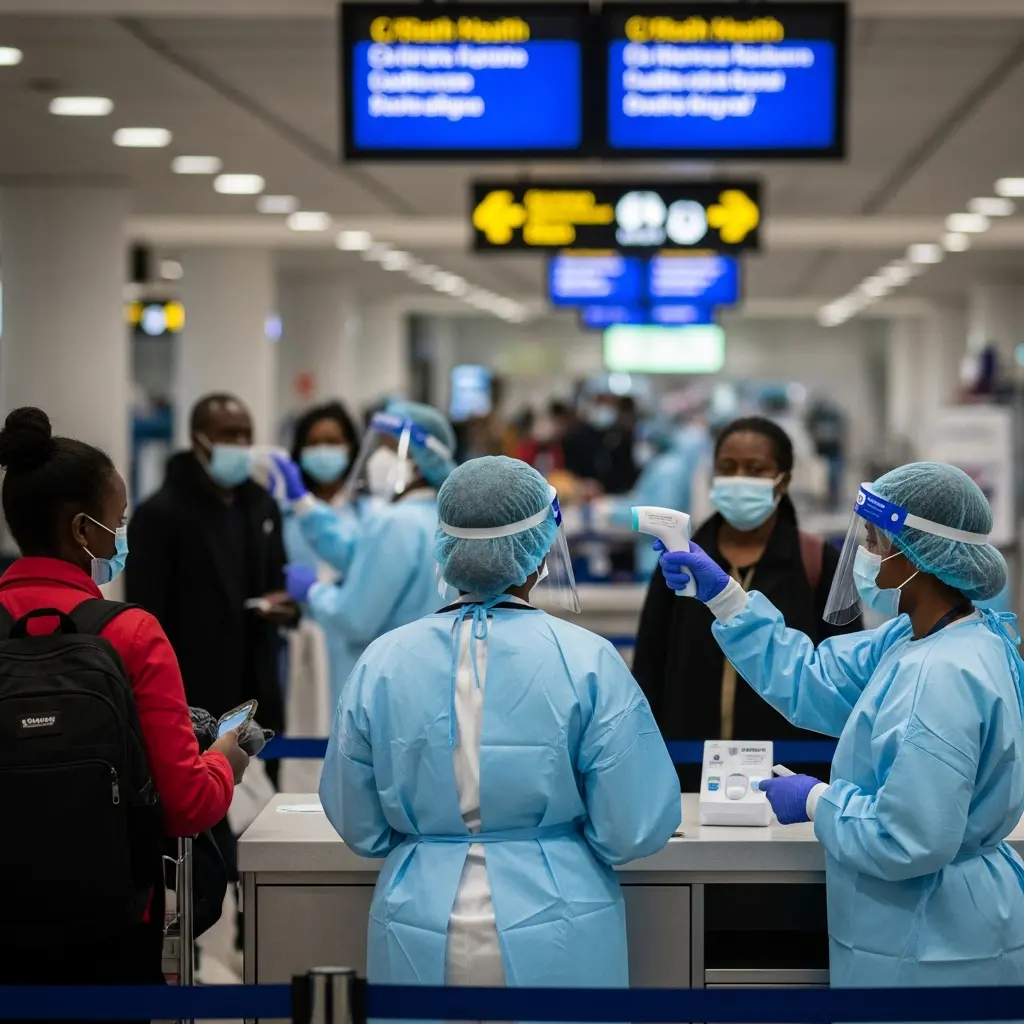
The disease prevention measures now being reinforced at international airports are a visible part of this. Airport screening protocols — temperature checks, health declaration forms, trained staff watching for symptomatic travelers — are not infallible, but they serve an important function: they create friction in potential transmission chains and generate data. Even a traveler who passes through screening without triggering an alert leaves a record that becomes useful if a case is identified later. That traceability is essential in outbreak containment.
“The question is never whether Ebola can be contained. We know it can — it has been, repeatedly. The question is always how fast we can build the ring of detection and response around it before it widens.”
What makes Ebola different — and manageable
Part of what drives public fear around Ebola is a misunderstanding of its transmission dynamics. Unlike airborne respiratory viruses, Ebola spreads through direct contact with the bodily fluids of someone who is symptomatic. This is simultaneously what makes it so lethal in healthcare settings without proper protective equipment, and what makes it containable in ways that, say, influenza is not. A person with Ebola is not infectious during the incubation period — the days between exposure and the onset of symptoms — which means that contact tracing, when done rapidly and thoroughly, can effectively identify and isolate those at risk before they can transmit.
The tools available to do that work are also meaningfully better than they were a decade ago. Rapid diagnostic tests that can confirm Ebola infection in hours rather than days have been deployed widely in affected regions. Two vaccines — rVSV-ZEBOV and Ad26.ZEBOV/MVA-BN-Filo — are now available and have been used effectively in recent outbreaks through a ring vaccination strategy that targets the close contacts of confirmed cases. These are not perfect solutions, but they represent a genuine transformation in the medical toolkit available to outbreak responders.
The WHO and Africa CDC have prepositioned Ebola vaccine stockpiles and rapid response teams in high-risk regions. Ring vaccination — targeting contacts and contacts-of-contacts of confirmed cases — has proven highly effective in limiting outbreak spread in recent years.
The fragile link: community trust and local health systems
If there is one consistent lesson from every Ebola outbreak response, it is this: the biology of the virus is rarely the hardest problem to solve. The harder problems are social. In regions where health systems are under-resourced and communities have historical reasons to distrust outside intervention, containment efforts can fail not because the response was too slow, but because people hid sick family members from screeners, refused to surrender bodies for safe burial, or fled isolation centers out of fear of what happening inside them.
This is why public health news about Ebola needs to be read carefully. The international coordination and airport screening headlines are important, but they represent only the visible layer of a response whose most critical work happens at the community level — in conversations between health workers and village elders, in the careful negotiations around burial practices, in the trust-building that determines whether a community member with a fever will seek care or hide at home. Getting that part right is slower, less photogenic, and more consequential than any airport temperature scanner.
What the public should understand
For people outside the directly affected regions, the current global health alert warrants attention but not alarm. Ebola has never sustained widespread transmission outside of outbreak epicenters in Africa, and the combination of its transmission characteristics and the now-robust international response infrastructure makes a global pandemic scenario extremely unlikely. That said, the distinction between unlikely and impossible is not a reason for indifference. The investments that make Ebola containable — in surveillance systems, in healthcare worker training, in community health infrastructure — are fragile and chronically underfunded in many of the regions that need them most.
The world’s ability to manage Ebola risks in 2026 is genuinely better than it has ever been. The response systems, the vaccines, the diagnostics, the international coordination mechanisms — all of it represents hard-won progress built on the devastating lessons of past outbreaks. What remains true, and will remain true, is that the disease exposes precisely the parts of the global health system that are still most vulnerable: the gaps in local capacity, the inequities in access to care, and the distance between the resources available and the resources needed. Watching Ebola closely is wise. Understanding why it keeps returning to the same regions is wiser still.