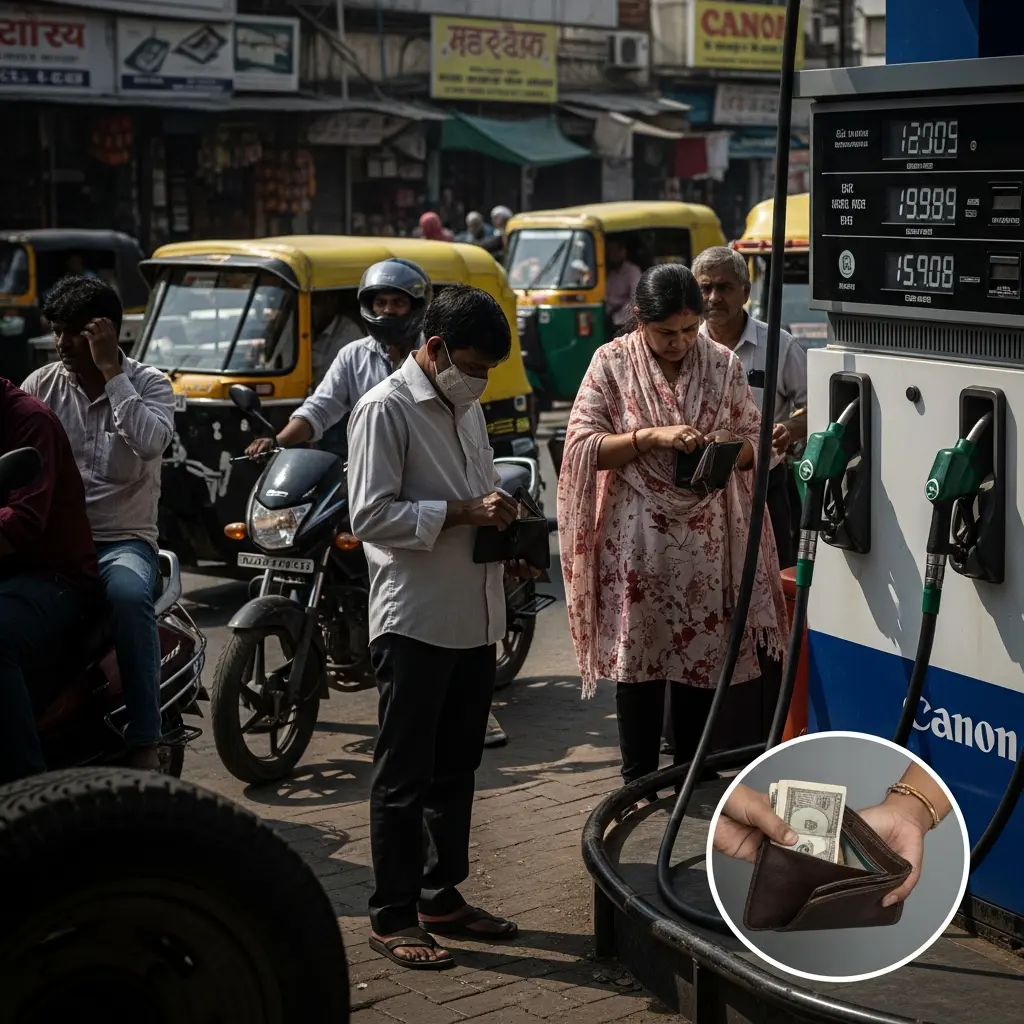
Walk into any autorickshaw stand in Delhi these days and you’ll hear it — the quiet grumbling that has become the background noise of everyday life. Drivers doing mental math on their phones.
Housewives reconsidering the month’s budget. Small business owners staring at logistics invoices they weren’t expecting. Fuel prices in India have risen again, and this time, the pinch is being felt from Mumbai to Chennai, from Kolkata to the capital itself.
LPG, CNG, petrol, and diesel — the four pillars of India’s energy consumption — have all seen upward revision in rates across major cities. And while energy companies are pointing to forces beyond their control, ordinary Indians are left figuring out how to absorb yet another round of increases in the cost of just getting through the day.
Why Are Prices Going Up?
The short answer is: the world outside India is making things expensive inside it.
Energy companies have cited mounting pressure from rising international crude oil costs as the primary driver behind the latest price hike. Global supply disruptions — many of them tied to ongoing transportation risks and geopolitical friction in West Asia — have pushed crude benchmarks higher in recent weeks. When crude goes up, everything downstream follows: refining costs rise, import bills swell, and domestic prices eventually adjust to reflect that new reality.
India imports a significant portion of its crude oil, which means it has limited ability to insulate itself from what happens in far-off markets. A conflict brewing near a key shipping lane, a production cut by major oil-producing nations, a spike in maritime insurance costs — all of it finds its way, eventually, into what Indians pay at the pump or for their kitchen cylinder.
City by City: Who’s Feeling It
The revised rates are not abstract numbers on a government notice board. In Delhi, commuters who depend on CNG-powered vehicles — autos, cabs, buses — are already factoring in higher fares or cutting back on trips. The CNG price increase in the capital has been one of the more immediately visible changes, given how deeply that fuel is embedded in the city’s public and private transport ecosystem.
In Mumbai, where distances are long and transport costs are woven into the economics of nearly every profession, the petrol diesel price hike is drawing sharp reactions from cab aggregators and delivery services. Fleet operators, who run on thin margins at the best of times, are already talking about passing costs on to customers.
Chennai and Kolkata are navigating similar pressures. In Chennai, where two-wheelers are the dominant mode of daily transport, petrol price sensitivity is particularly high. A few rupees per litre might sound modest in isolation, but for a rider filling up three or four times a month, it adds up quickly over a year.
In Kolkata, the concern is as much about logistics as personal transport. The city serves as a key distribution hub for goods moving into eastern India and the Northeast, and rising diesel costs directly translate into higher freight rates — costs that ultimately land on the shelves of stores and in the hands of consumers.
The Inflation Warning
Economists have been watching the LPG rates today and the broader fuel price trajectory with understandable unease. The concern isn’t just that driving becomes more expensive — it’s that fuel costs are deeply embedded in the price of nearly everything else.
When diesel gets costlier, trucks cost more to run. When trucks cost more to run, food, medicine, construction material, and manufactured goods all get pricier to move. That chain reaction feeds directly into retail inflation, a number that the Reserve Bank of India monitors closely and that affects decisions about interest rates, lending, and overall economic growth.
India inflation was already navigating a complicated path, with food prices remaining sticky and household budgets under pressure from multiple directions. A sustained rise in fuel prices is exactly the kind of compounding factor that can tip an already stressed inflation picture in the wrong direction.
For industries — especially those in manufacturing, agriculture, and e-commerce — rising logistics expenses cut into margins and force difficult choices: absorb the cost, raise prices, or find efficiency somewhere else. None of those options is painless.
What Can Consumers Do?
In the immediate term, not much beyond adjusting. Some commuters are already shifting toward public transport where it’s viable. Others are carpooling more seriously or cutting discretionary trips. For households that use LPG, the conversation often turns to consumption habits — cooking fewer elaborate meals, switching off burners sooner, planning grocery trips to reduce the number of meals cooked at home.
These are small adjustments, but they reflect the real behavioral shifts that happen when fuel prices India residents depend on start climbing without a clear ceiling in sight.
The longer-term answer — a more diversified energy mix, greater investment in electric vehicles and public infrastructure, reduced dependence on imported crude — is one that policymakers have been discussing for years. Progress is real but slow, and in the meantime, the burden of rising prices lands most heavily on those least able to absorb it.
The Bigger Picture
Fuel is not just an economic variable. It’s a social one. In a country where millions of families budget down to the last rupee, a jump in LPG rates today can mean a skipped meal, a deferred medical visit, or a child who takes the longer route home to save the bus fare.
That’s not a statistic. That’s a daily reality for a significant portion of India’s population. And it’s why, even as analysts debate crude benchmarks and import bills, the most important number in this story might simply be what a family in Chennai or Kolkata is spending this month compared to last — and what they’re giving up to cover the difference.
Fuel Prices Increase Across Indian Cities What It Means for Your Wallet and the Economy.