
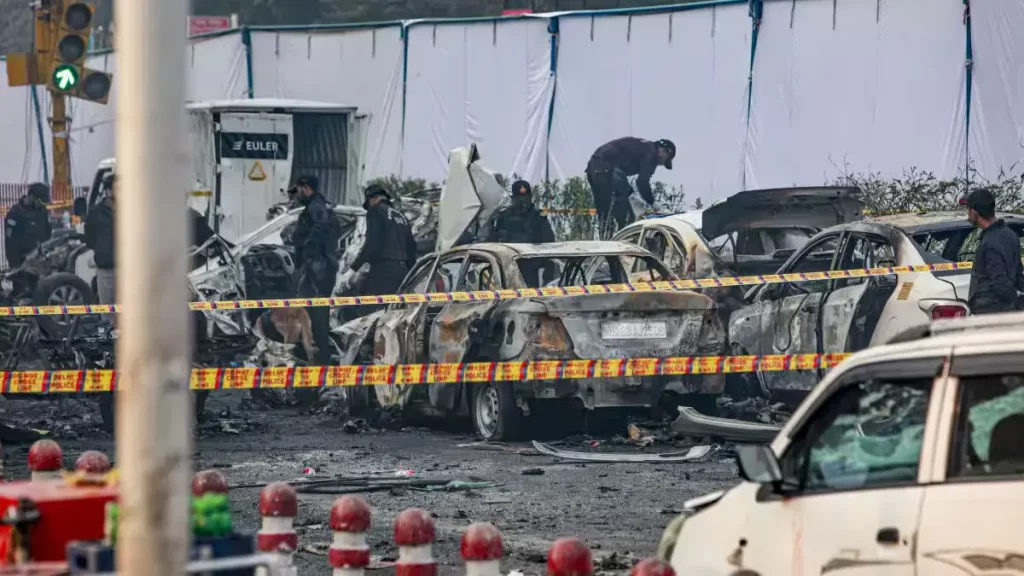
In a tragic incident that has sent shockwaves across India and beyond, a car explosion near the Red Fort metro station in New Delhi killed at least eight people and wounded dozens on 10 November 2025. The blast has prompted international condemnation and an outpouring of condolences from world leaders, including those of China and Israel, as India launches a full-scale investigation into the attack.
Local authorities say the explosion occurred at about 6:52 p.m. near Gate 1 of Lal Qila (Red Fort) metro station, in a slow-moving vehicle at a traffic signal. The vehicle, identified as a Hyundai i20, ignited a fireball that damaged nearby cars and auto-rickshaws and instantly caused multiple fatalities and injuries.
The immediate security response was swift. The Delhi Police declared a high-alert across the capital and neighbouring states, while the National Investigation Agency (NIA) has assumed control of the probe, treating the incident under anti-terror provisions. Investigators say preliminary evidence suggests the blast may be linked to a terror module that was detected in the region earlier. Sources cite a connection to arrests in Faridabad and a suspect from Pulwama whose DNA is being matched against remains found at the scene. Meanwhile, the government has moved quickly to provide relief: the Delhi government announced ex-gratia payments of ₹10 lakh to the families of the deceased, ₹5 lakh to those permanently disabled, and ₹2 lakh for the injured.
Internationally, reactions poured in. China expressed deep concern and called for joint efforts in combating such acts. Israel conveyed its condolences and solidarity with the Indian people. These responses form part of a broader wave of global sympathy for the victims and an acknowledgment of the significance of the location—a major heritage and tourist site in the nation’s capital.
The timing and site of the attack amplify its impact: the Red Fort area is heavily populated and symbolic, and the metro station is a key transit hub. The blast has triggered widespread questioning of the city’s security apparatus and raised anxieties about potential further strikes. Transport services in the area were temporarily suspended, and the metro operator closed the Lal Qila station for security checks.
The blast near the Red Fort marks one of the deadliest incidents in New Delhi in recent years. With the government invoking stringent laws and assigning the NIA to lead the investigation, authorities are sending a strong signal of zero tolerance for terrorism. The global condemnation adds diplomatic pressure as well as an expectation of swift clarity on the motive and perpetrators.
From a security-policy viewpoint, the incident could affect India’s counter-terror strategy, particularly in urban centres and heritage locations. The involvement of suspected interstate modules and cross-border elements underscores the increasing complexity of such threats. Moreover, the fact that countries like China and Israel—both major strategic partners—have publicly weighed in reflects the international dimension this attack has acquired.
As India mourns the lives lost in the blast near the Red Fort metro station, the incident has become a focal point for national and international scrutiny alike. With multiple nations condemning the attack and expressing solidarity with the victims, the case now stands at the crossroads of security policy, diplomacy, and domestic conviction. The key questions ahead will be whether investigators can swiftly identify those responsible and whether the global community and Indian authorities can translate this moment of tragedy into strengthened preventive mechanisms. The outcome will resonate beyond this one incident, affecting how India safeguards its public spaces and how the world engages with India’s anti-terror efforts in the years to come.

