
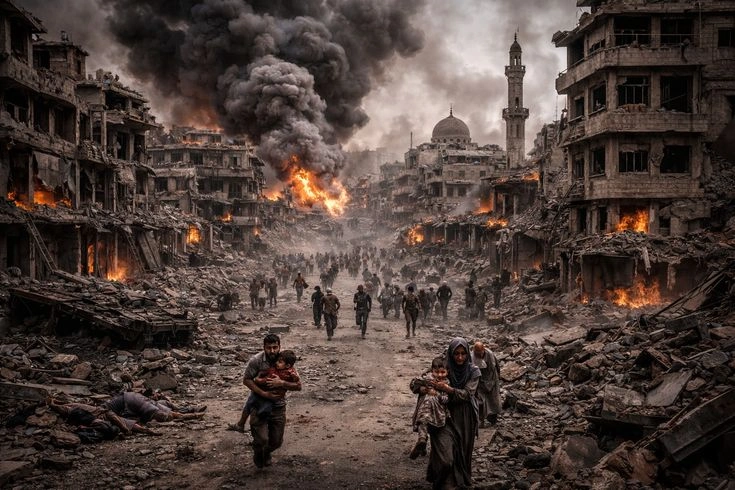
It’s not generally vehicles crossing borders or missiles lighting up the sky that start conflicts. Countries have recently started deploying more advanced methods, such as cyberattacks that shut down power grids, secret assistance for rebel groups, and trade squeezes that affect economies without firing a shot. This tendency toward grey-zone warfare, where the line between peace and conflict is blurred, is changing how the globe responds with threats as tensions build along India’s borders and elsewhere.
What is the point of grey-zone warfare?
When there isn’t a clear line between peace and war, that’s when grey-zone combat happens. It’s a set of plans that countries or groups employ to accomplish what they want without outright threatening to use force. Think of it as a long, planned process, not an explosion that happens all at once. Things like sabotage, spreading false information, and proxy wars are all meant to slowly make things worse.
Experts call it “competitive interactions” when people take advantage of faults without anyone being held accountable. The U.S. Special Operations Command first used the term in 2015, and it has been very widespread since then, keeping up with changes in technology and world events. The main aspects are plausible deniability, which helps people avoid responsibility, and a gradual approach that leads to significant benefits over time.
Why is this crucial right now? Democracies have a hard time here because their laws and armies are made for wars that are clear-cut, not this fog. Non-democracies do well in the dark since they don’t have as many rules. One analyst called it “illegal, forceful, aggressive, and misleading,” which is short for ICAP.
Cyber Attacks: The Frontline You Can’t See
Cyber operations are a great example of a conflict in the gray zone. Hackers penetrate networks, causing chaos and then disappearing, their damage done. The Russian government’s network breaches and the Lazarus Group’s attacks on banks and cryptocurrency exchanges in North Korea underscore their financial motivations and showcase their skills.
Things got worse in 2026. Iran’s cyber reaction to U.S.-Israeli operations in late February knocked the internet off for 27 days, and attacks that caused damage went up a lot. Unit 42 researchers indicated that groups from other countries inside Iran stopped talking to each other because of challenges with connectivity. On the other hand, groups from outside the country became more active. These aren’t random; they’re meant to hurt without sparking a fight.
It’s also having an effect on businesses. Gray zone cyber threats assault supply lines, like the 2022 Nord Stream sabotage or the Houthi cable cuts in the Red Sea that made it harder for people to connect to the internet between Asia and Europe. The Willis Research Network claimed in a research dated February 2026 that this kind of hatred is now a “serious menace,” and hiring gig workers makes it simpler to deny. Elisabeth Braw, a member of the Atlantic Council, expressed it clearly: if you don’t pay attention to this, you’ll respond too late.
This is really close to home for India. China and Pakistan utilize malware to uncover weak points in telecom and power infrastructure. You need to have cyber defenses that work together and do red teaming on a regular basis. Red teaming is when you test weak points by staging mock assaults.
Some popular cyber grey-zone moves are interfering with utilities, stealing data to use as leverage, and spreading misleading information.
Impact: Economies stop growing and people lose faith in the government when there are no formal statements.
Have you ever wondered if the outage at your local bank was just a mistake or something that was planned?
Proxy Wars: Fighting at a Distance
You don’t need to send your own troops when the people who live there can accomplish the job. Proxy wars let big countries battle each other through other countries, which keeps direct fighting to a minimum. Iran backs the Houthis in Yemen’s civil conflict against Saudi-backed forces. This is a clear example of this. When Russia invaded Ukraine in 2022, NATO aided Kyiv, and China and Iran backed Russia.
By 2026, Syria and Libya were being used as proxy playgrounds after Assad collapsed in 2024. Turkey, Russia, the UAE, Egypt, and Qatar are all attempting to get more power in the center of the chaos. Russia’s Ukraine churn mixes fake news with real news, such the fact that there are ethnic divides in Donbas.
The U.S. also plays this game, with CIA-linked drones bombing Russian energy supplies deep within. Moscow pays billions of dollars for Iranian Shahed drones and gets aircraft and technology in return. There are several methods to get around sanctions, which keeps low-level battles running.
India is very careful about what it does. Pakistan’s support for militants in Kashmir is like using proxies, and it works for cyber and information operations. These fights that never end change alliances, like NATO watching its southern flank.
Economic Coercion: Weapons of Wallet War
Why bomb when you can lose money? Economic pressure stops cash, technology, or trade from going to enemies without destroying them. Russia utilized gas supplies as a weapon during the crises of 2006 and 2009. It gave discounts later, during the Crimea conflict. China has influence because it controls most of the rare-earth chains. The U.S. eased several restrictions when Trump and Xi talked in 2025.
Some grey-zone economic crimes are washing money or damaging supply systems. Iran can trade freely with Russia’s Eurasian Union, which gets beyond Western prohibitions. Reports from 2026 warn that firms have to cope with “gig workers” who want to hurt them.
When there are border conflicts between India and China, trade differences are used as a bargaining tool. Insurance gaps see it as sabotage, not conflict, and it’s making the world less stable.
Asia and other places in the real world are hotspots.
China is ahead. In 2021, “cabbage strategy” sends fishing militias to reefs like Whitsun in the South China Sea, where they block the Philippines’ BRP Sierra Madre. They’ve dug out 3,200 acres of islands and put radars and missiles on them, all in other people’s EEZs. Vietnam fights back by taking land, yet it praises China for its harassment.
What is the border between India and China? The Galwan 2020 conflict killed 20 people from India. The accords that came after made buffer zones that cut off India from 1,000 to 2,000 square kilometers of land in Ladakh. In Depsang, 900 square kilometers are off-limits. Pictures taken by satellites between 2025 and 2026 reveal that China is growing. The salami-slicing keeps going.
Russia has done things in the Black Sea including ramming Ukrainian ships in the Kerch Strait in 2018 and buzzing HMS Defender in 2021. Ukraine is getting help from vessels from the UK and Turkey to rebuild, but NATO is unwilling to get involved.
These places check responses—U.S. FONOPs are a problem for China, although there is still some doubt.
Why the Change from War as Usual?
Old-fashioned wars could lead to nuclear weapons or alliances. General Sir Nick Carter of the UK remarked that grey-zone doesn’t need tanks to perform what it does. Instead, foes utilize cyber assaults, economic strikes, and other people’s actions to bring down democracies. Technology makes it feasible, and information operations make it bigger.
After COVID, virtual worlds make things worse. India is striving for integrated commanders, special forces, and drones, while democracies remain behind.
India’s Interest in the Gray Shadows
India can’t ignore this because the country is getting stronger. It is used by the China-Pakistan partnership in Pulwama-Balakot, Galwan, and coercive signals. Needs to be combined with red-teaming and cyber. Buffer zones changed the way patrols worked, and Modi’s 2024 accords created new rules.
It puts a lot of pressure on U.S. friends all over the world, like the Philippines and China at Second Thomas Shoal.

