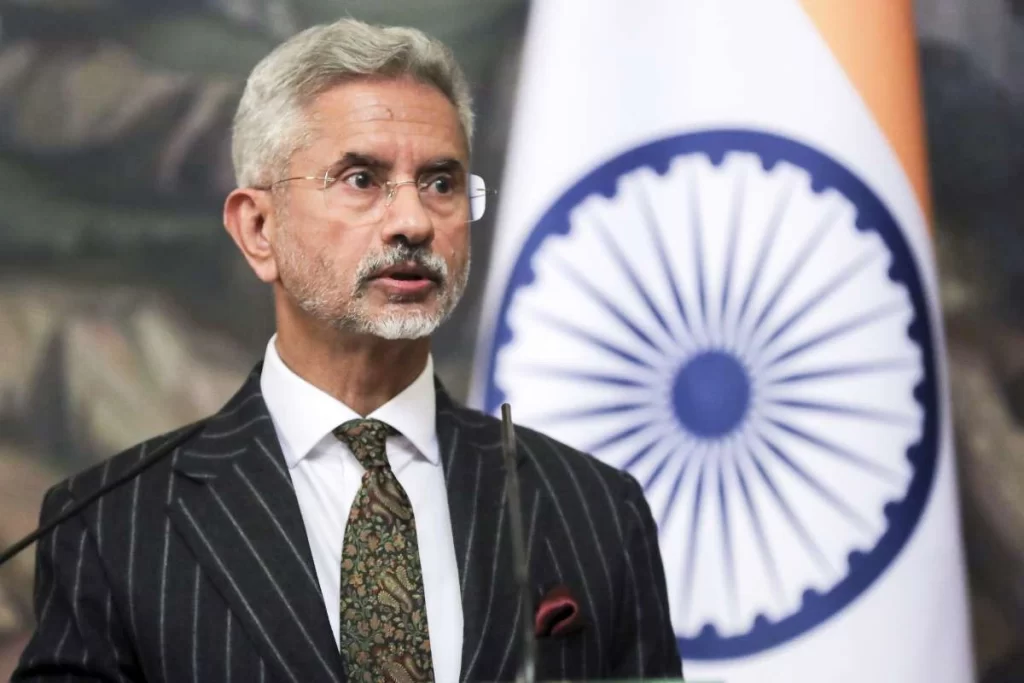
External Affairs Minister S. Jaishankar’s recent demand for an end to the West Asia war is important because conflicts in the Middle East often affect global energy markets and migratory flows. Jaishankar spoke at a high-level event this week and stressed India’s unflinching support for diplomatic efforts to restore peace, especially as tensions with Iran rise. It’s a reminder that peace isn’t simply a phrase for a country like India, which relies on oil from the region and has millions of expats living there. Why does this matter now, when people break red lines virtually every day? Jaishankar’s statements show that New Delhi wants to be a stabilizing force without taking sides, even though maritime lines are under danger and proxy warfare are getting worse.
The Spark: Jaishankar’s Strong Warning
Jaishankar was clear. He told diplomats and policymakers that the prolonged turmoil in West Asia, which includes Gaza, Lebanon, Yemen, and now direct tensions between Iran and Israel, is “a cycle that must break.”He talked about the human cost: thousands of people dead, businesses falling apart, and a region on the verge of a larger war. What is India’s position? Strong support for discussion, not more fighting. This comes at a time when tensions between Iran and Israel are at an all-time high. Recent Israeli attacks on Iranian assets and Tehran’s drone swarms in response have made people on edge from the Strait of Hormuz to the Red Sea.
This isn’t just an idea for India. More than 8 million Indians reside and work in the Gulf, sending money home that helps the economy of rural areas. Disruptions here are quite bad. For example, petrol costs going up in Mumbai or planes being delayed and families being stuck in Dubai. Jaishankar’s effort fits with Prime Minister Modi’s “neighborhood first” policy, which has been extended to the Middle East, where diplomacy has led to agreements like the I2U2 group with Israel, the UAE, and the US.
A Quick Summary of West Asia’s Powder Keg: The Roots of the Fire West Asia’s problems didn’t start yesterday. The battle between Israel and Hamas, which is already in its second year, has turned into a catastrophe on multiple fronts. Hezbollah’s missile attacks from Lebanon, Houthi attacks on Saudi oil fields and commerce in the Red Sea, and Syria’s never-ending civil war are all part of the picture. Then Iran comes into play, giving weapons to proxies and enriching uranium to near-weapons grade, which causes Israel to attack first.
Some important flashpoints are:
Iran has threatened to seal the Strait of Hormuz, which is a key shipping route for 20% of the world’s oil. India gets 85% of its crude oil from here, thus any blockade will raise gas prices all around the country.
Houthi disruptions: Their drone strikes have made ships change course, which adds 10 to 15 days to voyages and raises costs. Indian exporters, from spices to textiles, are feeling the pain.
Gaza’s effects: More than 40,000 Palestinians have died, which has led to protests from Delhi to New York and is putting India’s neutral stance on Palestine to the test.
Jaishankar’s involvement acknowledges these facts. India has stepped up evacuations, airlifting thousands of people from war zones, just like the dramatic Vande Bharat missions during COVID.
Iran’s Shadow: Why It’s Important to India
Iran is a big part of this story. There are strong ties between New Delhi and Tehran. For example, the INSTC commerce corridor cuts transit times to Central Asia, and the Chabahar port is India’s means to go to Afghanistan without going through Pakistan. But things are harder because of sanctions and Israel’s shadow. Jaishankar urged prudence as Iran tested missiles and captured ships tied to Israel in recent months.
India has been walking a tightrope. It didn’t vote on some UN resolutions that were critical of Israel, but it did vote against Houthi attacks. US sanctions caused trade with Iran to drop to $2.5 billion last year. However, Jaishankar met with his Iranian colleague in recent SCO discussions to push for more dialogue. He stated, “Stability benefits all,” which is what Modi said when he went to Tehran and Jerusalem.
What if the fighting between Iran and Israel gets nuclear? That’s the worst-case scenario that analysts talk about in hushed tones. The administration is secretly preparing for these situations, which include a lot of refugees coming to India, oil prices at $150 a barrel, and the rupee going up and down.
India’s Playbook: Diplomacy Instead of Drama
New Delhi’s way of doing things seems practical, almost simple. Jaishankar praised the UAE and Saudi efforts to facilitate discussions and UN-led ceasefires. India sponsored backchannel meetings, using its power as the G20 president.
Important steps:
Evacuations and aid: More than 10,000 Indians were taken out of Lebanon and Iran last year, while humanitarian shipments to Gaza went through Egypt.
Energy diversification: Guyana and Brazil are working together to cut down on Gulf dependence, but West Asia still makes over 60% of imports.
India works with the US, Japan, and Australia to improve marine security in the Indian Ocean and fight Houthi threats.
This isn’t anything new. Remember 2019, when India acted as a go-between for Saudi Arabia and Iran during tanker attacks? Jaishankar, a lifelong diplomat who is now a minister, knows how to avoid getting caught in the traps of large powers. His book The India Way explains how.
Ripples Around the World: From Oil to Inflation
The effects of the conflict are not limited. According to industry monitors, transportation rates throughout the world have doubled, which is bad news for Indian firms who send goods to Europe. What about inflation? Iran is the main supplier of chemicals, and a lack of fertilizer has caused food prices to go up 5–7%.
In India, it’s real: truck drivers in Nashik complain about rising diesel prices, and jewelers in Surat worry about the hazards of smuggling gold under sanctions. Migration waves are putting even more burden on Europe, just like the exodus from Syria in 2015.
If interruptions continue, economists say India might lose $50 billion. Adani Ports and Reliance Energy were in the crosshairs of stock markets, which fell 2% after recent warnings about Iran.
Voices from the Ground: Stories from Expats and What People on the Street Think
When you talk to Indians in the Gulf, it’s intimate. “We watch the skies for drones today,” says Rajesh, an engineer from Kerala who lives in Dubai. Families back home are often worried. During rallies in Delhi, students wave Palestinian flags next to Israeli peace banners. A comparison of these groups reveals the distinct characteristics of India’s Muslim and Jewish populations.
The #WestAsiaCrisis is dominating social media, where memes about gas shortages are interspersed with calls for a ceasefire. Jaishankar’s address on X certainly made waves, racking up half a million views. This sparked a debate: Should India arm the Kurds, or continue down the diplomatic path?
Proxy wars and power plays are coming up.
It won’t be easy to stop this. Iran’s “axis of resistance” gives militants more power, while Israel’s right-wing government says it won’t stop. The US elections make things less certain. Trump’s return could bring tougher policies against Iran.
India also has problems. It is hard to be neutral when you have to balance your relationships with BRICS (Iran is a member) with your alliances with QUAD. Jaishankar’s call makes this clear: India’s superpower is diplomacy.
But there are signs of development. China helped Saudi Arabia and Iran get along, and it seems to be working. The talks between Hamas and Qatar are slowly moving forward. Could India hold a summit? There are a lot of rumors going around.
A Way Forward: Stability for Everyone’s Wealth
Jaishankar’s message is simple: war that never ends is bad for everyone. India supports two-state solutions, economic corridors like IMEC that connect India to Europe through the Gulf, and agreements to lower tensions.
In the future, there will be more shuttle diplomacy. India’s prosperity is fueled by West Asia’s oil, and its ports fuel trade. Stability is a must. The minister’s statements make us think: In a world where everything is connected, can conflicts stay contained? India is betting on negotiations, and history shows that this typically succeeds.
This drive shows how much more power New Delhi has in the world. India is not only a bystander; it is a bridge-builder, going from being a G20 mediator to a peacemaker in West Asia. If tensions go down, everyone wins: fuel prices go down, the oceans are safer, and there is hope for areas that have been damaged by violence for a long time. We’ll see if words transform into action in the next few months.