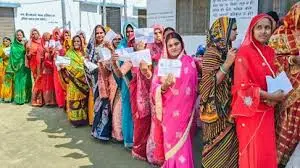
The second and final round of polling in the 2025 Bihar Legislative Assembly election got underway on November 11, 2025, across 122 constituencies in 20 districts of the state. Early figures suggest a strong voter response, while isolated incidents of clashes between supporters of the Jan Suraaj Party (JSP) and the Bharatiya Janata Party (BJP) in the Barbigha area of the Warisaliganj constituency have raised concerns about election-day disturbances.
According to the Election Commission of India (ECI), voter turnout stood at 14.55 percent by 9 a.m. in phase two, a modest early start that was still higher than the same time in phase one. By 11 a.m., the turnout had risen to 31.38 percent, and by 1 p.m., several reports quoted a figure of 47.62 percent. The polling process is taking place under heightened security, with the state government sealing the international border with Nepal for 72 hours as a precautionary measure.
The stakes are high in this phase, which involves 122 seats and covers key regions such as Seemanchal, Magadh, and western Bihar. Both the ruling National Democratic Alliance (NDA), comprising the BJP and the Janata Dal (United), and the Opposition alliance, including the Rashtriya Janata Dal (RJD), Congress, and JSP, are under intense pressure to secure decisive leads.
In the Barbigha area of the Warisaliganj constituency, a clash broke out between JSP supporters and BJP workers, resulting in vandalism of a vehicle and the deployment of additional police forces at the location. Local election officials described the incident as isolated and confirmed that the situation was brought under control quickly. However, the clash underscores the intensity of competition and the charged atmosphere in certain constituencies. Analysts note that Barbigha is among the key “swing seats” where voter allegiance has shifted in past polls, making it a focal point of this election phase.
The strong turnout reflects the enthusiasm of voters eager to make their voices heard. Themes such as regional development, employment, migration of workers returning home to vote, and the search for viable political alternatives have influenced participation levels. Several political leaders described the day as a “festival of democracy,” praising citizens for their engagement despite long queues and logistical challenges.
However, some opposition leaders raised concerns over the condition of polling booths in rural districts, citing inadequate lighting and security arrangements. While the Election Commission has dismissed reports of widespread irregularities, it acknowledged minor delays in some booths due to technical issues with electronic voting machines.
As polling continues through the afternoon, attention remains focused on whether the final turnout in phase two will surpass that of phase one, which recorded a historic 65.08 percent. Constituencies like Barbigha, Aurangabad, and Gaya are expected to play a decisive role in determining the overall outcome. The clashes and heavy security presence underline the tension accompanying what remains a vibrant exercise in democratic participation. The results of this phase will not only shape the next government in Bihar but could also influence the political direction ahead of the 2026 general elections.