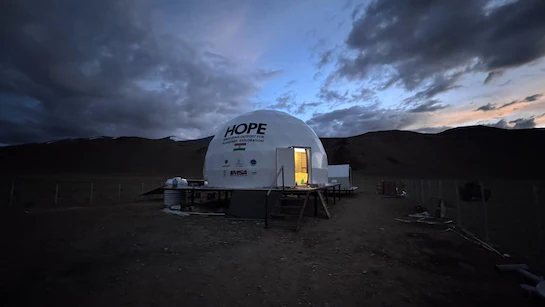
August 4, 2025 — The Indian Space Research Organisation (ISRO) has inaugurated a groundbreaking research facility in the remote Tso Kar region of Ladakh, aimed at simulating the harsh environmental conditions of the Moon and Mars. Named the Himalayan Outpost for Planetary Exploration (HOPE), the station marks a significant advancement in India’s growing planetary exploration efforts.
Located at an altitude of over 4,500 meters, the Tso Kar Valley presents a unique, high-altitude cold desert landscape that closely resembles extra-terrestrial surfaces. The region’s low atmospheric pressure, rocky terrain, and extreme temperature fluctuations offer an ideal setting for testing technologies and training personnel for future space missions.
HOPE: A Step Towards Interplanetary Readiness
The HOPE facility will serve as a vital research ground for upcoming missions under ISRO’s ambitious agenda, including the Gaganyaan human spaceflight mission, future Chandrayaan lunar expeditions, and the next phase of Mars exploration. The station will be used to test rovers, mobility systems, life-support technologies, and habitat modules intended for use on other planets.
Officials from ISRO emphasized that the HOPE station is designed not just for equipment testing, but also for long-term studies on human adaptability in extreme environments, geological sampling, and the development of sustainable survival strategies.
Speaking about the project, ISRO Chairman Dr. S. Somanath stated, “The HOPE station will allow our scientists and engineers to simulate realistic planetary conditions on Earth. It’s an important foundation for building confidence in our technologies and mission preparedness.”
A Gateway to Global Collaboration
ISRO’s establishment of the HOPE station has also opened avenues for international scientific cooperation. Research institutions and space agencies from countries such as France, Japan, and the United States have expressed interest in collaborative projects involving astrobiology, robotics, in-situ resource utilization, and remote sensing experiments.
The outpost is expected to support joint simulations, technology demonstrations, and student research programs, fostering deeper international engagement in space science.
Tso Kar’s Unique Landscape: A Natural Testbed
The selection of Tso Kar Valley as the site for HOPE is backed by years of geological and environmental studies. The region’s arid plains, saline deposits, and lack of vegetation mirror many of the challenges astronauts are expected to face during surface operations on the Moon and Mars.
This naturally challenging environment enables realistic rehearsals for spacewalks, sample collection, and communication systems in low-resource conditions, making the location a valuable asset for mission planning.
Implications for India’s Space Leadership
The launch of HOPE aligns with ISRO’s strategic vision to position India as a key player in global space exploration. Following the success of Chandrayaan-3 and the continuing progress of Gaganyaan, the outpost demonstrates India’s readiness to transition from satellite launches to long-duration, crewed interplanetary missions.
By building capabilities on Earth that mirror the demands of outer space, ISRO is not only enhancing its technological resilience but also contributing to global scientific understanding.