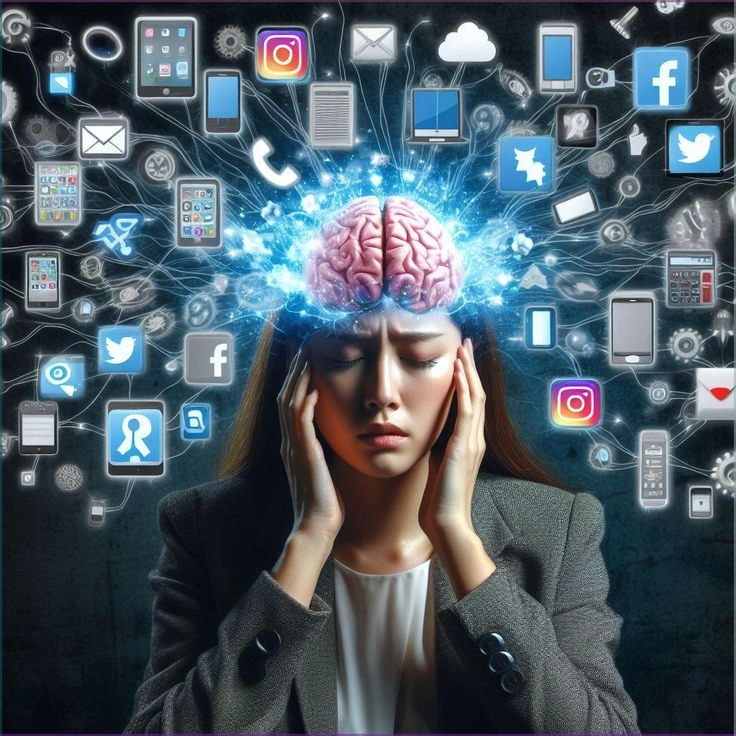
Instagram, TikTok, and X are all social media sites that are now a part of our lives, just like cell phones are an extension of our hands. These digital ecosystems promise to connect us, keep us interested, and make it easier for us to get information. By 2026, they will have more than 5 billion users around the world. But there is a darker truth behind the flashy feeds and viral trends: social media is hazardous for your brain. New research shows that scrolling all the time can make you feel like you’re addicted, make it hard for you to focus, and affect how your brain works, which can make you more anxious, dissatisfied, and mentally slow. This essay explains a lot about how this huge power changes the brain, the mind, and society. It shows us the bad side of social media and makes us think about how we use it.
The Science of Doomscrolling in the Mind
Dopamine is a neurotransmitter that has to do with pleasure and reward. This is why it’s so hard to stop using social media. Like the fun of playing slot machines, platforms’ algorithms throw out unpredictable bursts of validation, such as likes, shares, and comments. In 2025, Anna Lembke, a neurologist at the University of California, published a study that showed that using social media a lot makes the nucleus accumbens in the brain work. This brain area is also linked to a gambling addiction.
These changes aren’t simply ideas; they produce problems in the real world, such when people can’t concentrate for long periods of time. Some people call this “social media brain fog.”
Lessening of Attention Span
People used to like social media because it made information available to everyone, but now it’s hard to focus on it. In the past, people could pay attention for 12 seconds, but now they can only do it for 8 seconds, which is less time than a goldfish. The main reason for this is that there isn’t much to read on the sites. Reels and Stories last 15 to 60 seconds, which helps the brain learn how to switch gears fast. This makes it harder to finish things.
Gloria Mark, a cognitive psychologist at the University of California, Irvine, watched more than 100 workers for a long time in her 2025 study. She found out that it took her 23 minutes to get back on track after being halted by social media. This “attention economy” exploits the brain’s default mode network, which is always on the go while you’re not doing anything and gets flooded with notifications instead. What happened? A generation that doesn’t want to read long articles or talk about serious matters.
When people say they can’t recall anything for more than 30 seconds, think of how “TikTok brain” has developed. It’s quite evident what this entails for schools: A 2024 study by the OECD found that students who used social applications for four or more hours a day had a 15% decline in their reading ability. Sites like Instagram Reels that favor popularity over merit produce echo chambers that keep biases alive and make it harder to think critically. This makes it tougher for your brain to see little changes.
The Quiet Epidemic of Mental Health
Social media can also be bad for mental health since seeing carefully chosen perfection can make people feel bad about themselves. Leon Festinger came up with the idea for “social comparison theory” in the 1950s. It’s true now, as shown by the lives of influencers and photoshopped selfies. The American Psychological Association’s 2025 study was the first of its type to reveal that teenage females who used Instagram were 30% more likely to develop body dysmorphia because they observed unrealistic standards.
A lot of people are sad right now, especially teens and young adults. Meta’s own stolen data from 2021, which was later confirmed by other investigations, demonstrates that Instagram makes 32% of young girls more scared about injuring themselves. This is worse because of cyberbullying. A lot of people on X get nasty things said to them by anonymous trolls, which triggers the limbic system in the brain go into “fight or flight” mode.
Teenagers are impacted by it in various ways:
Teenagers between the ages of 13 and 17 who spend an average of 4.8 hours a day on their phones are 45% more likely to be depressed.
Young adults between the ages of 18 and 24 are 38% more likely to do so if they spend 5.2 hours a day.
People between the ages of 25 and 34 who spend 3.9 hours a day see a 25% increase.
(Source: Information from the CDC and Pew Research in 2025)
Adults are also not safe. According to a Deloitte survey from 2026, 70% of people check their apps at night or during meals so they don’t miss anything. This affects the amounts of serotonin in the brain and makes people feel alone, even when they have “friends” online.
Changing the world and the way we get along
Not only does social media make people stupid, it also breaks apart friendships. The “like economy” turns relationships into numbers, which makes people less caring since interactions become more businesslike. Sherry Turkle’s Alone Together (2024 edition) says that people don’t converse to each other as well in person when they are always connected. The parts of the brain that help us empathize, called mirror neurons, are 20% less active after we use a lot of apps.
This is a great place for polarization to get worse. Filter bubbles develop when algorithms show people items that agree with what they already believe. According to internal audits, Facebook’s recommendation system made posts that people disagreed with 40% more likely to be viewed during the 2025 U.S. elections, which made divisions in society even worse. MIT tests in 2024 showed that the echo chamber effect makes people 25% more likely to believe something that aren’t true.
Extremism is more widespread on social media. Telegram and other applications have radicalization pipelines that keep people coming back by offering them a dose of dopamine. The EU Commission indicated in a study from 2026 that problems with TikTok were to blame for 15% of internet radicalizations. This means that gamified content can push people who are easily misled to the limit.
The Business Machine That Attracts People In Big tech companies know how to make consumers want to buy products. In 2017 and again in 2025, Chamath Palihapitiya, who used to work for Facebook, told Congress that platforms put “engagement” ahead of health. Tristan Harris is in charge of the Center for Humane Technology. In 2026, they explained how the Zeigarnik effect in the brain makes people feel like they have to do things even when they can play and scroll on their own.
People keep coming back for different rewards, which is like B.F. Skinner’s operant conditioning. In 2025, Stanford ran a study that found that when the “limitless scroll” feature was taken away from prototypes, people utilized Twitter 21% less. But people have to be interested in it for it to make money. In 2025, Meta made $150 billion from ads because 3.5 billion users used the site every day and spent an average of 2.5 hours on it.
Regulatory efforts are taking too long. The Digital Services Act (2024) of the EU says that everything must be clear, however this isn’t always the case. In 2026, there will be bipartisan plans for age-gating in the U.S., but lobbyists are getting in the way, which is harmful for your brain.
Teenagers and adults are the ones who are most likely to get hurt. Teens are the most hurt since their minds are still growing. A 2025 NIH study discovered that kids who spend more than three hours a day on social media have weaker cortices in areas that are linked to self-control. People who start using drugs while they are young go through something like this. Girls are under more pressure because of apps that emphasize on appearance, and boys are having difficulties with intense gaming crossovers on Twitch.
Scams and making individuals feel alone go after elderly adults who want to meet new people. AARP’s 2026 study found that fraud against seniors in Facebook groups had gone risen by 50%. This is because older adults have brain problems, such as a shorter working memory.
How to Get Off the Internet
You need to make an effort to remedy the harm that social media causes. Experts say that “dopamine fasting,” or stopping using applications, can help your brain’s pleasure reactions return back to normal. The Journal of Behavioral Addictions conducted a study in 2025 that indicated that users who used apps like Freedom and Opal said their moods improved 35% better after 30 days.
Mindfulness exercises could help you get back on track. For example, meditating for 10 minutes every day makes the prefrontal cortex thicker, which keeps it from getting smaller. “Digital minimalism” is a style of life that experts like Cal Newport agree with. They want platforms to be altered such that limited streams are at the top.
Last words
One terrible thing about social media is that it may make you addicted, busy, and anxious on purpose. Its effects are clear, and more and more studies in neurology and epidemiology support this. Some of the effects are dopamine hijacks, loosing focus, mental health problems, and a division in society. In 2026, when consumption is at an all-time high, the stakes are much higher. If things don’t change, we might end up with a generation of kids whose brains are hurt and who aren’t ready for complicated things.
On the other side, knowing about it and doing something about it offers you hope. Detoxes can help people concentrate again, and the government needs to make sure that technology is safe for everyone. Finding a means to be connected and still think is vital for the future. Will we allow computers tell us how to think, or will we make better decisions about technology? The data is asking for a change right now.