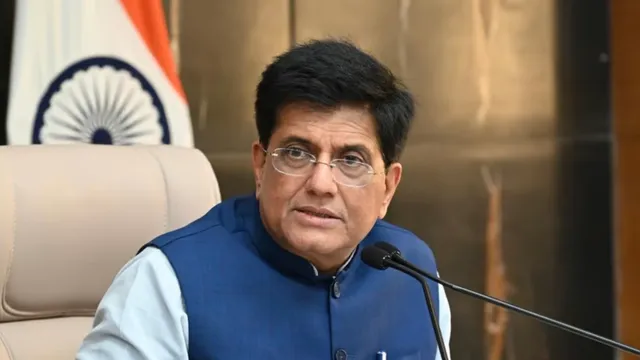
Union Commerce and Industry Minister Piyush Goyal on Wednesday asserted that no matter how advanced artificial intelligence (AI) becomes, the human mind will always remain superior. Speaking at a national technology summit in the capital, Goyal underlined India’s commitment to embracing AI while ensuring that its adoption is guided by ethical considerations and centered around human welfare.
“Artificial Intelligence is an area that India is absolutely going to adopt,” Goyal stated. “But we must never forget — the human mind will always be superior to any kind of AI.” His remarks come at a time when rapid advancements in AI technologies are sparking global debates about their societal impact.
Goyal stressed that India’s approach to AI will be one of cautious optimism. He highlighted that while AI holds immense potential to transform sectors such as healthcare, agriculture, education, and public services, it must be developed and deployed responsibly. “We are not in a race to replace humans with machines,” he said. “Our aim is to use AI to enhance productivity and improve lives without compromising ethical values.”
India’s National Strategy on Artificial Intelligence, spearheaded by NITI Aayog, is expected to provide a comprehensive framework for AI adoption in the country. Goyal indicated that the government is prioritizing transparency, inclusivity, and data protection in shaping its AI policies. “We want AI that is explainable and rooted in democratic principles,” he said.
The minister also called for increased collaboration between government, academia, and the private sector to create AI solutions that address India’s unique challenges. He encouraged startups and innovators to focus on indigenous development and ethical innovation. “India can become a global leader in responsible AI if we remain focused on our values,” he added.
Goyal’s statement also touched on the growing global discourse around regulating AI. With international bodies and governments, including the European Union and the United States, moving towards legislation to govern AI applications, India too is exploring policy frameworks to mitigate the risks of algorithmic bias, misinformation, and surveillance.
“AI should be a tool that supports human creativity and judgment — not something that controls or replaces it,” Goyal said. He concluded by reminding the audience that while machines can replicate logic, they cannot replicate the emotional intelligence, intuition, and empathy that define human beings.
The minister’s remarks reflect India’s broader vision of aligning technological progress with social good, signaling a path forward that prioritizes both innovation and ethical integrity in the age of AI.