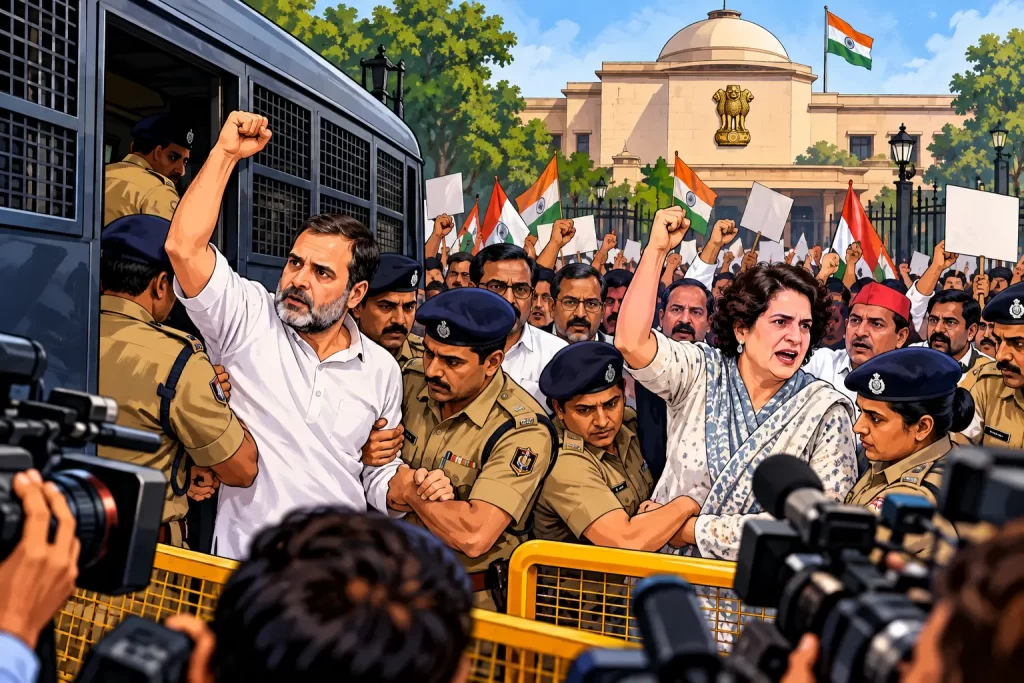
Politics in India rarely stays quiet for long, but some days manage to compress an entire debate into a single image. On 6 October, that image was of opposition leaders sitting for hours outside Akashvani Bhavan in New Delhi, and then being taken away by police. The INDIA bloc protest, which ran for nine hours, ended with Leader of Opposition Rahul Gandhi and Priyanka Gandhi Vadra being detained by Delhi Police.
By most accounts, the day was long, tense, and loud. It was also a reminder that the argument over how India’s voters are counted and verified has moved well beyond technical circles and into the streets.
A Nine-Hour Sit-In
The protest centred on a simple, forceful demand: the resignation of Chief Election Commissioner Gyanesh Kumar. The opposition alliance accuses the Election Commission of India of failing to protect the integrity of the voter list, and its leaders have used the phrase “vote chori,” or vote theft, to describe their concerns.
Sitting in for nine hours is not a casual gesture. It takes planning, patience, and a willingness to stay put while the day wears on, the crowds thin and swell, and the television cameras wait. For the leaders involved, the length of the sit-in was part of the message. They wanted it to be clear that this was not a photo opportunity but a statement of seriousness.
Eventually, police stepped in. Rahul Gandhi and Priyanka Gandhi Vadra were detained, and later released.
The Police and the Commission Respond
Delhi Police said the detentions were meant to maintain law and order. That is the standard explanation in such situations, and it is also the one that opposition parties tend to challenge, arguing that peaceful protest is a democratic right and that detentions send the wrong signal.
The Election Commission offered its own account. It said MPs had rejected a meeting offer, suggesting that a channel for dialogue existed but was not taken up. The opposition, for its part, has argued that a private meeting is no substitute for accountability, and that the issues raised deserve a public answer rather than a closed-door conversation.
Neither version can be fully tested from the outside. What is clear is that both sides came away with a story to tell, and that the gap between them is wide.
What Is the Special Intensive Revision?
At the heart of the dispute is the Special Intensive Revision of electoral rolls, often shortened to SIR. In simple terms, it is a large exercise to review and update the list of eligible voters, checking names, removing entries that should not be there, and adding those that are missing.
On paper, nobody objects to clean voter lists. Duplicate names, entries for people who have died or moved away, and genuine eligible voters left off the rolls are all real problems. The controversy arises over how the exercise is carried out. But critics are concerned that uneven implementation, short timeframes and documentation requirements could shut out real voters, especially poorer or more mobile citizens. Supporters of the process say it is exactly the kind of housekeeping that strengthens trust in elections.
That tension is why the issue has proven so durable. Voters want accurate rolls and fair access at the same time, and balancing the two is difficult.
Why “Vote Chori” Resonates
The phrase “vote chori” is blunt, and it is meant to be. It packages a complicated, technical grievance into something anyone can repeat at a tea stall. Whether or not one agrees with the allegation, the slogan shows how much the opposition believes this is a fight about trust.
Elections depend on a shared belief that the process is fair, even among those who lose. When that belief weakens, the consequences go beyond any single result. That is why both supporters and critics of the INDIA bloc tend to treat these allegations with great seriousness, though they draw very different conclusions from them.
Counting the Detained
One detail worth noting is that reports differ on how many leaders were detained. Some accounts give one figure, others a different one. This is common in fast-moving situations, where crowds are fluid and information trickles out through multiple sources. Until official numbers are published, it is wise to treat any specific count with caution.
The Next Move
The story did not end on 6 October. The AAP said it would join the protest scheduled for today, which suggests the opposition is trying to widen the coalition of voices behind its demand. That matters politically. A protest backed by more parties looks broader and harder to dismiss, though it also raises the challenge of keeping different groups aligned on a single message.
Meanwhile, the Election Commission faces its own test. Whenever its neutrality is challenged, it must respond in a way that reassures citizens rather than increases suspicion. Clear explanations of how the Special Intensive Revision works, transparent data on additions and deletions, and accessible ways for voters to check and correct their entries would go a long way.
What Ordinary Voters Can Do
Amid all the noise, there is something practical that every citizen can do. Check that your name is on the electoral roll. Confirm that your details are correct. If something is wrong, use the official channels to fix it, and keep a record of what you submitted. These small steps protect your vote regardless of how the larger political argument unfolds.
A Debate That Is Not Going Away
Protests, detentions, counter-statements, and meeting offers all follow a familiar rhythm in Indian politics. What makes this episode notable is the subject matter. Few things are more basic to a democracy than the right to vote and the confidence that votes are counted fairly.
The images from Akashvani Bhavan will fade, but the questions behind them will not. How should voter lists be cleaned without excluding the genuine? Who answers when trust in an institution slips? And how can an opposition and a constitutional body argue without eroding public faith in the process itself?
For now, the INDIA bloc protest has put those questions back in front of the country. Whether they are answered with transparency, dialogue, and reform, or with more standoffs, will say a great deal about the state of the debate in the weeks ahead.