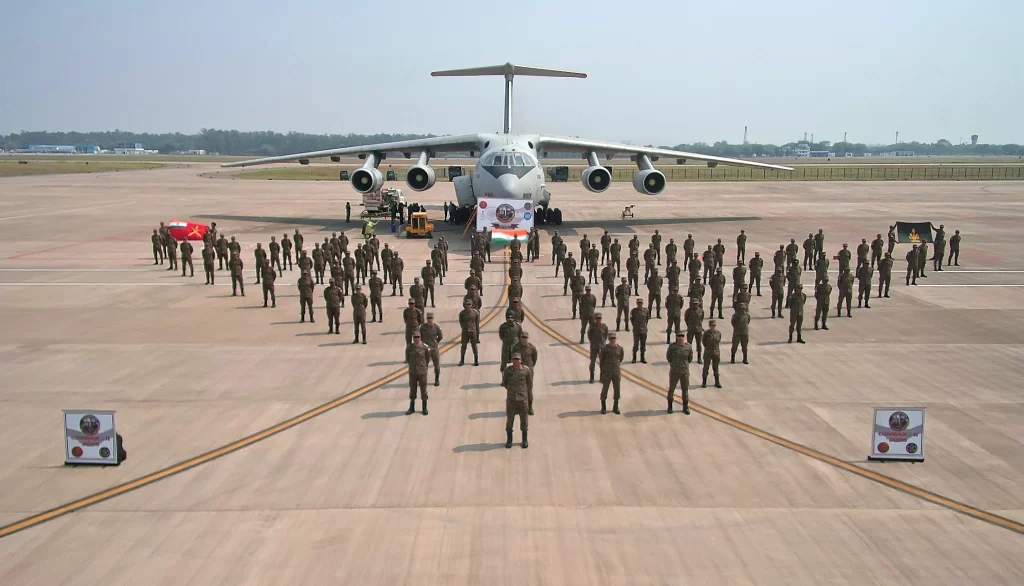
Troops from India and Cambodia got off to a flying start today in a crucial joint exercise that’s all about honing counter-terrorism skills. CINBAX-II 2026 kicked off its second edition at a training base in Cambodia, signifying stronger military ties between the two countries amid simmering security problems in Southeast Asia.
Exercise Launch and Logistics Support
The practice began May 4 at the Techo Sen Phnom Thom Mreas Training Centre in Kampong Speu Province, Cambodia. It concludes up May 17 enabling both sides two full weeks to practice scenarios that resemble real-world dangers.
Some 120 Indian soldiers, mainly from the Maratha Light Infantry Regiment, joined 160 members of the Royal Cambodian Army. This is a company level setup as per UN mandate chapter VII. Focus is sub-conventional ops in semi-urban areas. Imagine urban battle against terror groups.
Just a few days ago the Indian contingent had flown out and landed in Phnom Penh to a fanfare. Cambodian hosts welcomed the troops, with local media talking about how it builds on last year’s tabletop version.
Training Menu Highlights You’ll be getting your hands dirty here. Soldiers will train in drone operations, mortar firing and sniper tactics – abilities essential to today’s battlefields.
The main modules are:
Raids on populated areas for terrorism
Sharing intelligence and best practices from earlier operations
Big validation exercise at the end to test it all out.
This isn’t simply the drills. This is about getting in rhythm. Indian troops have experience from operations like those in Jammu and Kashmir while Cambodians have their own peacekeeping missions to draw from.
One officer off-record said the spot-on semi-urban approach is a welcome response to rising urban concerns globally. How can you fill the gaps in language and tactics in 14 days? That’s the real test for these guys.
Building on CINBAX-I Roots
This is round 2. The first CINBAX, a tabletop exercise with 20 troops per side, was held in Pune, India in December 2024. It was about countering terrorism, UN peacekeeping, hybrid warfare and logistics – laying down the foundations.
It was a small but clever Pune session, it was about strategy and not about boots on ground. CINBAX-II takes it to the next level, heading out to field training in Cambodia to put those talks into action.
Such progress demonstrates dedication. India-Cambodia defence ties have steadily grown, from rudimentary exchanges to these full-blown drills.
Defense links go deeper
India and Cambodia signed a deal against terror, organised crime and drugs in 2005. Since then it’s evolved, from goodwill visits by navy ships, to delivering medical equipment, to training Cambodian soldiers in demining.
It turned up the last several years. High-level army talks in Phnom Penh last month called for expanded exercises and training exchanges. India even aims to post a defense attache and open an office there, as well as make naval port calls like the one in Sihanoukville earlier this year.
Cambodia is embracing the diversification. Analysts believe it’s a careful transition away from China dependence, in keeping with India’s middle-power feel.
For India, it’s the Act East Policy in action, upgraded from Look East in 2014 to develop commercial and security connections across ASEAN. Cambodia is a gateway, assisting rebalance in the Indo-Pacific.
Why It Matters Now: The Regional Stakes
Southeast Asia ain’t no cakewalk. South China Sea tensions flare, territorial disputes challenge ASEAN unity. Terror organizations are on the prowl, hybrid threats combine old and modern combat and peacekeeping demands top expertise.
India’s “net security provider” push suits CINBAX-II. Think BrahMos missiles to Philippines or warship gifts to Vietnam. Hardware and drills to create a deterrence arc.
For Cambodia the scars after Khmer Rouge remain. Stability demands strong partners. The drill is about sharing India’s knowledge of fighting terror, which is very important because extremism is making a comeback in the region.
India’s angle? Closer ASEAN linkages, improved commercial routes, supply chains, a check on dominance plays. Last year, bilateral trade reached record levels, with defence as the glue.
Improved interoperability for combined ops
Fosters trust throughout global flux
Both countries support UN-style missions
What happens when these drills become multi-party formats? Could trigger greater ASEAN-India frameworks.
Troops Under the Lens
India: Maratha Light Infantry charges the front. This regiment is battle-hardened. Kargil, UN missions, you name it. Their grit matches the Cambodian spirit, tempered by a difficult history.
Royal Cambodian Army has home field advantage. They train in an air force connected site. So real terrain. Humid jungles bordering urban areas, great for semi-urban sims.
There were no serious hitches to report so yet. Social media films capture joint marches, gear checks—camaraderie rising rapidly.
Deeper India-Cambodia Ties
Defense is not a one man job. India backs infrastructure, capacity building and even renewable energy talks this April. Shared heritage—Angkor Wat’s origins in Hinduism are profound.
Tourism is a two-way street. Indians throng to the temples of Cambodia. Cambodians eye the tech hubs of India. Trade in pharmaceuticals, agriculture and textiles should develop steadily.
In Pune or Phnom Penh this is seen as a win-win. One Cambodian trainee last year said Indian methods were “practical, no fluff.” Echoes that sentiment here.
Challenges and Real Talk
Logistics test number one: heat, different kit, time zones. But that’s the thing—adapt or perish.
More generally ? Regional powers are watching. Nearby China’s Ream Naval Base raises eyebrows, although Cambodia says it’s multipurpose. India remains neutral, urges cooperation.
Diversity in techniques is helpful. India’s focus is on innovation like drones; Cambodia’s on local intelligence Mix them up? Hybrid battles for the gold.
Some critics may ask: Does this promote arms races? Organizers say no – only defensive, peace-focused.
Looking Forward Post-Drill
CINBAX-II concludes, prepare for lessons learned: better coordination, perhaps more exchanges. Next up could be navy or air drills.
India’s accelerating Act East – BIMSTEC inner circle for tight security nets. Cambodia obtains a stable partner, diversifying wisely.
This practice drives home a basic truth: Friends who train together stand strong in shaky times. Timely with ripples in South China Sea and shadows of dread, these ties seem. Such moves are vital for peace in the region. Will others join in?
India-Cambodia Joint Military Drill CINBAX-II 2026 Kicks Off: Strengthening Defence Ties in the Shadow of Regional Tensions