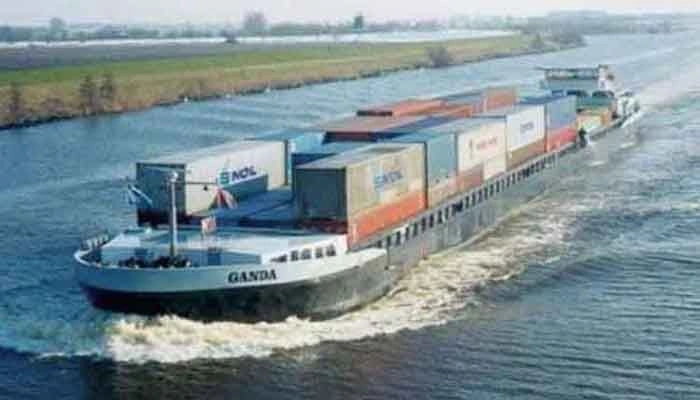
If you travel along the banks of the Ganga or the Brahmaputra you could notice something changing. It’s not just the scenery, it’s the very movement of products that is slowly but surely beginning to shift. The steady drone of trucks on highways and the rhythmic clatter of freight trains has been the heartbeat of India’s supply chain for decades. But with our logistics environment growing more congested and more aware of carbon, a far older, quieter option is getting a huge regulatory push: inland waterways.
Logistics in India is known well to often have a set of distinct issues. Congested roadways cause delays, while rail networks often face high demand and capacity limitations. Here, the government’s increased focus on using the country’s vast river network is not just about infrastructure; it is an economic imperative. The target is enormous – increasing the percentage of inland water transport from a meager 2 percent to 5 percent by 2030 – but its potential for greener, cheaper, more efficient freight transit is becoming hard to ignore.
The economic and environmental advantage
So why the sudden interest in rivers that have been running for thousands of years? The answer is straightforward economics and new environmental requirements. Inland waterways provide a compelling advantage at a time when corporations face huge pressure to optimise costs while satisfying tight ESG (environmental, social and governance) standards.
When you break down the numbers, the effectiveness of water transport becomes evident. Water transport has much lower operating costs per ton-kilometre than road and rail. While conveying the same cargo using a vehicle may cost around ₹2.58 per ton-km and a train ₹1.41, moving the same across inland waterways may cost around ₹1.06 to ₹1.20. These margins may look little in isolation but for big volume bulk industries like coal, cement and food grains, they translate into significant savings over time.
Beyond the balance sheet, there is the unmistakable carbon imprint. Barge transport uses significantly less fuel than the alternatives. The data shows that energy usage for water transport is quite low, at about 0.0048 liters per ton-kilometer, vs 0.0313 for road and 0.0089 for rail. With the logistics industry looking for ways to decarbonize, moving freight to the water is one of the most effective strategies ready for implementation.
Closing the Infrastructure Gap
Converting rivers into active freight arteries is more than water; it involves an elaborate network of infrastructure. This is where government’s “Jal Marg Vikas Project” enters into the picture. One of the main elements of the project is to ensure year-round navigability on the Ganga-Bhagirathi-Hooghly river system, for instance. This means continual dredging to maintain proper depth and width, and development of modern, well-equipped terminals.
It’s like establishing a freeway system, but in the water. This requires specialized terminals for fast loading and unloading and sophisticated navigational aids to allow safe movement of vessels, especially at night or in adverse weather. This is big engineering. The government has already invested billions, but the true challenge is in keeping this pace and ensuring these waterways are connected smoothly with the last-mile connection offered by roads and rail.
Have you ever asked yourself why we have not made better use of these natural roadways till now? Lack of good hinterland connectivity and the expensive cost of specialist vessels hindered the development of waterways for years. Current regulatory improvements such as the Inland Vessels Act, 2021 and new cargo promotion schemes are finally tackling these friction spots. The government are ripping back regulatory red tape and providing financial incentives for shippers and are laying a red carpet for private investment in terminals and jetty building.
Real World Impact and Integration
The change is already apparent in the figures. Recent fiscal years have brought record cargo quantities flowing on National Waterways. And it’s not just about hauling huge industrial goods either. The “Arth Ganga” scheme and similar initiatives are trying to revive local economies by linking farmers, craftsmen and small-scale producers directly to larger markets through river networks. It’s a holistic strategy that considers the river not just as a transport canal, but as an economic artery for the communities living along its banks.
To get a better feel for how this form of travel matches up, here’s a short glance at the operational efficiency:
Operating cost per ton-kilometer: Waterways (~₹1.06) are always lower than rail (~₹1.41) and road (~₹2.58).
Energy footprint: Barges on inland waterways use a fraction of the fuel, reducing the overall carbon cost per ton-mile.
Versatility: Waterways are ideal for transporting huge, outsized breakbulk shipments that would otherwise require expensive and sophisticated land-based logistical planning.
This transition doesn’t mean the elimination of trucks or trains. What we are looking at instead is a future of ‘multimodal logistics’. The actual power of a sophisticated supply chain is its capacity to pick the correct mode for the right task. Waterways will handle the heavy-duty, long-haul transportation while roads will still be the best solution for crucial last-mile distribution. It’s about developing a balanced system where each mode plays to its strengths.
Gazing at the Horizon
As we approach 2030, the route ahead is increasingly clearer. The success of this policy drive is in consistent implementation. Developing the necessary infrastructure, enticing more private sector partners to oversee operations, and ensuring that our river systems stay biologically healthy. There’s a thin line between corporate growth and environmental responsibility.
Could it be that in a few years we will cease to perceive the river as a barrier to be crossed, and see it as a main artery for the commodities we use everyday? The transformation is undoubtedly under process. With continuous dedication to modernization and focus on sustainable growth, inland waterways are ready to rewrite the logistics map. It’s not only about cheaper travel, it’s about constructing a more resilient and sustainable platform for the future of our economy. The rivers have apparently always been ready for this; we are now at last learning to employ them.
Guiding the Future: India’s Silent Shift to Waterway Logistics