
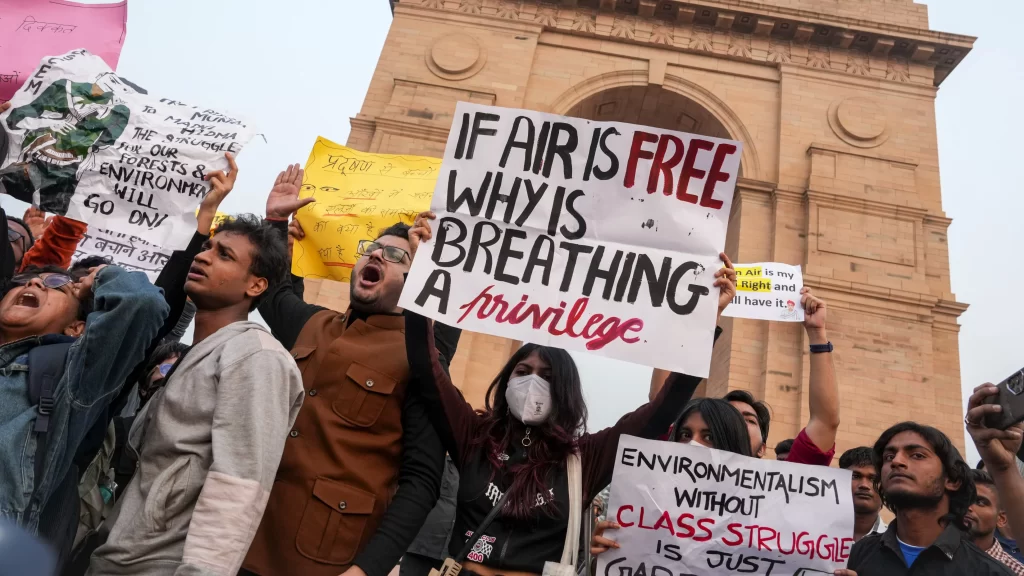
A protest against the worsening air quality at India Gate escalated into violence on Sunday evening, with demonstrators allegedly using chilli spray on police officers. The incident led to the arrest of 22 people and prompted a police investigation into the chanting of pro-Maoist slogans.
Protest Erupts Amid Public Health Crisis
The demonstration was organized by the Delhi Coordination Committee for Clean Air, which has repeatedly criticized the government’s response to Delhi’s smog-choked environment, calling existing measures “cosmetic” rather than structural. Protesters gathered at India Gate despite orders directing demonstrations to Jantar Mantar, citing the urgency of the air pollution crisis.
According to officials, the situation escalated when some demonstrators refused repeated police requests to step aside and allow ambulances and medical vehicles to pass. A crowd that broke through barricades and sat on the carriageway further intensified the standoff.
Violence and Arrests: Chilli Spray and Maoist Slogans
The confrontation turned physical when protesters allegedly used chilli spray against police personnel, causing eye and facial injuries to several officers, who were treated at a local hospital. In a rare occurrence, demonstrators reportedly employed irritants during a civic protest.
Adding a political dimension, a subgroup of protesters raised slogans in praise of Maoist commander Madvi Hidma, recently killed in a police encounter. Posters celebrating Hidma and chants like “Madvi Hidma Amar Rahe” (“Long Live Madvi Hidma”) were observed among the crowd. Police have launched an inquiry into how these slogans and posters became part of the demonstration.
Legal Action
Authorities have registered two separate FIRs, citing charges including obstruction of public servants, criminal force, and conspiracy. Police are also investigating the origin of the pro-Hidma slogans and posters.
Underlying Crisis: Pollution vs. Political Overtones
Organizers argue that Delhi’s deteriorating Air Quality Index (AQI) represents a severe public health emergency, criticizing temporary government measures such as sprinklers and cloud seeding for failing to address root causes. Observers note that the introduction of Maoist imagery politicized what began as an environmental protest, reflecting deeper frustrations among marginalized communities.
What Happens Next
- Police investigation: Authorities are identifying individuals who used chilli spray or displayed pro-Hidma slogans.
- Health concerns: Injured officers continue treatment, while activists warn of long-term risks from the city’s worsening air quality.
- Policy pressure: The incident may push the government to adopt more sustainable anti-pollution strategies beyond temporary fixes.

