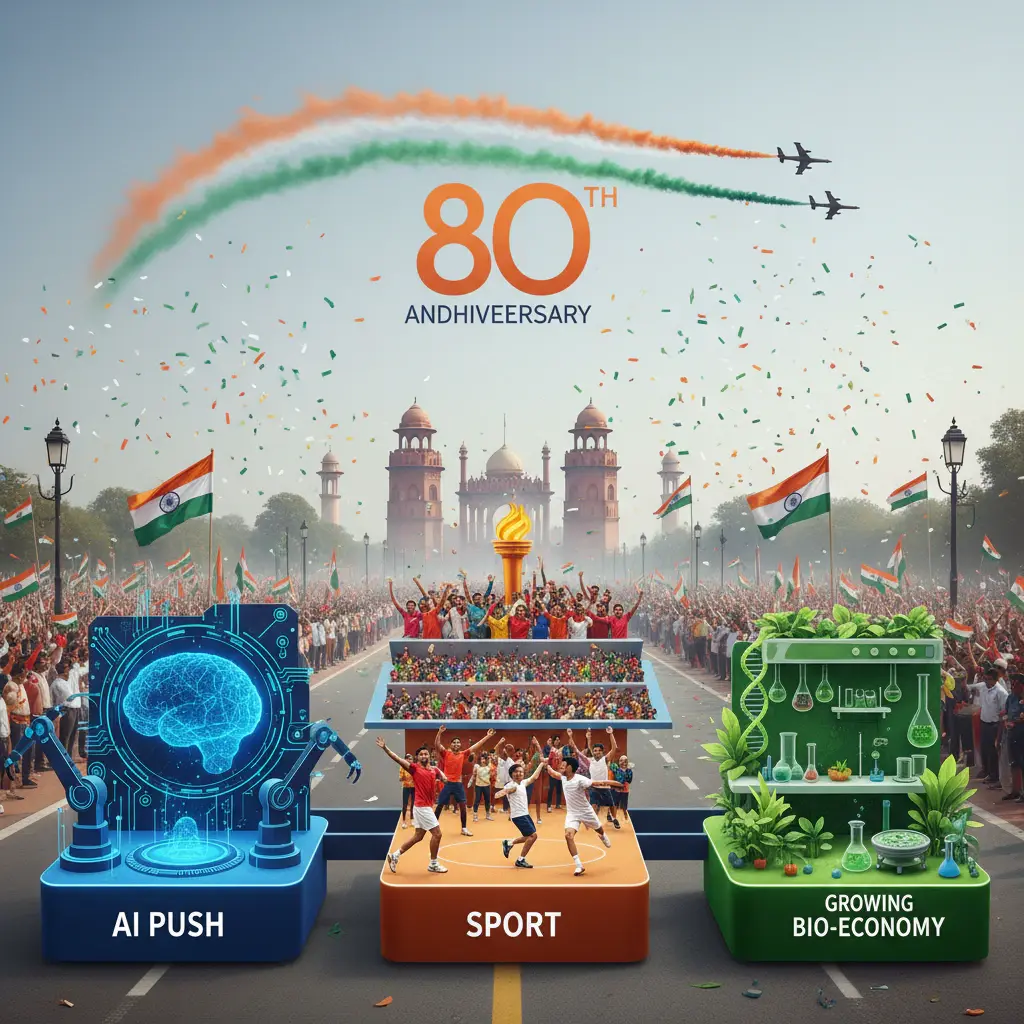
India woke up to a special kind of August 15 this year. The country celebrated its 80th Independence Day, and as has become tradition, Prime Minister Narendra Modi addressed the nation from the ramparts of the Red Fort in Delhi. It was his 13th consecutive Independence Day speech from that same spot, a record that now makes him the longest-serving non-Congress leader to deliver the address year after year. But beyond the ceremony and the flag hoisting, this year’s speech stood out for the scale of what was announced, especially when it comes to technology and the youth of the country.
A Massive Bet on AI Skills for the Youth
The headline from PM Modi’s Red Fort speech was undoubtedly the announcement around artificial intelligence. He said the government has resolved to train one crore, that’s 10 million, young Indians in AI skills over the next year. For a country that has long positioned itself as a hub for IT talent, this is a fairly bold next step. Modi framed it as essential groundwork so India doesn’t just consume AI technology built elsewhere but actually leads in the space.
The reasoning is simple enough. AI is moving fast globally, and countries that build a skilled workforce early tend to hold an edge for years. By putting numbers on the table, one crore youth in twelve months, the government is signaling that this isn’t just a talking point but an actual policy target with a timeline attached. Whether the rollout matches the ambition remains to be seen, since a program at this scale will need serious coordination across states, universities, and private training partners. Still, the intent lines up with India’s broader Viksit Bharat vision, the goal of turning the country into a developed nation by 2047, the 100th year of independence.
Interestingly, technology also played a visible role in the ceremony itself this year. The speech was live-translated into 22 Indian languages using an indigenous AI translation platform, letting people across the country follow along in their own tongue in real time. That was a small but telling detail, one that showed how the government wants to weave AI into the everyday fabric of governance and public life, not just talk about it in policy papers.
Getting Kids Into Sport Early The Prime Minister also announced a nationwide sports talent hunt for children aged between 5 and 15 years, along with the AI announcement. The idea here is to catch potential athletes early, before their formative years pass, and give them structured support and coaching pathways. India has often struggled to convert its population size into proportional success on the world sporting stage, and initiatives like this are meant to change that story over the coming decade. It fits into a pattern the government has followed before, using big national platforms like Independence Day to launch programs that are meant to play out over many years rather than deliver instant results.
The Bio-Economy Story
Another figure that stood out in the speech was about India’s bio-economy, the sector covering biotechnology, pharmaceuticals, agriculture-linked biology, and related industries. Modi pointed out that this sector has grown from around ₹60,000 crore before 2014 to nearly ₹20 lakh crore today. That’s a jump of more than 30 times in just over a decade, which is a genuinely striking number by any measure. It reflects investment in biotech research, a stronger pharmaceutical manufacturing base, and India’s growing role as a global supplier of vaccines and generic medicines. The Prime Minister used this as one more example of the country’s economic transformation story, alongside mentions of the Semiconductor Mission and India’s ambitions in nuclear energy and 6G testbeds.
The World Was Watching Too
India’s 80th Independence Day didn’t go unnoticed on the international stage. Several world leaders sent their congratulations, and among them was US Secretary of State Marco Rubio, who described the India-US relationship as stronger than ever. Messages like these matter more than they might seem at first glance. They’re a small but public signal of where the diplomatic relationship stands, especially at a time when India is trying to position itself as a serious player in AI, semiconductors, and global manufacturing, areas where partnerships with countries like the US carry real weight.
What This Independence Day Really Signals
Put together, this year’s Independence Day speech wasn’t just about looking back at 80 years of freedom. It was very clearly about looking ahead. The AI skilling push, the sports talent hunt for young children, and the bio-economy numbers all point toward the same underlying message: India wants its youth to be at the center of the next phase of growth. Whether it’s coding, biotech research, or competing on a sports field, the government’s framing this year was less about nostalgia and more about building capacity for the next 25 years, right up to India’s centenary of independence in 2047.
For a country of well over a billion people, the challenge will always be in execution rather than ambition. But if even a fraction of these announcements translate into real programs on the ground, this 80th Independence Day could end up being remembered as a genuine turning point rather than just another speech from the Red Fort.
India Marks 80th Independence Day With a Big Push Toward AI, Sport, and a Growing Bio-Economy