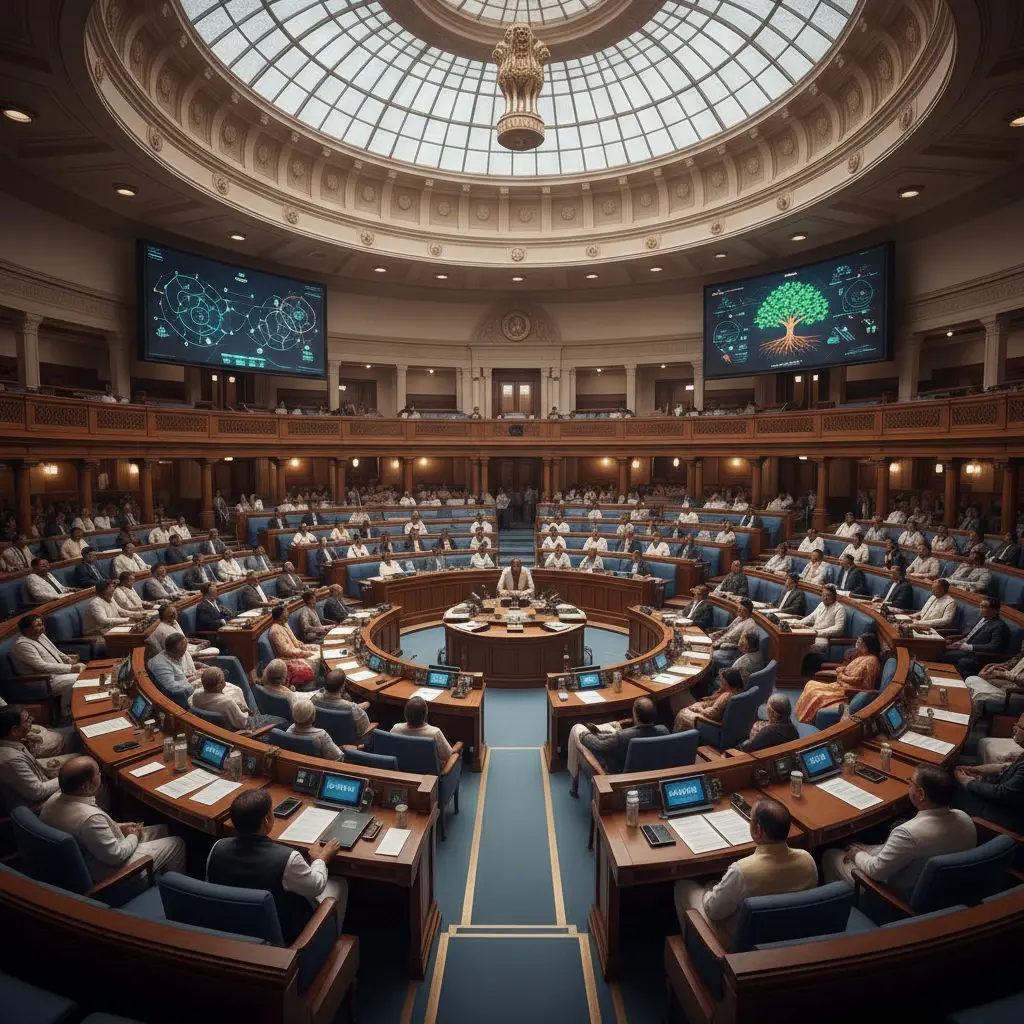
Not all elections in India are proclaimed with the roar of rallies, campaign posters and prime time debates. Some happen quietly, inside state assembly buildings, decided by MLAs rather than the general public. That’s exactly what’s been playing out through much of 2026, as India works its way through the routine six-year Rajya Sabha election cycle. It’s not the sort of story that makes headlines the way a general election does but its effect on Indian politics is just as real, and in some ways, more lasting.
What’s Really Happening
The Rajya Sabha, the upper house of parliament, does not get dissolved and re-elected at one go like the Lok Sabha. Instead, roughly a third of its members retire every two years, and elections are held to fill those seats. This year’s cycle covers 72 of the House’s 245 seats, spread out across a series of election rounds running from March all the way through November 2026.
The first big round of polling happened in March, when the Election Commission opened up 37 seats across ten states, including Maharashtra, Odisha, Bihar, Tamil Nadu, West Bengal, and several others. In most of these states, the number of candidates matched the number of open seats after nominations closed, meaning those MPs were declared elected without any actual voting taking place. Maharashtra’s seven seats were settled this way. But in Odisha, Bihar, and Haryana, there were more candidates than seats, so those states saw real contests decided by MLA votes.
A second round followed in June, covering 27 more seats in states like Gujarat, Rajasthan, Karnataka, Madhya Pradesh, Jharkhand, and a handful of the northeastern states. And more rounds are expected before the cycle wraps up later in the year, ahead of the Winter Session of Parliament.
The Odisha Contest Worth Watching
Of all the state legislature MLA votes cast so far, Odisha’s turned out to be one of the more dramatic. Four seats were up for grabs, and five candidates were in the fray, which meant an actual contest rather than an unopposed win. The BJP fielded its state president Manmohan Samal and sitting MP Sujeet Kumar, while former Union Minister Dilip Ray ran as an Independent with BJP backing. On the other side, the BJD nominated its own leader Santrupta Mishra, while Dr. Datteswar Hota stood as a common candidate backed jointly by the BJD, Congress, and CPI(M).
When the votes were counted, Samal and Kumar won their seats comfortably as BJP nominees. Santrupta Mishra also came through for the BJD, keeping the regional party’s presence in the upper house intact. But the real surprise was Dilip Ray’s win as an Independent, which came after a number of BJD and Congress MLAs reportedly cross-voted in his favor, defying their own party’s official position. Cross-voting like this doesn’t happen often in India Parliament news, and when it does, it tends to say something about internal cracks or shifting loyalties within a party that don’t always show up in public statements.
Why This Matters Beyond the Numbers
It’s easy to treat Rajya Sabha elections as a technical, almost bureaucratic exercise, since most seats simply confirm whatever the ruling party in a state already controls through its assembly strength. But the composition of the upper house genuinely affects how easily the central government can move legislation. Unlike the Lok Sabha, where a party with a majority can usually push bills through, the Rajya Sabha often forces coalition-building and negotiation, especially on contested policy matters. A shift of even a handful of seats can change how difficult, or how easy, it becomes to pass a bill.
That’s part of why this year’s cycle is being watched closely ahead of the Winter Session of Parliament. With state-level power balances shifting in places like Maharashtra and Odisha since the last full Rajya Sabha cycle, the fresh set of MPs will shape debates on everything from economic legislation to constitutional amendments over the next six years.
What Comes Next
With the March and June rounds behind us, the remaining seats in this year’s cycle will be filled through further biennial elections stretching into November. Each round tends to follow a similar rhythm: nominations, a short campaign period focused entirely on winning over MLAs rather than voters, and then either an unopposed declaration or a tense floor vote depending on how the numbers stack up in that state’s assembly.
For a country used to the spectacle of full-scale general elections, the Rajya Sabha process can feel almost understated by comparison. There are no long queues at polling booths, no exit polls, no dramatic television coverage on counting day. Yet by the time this cycle finishes later in the year, it will have quietly reshaped a good chunk of the upper house, setting the stage for how the next phase of India Parliament news, and the legislative battles that come with it, will play out through the Winter Session and beyond.