
July 22, 2025 —
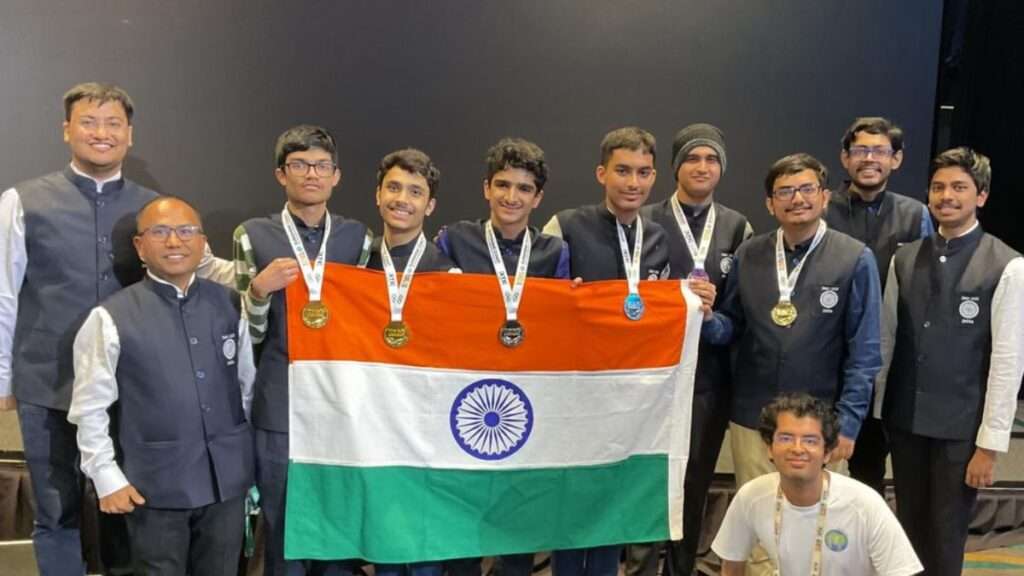
India has achieved its highest-ever ranking at the prestigious International Physics Olympiad (IPhO) 2025, securing the 7th position globally with a record total score of 193 out of 252 points. This remarkable performance reflects a significant surge in the country’s academic excellence in physics and showcases the growing strength of Indian students on the global scientific stage.
Held this year in Bucharest, Romania, the 2025 edition of the IPhO witnessed participation from over 90 countries. The five-member Indian team delivered a stellar performance, winning three gold and two silver medals. This marks one of India’s best medal hauls at the event in recent years.
Since making its debut at the IPhO in 1989, India has steadily improved its standing, winning a total of 23 gold medals. Notably, 12 of these have come between 2019 and 2025, including nine in just the last three years. The consistent improvement underscores the country’s growing emphasis on STEM (Science, Technology, Engineering, and Mathematics) education and talent development.
The Indian contingent was selected and trained by the Homi Bhabha Centre for Science Education (HBCSE), which conducts the rigorous multi-stage Olympiad program. Students go through the National Standard Examination in Physics (NSEP), the Indian National Physics Olympiad (INPhO), and a series of training camps before making it to the international stage.
“This is a proud moment for India. The outstanding performance of our students at IPhO 2025 highlights not only their hard work but also the effectiveness of the academic and training systems that support them,” said a statement from HBCSE.
India’s total score of 193 points is its highest to date and placed it ahead of countries such as Germany, Japan, and South Korea. China, Russia, and the United States topped the global rankings this year.
Educational experts believe India’s success can be attributed to increased government focus on nurturing young scientific talent through initiatives like the Atal Innovation Mission, National Talent Search Examination (NTSE), and enhanced support for Olympiad programs across the country.
“This achievement reinforces the importance of continued investment in early-stage scientific education. It sets a benchmark and creates motivation for the next generation of Indian students,” said Dr. Anjali Mehta, a senior physics educator and Olympiad mentor.
The International Physics Olympiad is widely regarded as one of the most challenging global competitions for high school students. It tests participants’ problem-solving abilities through demanding theoretical and experimental physics problems.
With this year’s performance, India has not only demonstrated its growing academic prowess but also strengthened its position as a rising global leader in science and education.

