
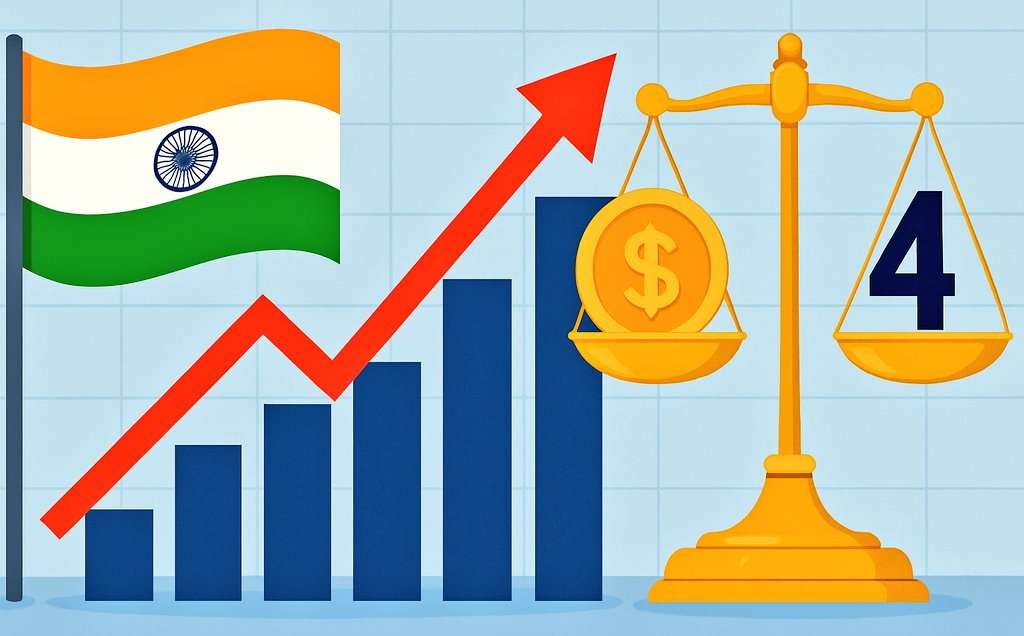
8 July, 2025-India has been ranked fourth in the world for income equality, according to a recent report by the World Bank titled Global Income Distribution 2025. The report shows a significant improvement in the country’s income distribution, driven by focused economic reforms and inclusive welfare programs over the past several years.
The study uses the Gini coefficient—an international standard for measuring income inequality—where a lower score reflects more equal income distribution. India achieved a Gini score of 0.27 this year, marking its most equal distribution in more than two decades. This result places India just behind Slovenia, Norway, and the Czech Republic, and ahead of many developed economies.
The World Bank attributes this positive shift to multiple government initiatives aimed at promoting inclusive growth. Key contributing factors include the expansion of direct benefit transfers, stronger rural employment schemes like MGNREGA, increased investment in public health and education, and minimum wage hikes. The growth of digital infrastructure has also played a pivotal role, especially in extending financial and government services to rural and low-income communities.
The report emphasizes that income growth for the bottom 40% of the population has outpaced that of the top 10%, indicating a more balanced economic development pattern. It further notes that the formalization of the economy, led by the implementation of the Goods and Services Tax (GST) and the rise of digital payment platforms, has helped streamline income flows and improve accountability.
In contrast to India’s improvement, many high-income countries have shown a widening wealth gap. Nations such as the United States and the United Kingdom continue to record higher Gini coefficients, reflecting greater income inequality. The World Bank suggests that India’s progress could serve as a case study for other emerging economies aiming for equitable growth.
Despite the positive outlook, the report outlines ongoing challenges. A large portion of India’s workforce remains in the informal sector, where access to stable income and social security is still limited. Additionally, economic disparities between states continue to pose barriers to achieving uniform progress.
Experts believe that while the current trajectory is promising, continued efforts will be essential to maintain momentum. Concerns such as inflation, global economic instability, and the impact of climate change could potentially hinder future gains in income equality.
The World Bank concluded that India’s economic policies are moving in the right direction, fostering not just growth but fairness. Sustained investment in social welfare, digital access, and job security will be crucial to ensure long-term, inclusive development.

