A new era is beginning in the middle of India’s huge farmlands, where monsoon rains and uncertain weather have long determined a farmer’s fate. Earlier this week, on a clear morning, the government announced the Digital Agriculture Mission. This marks a significant leap forward in integrating AI, drones, and data analytics into the everyday routines of over 140 million farmers. This isn’t just another initiative; it’s a vital support system designed to boost crop yields by 20–30%, reduce input costs, and deliver real-time information directly to cellphones in remote areas. The goal directly addresses India’s food security and rural economy, given that agriculture continues to employ roughly half of the country’s workforce and contributes 18% to GDP. The outlook is grim. Farmers are currently weathering a perfect storm.
The Digital Agriculture Mission, with its hefty Rs 2,817 crore allocation spread across three years, is an evolution of earlier initiatives such as the Agri Stack and the Krishi Decision Support System. This undertaking is part of the larger Amrit Kaal vision for 2047, which aims to make India a $5 trillion economy, with agriculture at its core. Union Agriculture Minister Shivraj Singh Chouhan presented the plan in New Delhi, highlighting how digital technologies could fundamentally change the lives of farmers.
The mission’s core unfolds in two distinct phases. Initially, the aim is to create a comprehensive database of farmers—think of it as an Aadhaar-like system, but for farms. This database will link soil health certificates, crop surveys, and market data.
By 2027, all farmers should be able to get tailored advice using apps like Kisan e-Mitra. In phase two, more hardware is added, such as 15,000 drones for precise spraying and mapping of soil, AI models that predict pest outbreaks, and satellite images for keeping an eye on crops.
Farmers in Maharashtra’s Vidarbha region, which had a lot of problems with cotton crops last year, are already testing prototypes. One pilot in Nagpur used drone pictures to find soybean areas that were stressed for water, which saved 15% on irrigation. “It’s like having an expert in your pocket,” says Raghunath Patil, a 55-year-old farmer from the area. His story shows how the mission goes beyond paperwork to real-world tech that can be used.
Smart Crops: The Brain Behind AI and Data Analytics
Imagine this: an AI program looks at satellite data all night and sends you a message at dawn: “Put 20 kg of urea here, skip there.” That’s what the mission’s AI backbone promises. India is adapting global models like the US’s John Deere AI and Israel’s precision ag tech for its own crops, such rice, wheat, and millets.
Some important parts are:
Crop Yield Prediction Models: These models use machine learning on 10 years of weather and harvest data to make predictions that are 85% accurate. In Punjab’s wheat belt, early tests suggested that farmers changed when they planted their crops to avoid rains that weren’t supposed to happen.
Soil Health Analytics: More than 20 crore soil samples have been digitized so far. AI now cross-references these with micronutrient needs, which cuts down on fertilizer consumption by 10–15%.
Pest and disease alerts are becoming increasingly sophisticated. Computer vision software, for instance, can identify threats in images with a speed that surpasses even the most experienced extension officer. Consider the detection of leaf blight on paddy crops; the software can pinpoint this issue rapidly and accurately.
Data flows in from IoT devices scattered across farms, weather stations, and even mandis.
The National Crop Forecast Centre will grow and use blockchain to make supply chains more open. This means that smallholders, who make up 86% of farmers, will have to compete with giant agribusinesses. But there are problems ahead: barely 40% of people in rural areas have smartphones. The mission responds with offline modes and voice assistants that work in Hindi, Marathi, and other regional languages.
What happens if a farmer in Bihar doesn’t pay attention to the alert?
Drones Fly: Eyes in the Sky for India’s Fields
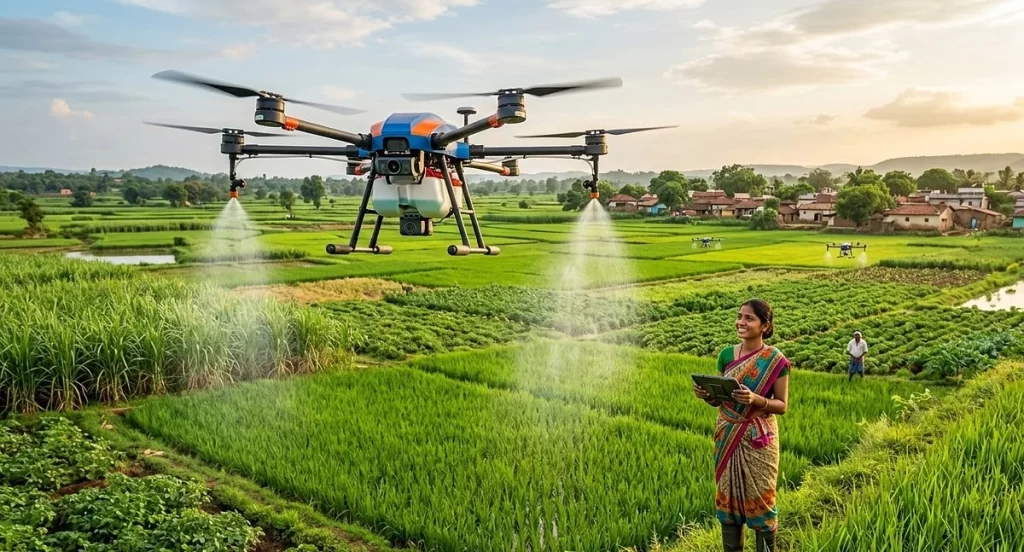
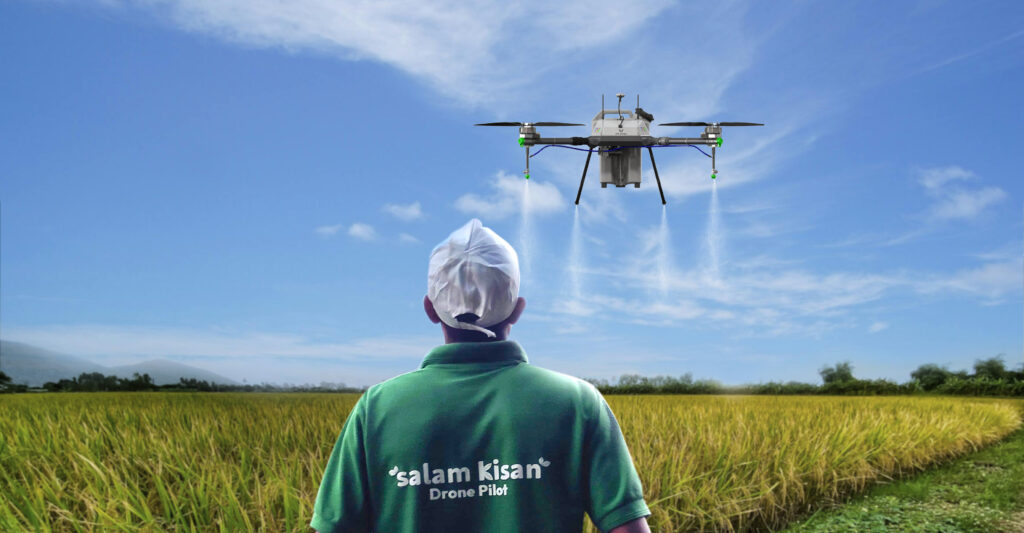
Drones aren’t just for science fiction anymore. They’re flying above cotton crops in Gujarat, spraying pesticides with precision accuracy. The plan sets aside money for 5,000 high-end devices at first and trains 10,000 “drone didis” (woman operators) to give rural women more control.
The benefits add up quickly:
Precision Spraying cuts chemical consumption by 30%, which is important because groundwater is running out.
Field Mapping: Multispectral cameras can find nutritional gaps that the human eye can’t see.
Monitoring in Real Time: Last year, post-monsoon flood assessments in Assam rescued rice harvests worth Rs 500 crore.
In 2021, India’s drone restrictions become a little less strict, but scaling is still hard. The goal of partnerships with firms like IoTechWorld and Garuda Aerospace is to put 1 lakh drones in the air by 2026. In Rajasthan’s dry areas, tests used thermal imaging to map groundwater and help with borewell digs. How much? A single drone service cuts the cost of pesticides from Rs 1,500 to Rs 800 per acre.
But skeptics object to logistics: charging stations in communities with a lot of dust? The idea calls for hubs that run on solar electricity. And regulatory nods make sure the skies are safe, even as flight traffic increases.
Real-World Impact: From the Farm to the World Market
When you look at the big picture, the mission fits with India’s goals for exports. In 2024, agri-exports reached $53 billion. Digital tools might help that number reach $100 billion by making logistics more efficient. Last summer, there were too much tomatoes in Maharashtra. AI market links may have sent the extra tomatoes to processors, which would have kept prices stable.
India joins global leaders like China (which has 1 million ag drones) and the EU’s Farm-to-Fork digital agenda. But made to fit India’s size: 146 million hectares of land are farmed, and the average holding is only 1.08 hectares.
Ground reports give a clear picture. A cooperative in Telangana used data analytics to switch to high-yield basmati, which brought in 25% more money. Early warnings helped Tamil Nadu’s delta farmers avoid harm from the hurricane. Even tribal communities in Odisha get advice on how to grow millet, which is in line with the UN’s goal of ending hunger.
This means that the cost of vegetables will be more stable and the food will be safer for people who live in cities. Did you ever wonder why the onions at your local sabzi vendor went up last Diwali? Digital missions like this one try to make the shocks less harsh.
India Starts Digital Agriculture Mission: AI, Drones, and Data Will Change Farming for Millions