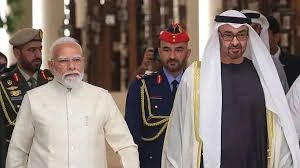
In what many observers are calling a watershed moment for India’s energy security architecture, Prime Minister Narendra Modi’s brief but high-stakes visit in Abu Dhabi last Friday generated agreements that went beyond diplomatic pleasantries. India and the United Arab Emirates have signed a landmark memorandum of understanding that will allow Abu Dhabi National Oil Company (ADNOC) to store up to 30 million barrels of crude oil in India’s Strategic Petroleum Reserve (SPR) facilities – a deal that carries huge weight at a time when the Gulf region is burning with conflict.
The agreement, signed by Indian Strategic Petroleum Reserves Limited (ISPRL) and ADNOC, is a substantial deepening of a collaboration that has been quietly growing over the past decade. Separately, Indian Oil Corporation Limited (IOCL) and ADNOC signed a strategic collaboration agreement to explore long-term liquefied petroleum gas (LPG) supply arrangements. During the visit, six agreements were inked. The UAE also promised to spend $5 billion in India. It was a brief visit by any standards, but it was certainly a memorable one.
— ### The Time Is Ripe
To understand why this trade matters, you need to look at the globe – and then the news.
The Strait of Hormuz is a small channel that, at its narrowest point, is only 21 miles wide, and transports between 20 and 21 million barrels of crude oil a day. That is roughly one-quarter of all the seaborne oil traffic in the globe. The Strait is not only a trading route for India, a country that imports over 89 percent of its crude oil needs – it is an economic lifeline. And right now, that lifeline is under real duress.
The deepening Iran-US-Israel crisis that has consumed West Asia through 2026 has put global oil markets into near-panic. Oil-importing economies have been roiled by the spike in oil prices from roughly $70 a barrel in February to nearly $120 in March. India felt it keenly. Historically, almost 85% of India’s crude oil imports have come through the Strait of Hormuz. Some 90 percent of its LPG supplies, the cooking gas that fuels millions of Indian kitchens, also travel over the same corridor.
So when Modi last Friday got down with UAE President Sheikh Mohamed bin Zayed Al Nahyan, the stakes on the table were not abstract policy ambitions. It was grocery bills, travel costs and the sort of knock-on inflation that every household feels.
— ## The Actual Deal
The arrangement with the Indian government also grants ADNOC the right to store crude oil at current facilities in Visakhapatnam, Andhra Pradesh, and upcoming reserve projects being built at Chandikhol in Odisha. The accord also opens the door for India to store its own crude reserves at Fujairah in the UAE – a clever reciprocal move that might give India a foothold in Gulf storage infrastructure closer to its suppliers.
This is not ADNOC’s first foray into India’s underground caverns. The company struck an arrangement with ISPRL in 2017 and became the first foreign company to store crude in India’s SPR in 2018. The previous arrangement provided ADNOC with access to the 750 TMT-capacity Cavern-A plant at Mangaluru. The new deal is a major enlargement of that partnership, in terms of both scale and scope.
The strategic smartness here is the shared gain. India gets a share of its reserves from a reputable Gulf partner without having to bear all the capital expenditures itself. ADNOC gains safe, geographically diverse storage outside the Gulf, a buffer that becomes more valuable if access to Hormuz is interrupted. Both parties are hedging their bets. This is the kind of setup that sounds complex until you comprehend it may be the difference between energy stability and a national fuel crisis.
Of equal importance is the agreement on the delivery of LPG. The UAE already supplies around 40 per cent of India’s LPG imports. The new IOCL-ADNOC agreement is meant to place that supply on a long-term, structured footing — lowering India’s exposure to spot-market volatility and providing a more reliable pipeline of cooking fuel to millions of Indian homes.
— ## India’s SPR: Its Current Status
India has strategic petroleum reserves in underground rock caverns at Visakhapatnam in Andhra Pradesh and Mangaluru and Padur in Karnataka with a capacity of about 5.33 million metric tonnes. The country’s overall crude oil and petroleum storage capacity, including commercial refinery stockpiles held by oil marketing organizations, is at a level equivalent to some 74 days of domestic consumption. The government had also approved two further facilities in 2021 – a 4 MMT project at Chandikhol and a 2.5 MMT extension at Padur. Construction work on the Padur expansion was awarded as recently as October 2025. In April 2026, the Chandikhol project was also further fast-tracked as part of India’s emergency reaction to the West Asia issue.
74 days is enough? That depends on whoever you ask. The International Energy Agency recommends that large energy-importing nations have at least 90 days of net import insurance. India still trails that standard. China, by contrast, has an estimated 1.2 billion to 1.3 billion barrels, or several months worth of use. The difference is large and the present crisis has made it impossible to overlook.
India has secured crude oil supplies for the next 60 days and has around 60 days of LNG reserves, including nearly 45 days of LPG inventories, Petroleum Minister Hardeep Singh Puri said in May 2026. Reassuring, undoubtedly — but not a long-term answer in the event of a lengthy disruption of the Strait of Hormuz.
— #UAE Gamble in Fujairah
We should also examine another piece of the puzzle. At the same time as the signing ceremony in Abu Dhabi, the UAE also revealed that it will speed up the development of its West-East Pipeline, a project that seeks to boost crude export capacity through the Port of Fujairah, totally circumventing the Strait of Hormuz. On the same day that Modi visited, UAE President Sheikh Mohamed bin Zayed Al Nahyan directed ADNOC to speed up the project during an executive committee meeting.
The Abu Dhabi pipeline now stretches 406 km from the landlocked Habshan terminal to Fujairah on the Gulf of Oman coast, with a throughput capacity of between 1.5 and 1.8 million barrels a day. The UAE can produce 4.85 million barrels per day, freed lately from OPEC+ output constraints after the country made a high-profile withdrawal from the organization. The plan to quadruple or enhance this bypass capacity by 2027 would enable significantly more oil to load at Fujairah, including supplies bound for India, without ever transiting the strait.
For India, which uses some 5.5 million barrels of oil a day, this is more than just an interesting piece of infrastructural news. Enhanced export capacity from Fujairah will allow India to obtain UAE crude even in a Hormuz crisis. Add in the potential to house Indian reserves in Fujairah under the new SPR agreement and you have the ingredients for a real bypass strategy, one that could partially insulate India’s oil supply from the worst-case scenario that everyone in the energy sector is quietly fretting over right now.
— ### Beyond Oil: A Wider Strategic Partnership
It would be wrong to read this visit as only about petroleum. The deals inked in Abu Dhabi span a far broader canvas – defence, shipping, artificial intelligence, maritime talent development and infrastructure finance.
We signed a Framework for Strategic Defence Partnership embracing defence industry collaboration, advanced technology, marine security, cyber defence, special operations and interoperability. India’s marine ambitions also received a boost: Cochin Shipyard Limited signed agreements with Dubai-based Drydocks World for a ship repair cluster at Vadinar under India’s marine Development Fund Scheme. In a move that positions India as a serious participant in a sector it has long desired to dominate, Cochin Shipyard and Drydocks World have joined up with a Centre of Excellence in Maritime and Shipbuilding to enter into a tripartite partnership for training trained workers for global shipbuilding operations.
On the investing side, Emirates NBD disclosed a potential $3 billion stake in RBL Bank. The Abu Dhabi Investment Authority said it will invest up to $1 billion in Indian infrastructure, in conjunction with the National Infrastructure and Investment Fund. International Holding Company has injected an additional $1 billion into Sammaan Capital. $5 billion of UAE wealth flowing into Indian markets on a single diplomatic stay.
Modi called the visit “short but incredibly productive”. That may be an understatement.
— ## What this means for the average Indian
The honest issue that most policy conversations duck is: will any of this truly bring down the price of petrol or LPG cylinders at the local pump?
The short answer is — not right away. Energy industry acquisitions of this magnitude take years to close, not weeks. The LPG supply deal will take time to turn into contracts and shipments. The SPR extension at Chandikhol is not going to be ready over night. And the forces far beyond India’s control — the daily calculus of violence in the Gulf, for example — are still setting global crude prices.
What these accords do, and this is vital, is to lessen India’s structural vulnerability to future shocks. ADNOC’s long-term LPG supply deal guarantees fewer price jumps on cooking gas during times of regional turmoil. If oil imports are disrupted, more crude stockpiled in Indian underground caves equals greater breathing space. It’s not a remedy. It’s a cushion. And buffers are quite important right now.
The West Asia crisis pushed prices up and India’s oil marketing firms (OMCs) — IOCL, BPCL and HPCL — were already experiencing losses of almost Rs 30,000 crore a month. The government had earlier this year increased fuel and diesel by Rs 3 a litre. The pinch on household budgets is significant and persistent. Any deal that brings some certainty to supply – even in the long term – takes some of that strain off.
— ## The Big Picture: India’s Changing Energy Diplomacy
Step back, and you find a country grappling — sometimes brutally — with what it means to be a big oil importer in a world of crumbling relationships. India has long tried to walk a tightrope: buy inexpensive Russian crude while safeguarding Gulf ties, diversify supplies while keeping costs down, pursue renewable energy objectives while remaining highly reliant on fossil fuels.
The 2026 West Asia crisis has demonstrated the limits of that method in ways that could not be papered over. India has responded with an energetic pragmatism – rushing to expand SPR, diversifying into US, Brazilian and Argentinian supplies, providing naval escorts through Operation Sankalp, and now expanding the UAE alliance in the most concrete manner conceivable.
The Abu Dhabi deal is part of a bigger recalibration. India is no longer merely dealing with energy dependency. It is striving to create resilience in its supply architecture, one agreement at a time. It is also cementing ties with a Gulf partner that has decided to leave OPEC+, freeing itself to pump more oil without cartel-imposed limits. This meeting of interests — India needing more supply, the UAE needing more customers — sets the conditions for a truly lasting alliance.
— ## Looking Forward
It will be telling over the following few months. We will be keeping a careful eye on the construction timetables at Chandikhol and the expansion of Fujairah pipeline. “The LPG supply arrangement between IOCL and ADNOC will have to be turned into binding contracts with real delivery schedules.” And the bigger question of India bridging the gap to IEA’s 90-day reserve standard is still unresolved.
It is evident that India and the UAE have decided to enhance their partnership at the very moment when it is most difficult and most needed – with West Asia in turmoil, global energy markets in flux and the Strait of Hormuz casting a long shadow over both economies. The center of this arrangement is 30 million barrels. But these are not simply barrels of oil. They are a joint gamble that two countries, with wildly different geographies but increasingly shared interests, can build something together that is more resilient than either could construct alone.
The success of that bet will depend on execution, diplomacy and developments neither side can fully control. But the contract is done, the signature is on paper and for India’s energy planners it is — for now — something to build on.
—
India, UAE Sign Historic Energy Pact: How 30 Million Barrels of Oil Could Redefine India’s Strategic Security