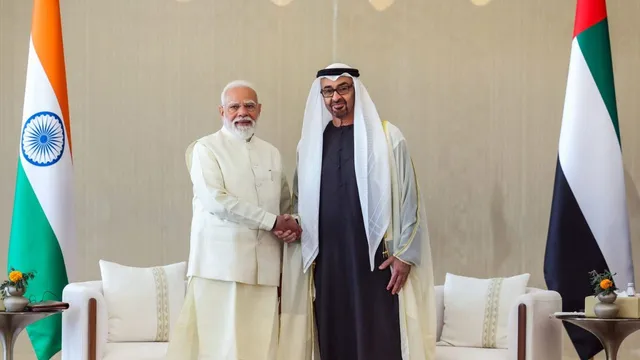
Prime Minister Narendra Modi’s stay in Abu Dhabi on Friday was described as a short layover before he flies to the Netherlands as part of a five-nation diplomatic tour. from what transpired in those few hours was anything from regular. Six landmark agreements, a promise of $5 billion of investments and a framework for a strategic defence relationship. All signed in the shadow of the most disruptive energy crisis the world has seen since the 1970s. The message from India and the UAE was clear: in a region on fire, the two countries are going all-in on each other.
The high-stakes meeting between Modi and President of the UAE, Sheikh Mohamed bin Zayed Al Nahyan — known commonly as MBZ — came at a time when India’s energy security is under tremendous strain. The West Asian crisis, ignited by the US-Israel military assault against Iran in late February 2026, has shut the Strait of Hormuz, one of the world’s most crucial maritime chokepoints. The fallout has been devastating for India. India, the world’s third-largest oil importer, with almost 90 percent of its crude coming from abroad and roughly half of it historically flowing via the Strait, has scrambled to stabilize gasoline supply and protect its economy from the shock.
— ## The Crisis That Made This Meeting Necessary
You have to know the gravity of the challenge India is facing today to appreciate why this visit to Abu Dhabi was so important. Since early March 2026, the 34-kilometre-wide waterway between Iran and Oman, the Strait of Hormuz, has been fully blockaded after Iranian forces declared it blocked and began targeting commercial vessels attempting to traverse the channel. This is the biggest supply interruption the world oil market has ever seen, said the International Energy Agency. That is no exaggeration.
Brent crude, which was trading at roughly $80 a barrel when the fighting began, has subsequently soared to around $108. India’s oil marketing corporations were losing up to ₹1,000 crore a day for a while, while the government maintained retail fuel prices artificially low to protect consumers. The rupee fell to fresh lows. Foreign investors withdrew about $20 billion from Indian equities in the first four months of 2026. And India’s GDP growth estimate for fiscal year 2026-27 has been reduced to 6.7 percent from 7.7 percent last year.
The crunch came when the government eventually hiked petrol and diesel prices by almost 3 percent, one of the last big economies to pass on the higher cost of oil to consumers. It was a hard but necessary call. India had been living on its stockpiles, diverting LPG from industry to households and acquiring oil through other channels whenever it could. The crisis, in short, rendered the Modi-MBZ dialogue diplomatically vital and economically imperative.
— ## Six Agreements, One Loud Signal
The six pacts agreed in Abu Dhabi span a vast strategic territory. The centrepiece was a Memorandum of Understanding between Indian Strategic Petroleum Reserves Limited (ISPRL) and Abu Dhabi National Oil Company (ADNOC) – a deal that could significantly change India’s emergency energy readiness.
Under the deal, ADNOC can store up to **30 million barrels of crude oil** in India’s strategic petroleum reserve facilities including in Visakhapatnam in Andhra Pradesh and the upcoming Chandikhol site in Odisha. But the surprise that jumps out is that the pact also includes the storage of Indian crude reserves in Fujairah, UAE, allowing New Delhi access to oil inventories positioned fully beyond the Strait of Hormuz. Given the situation, this is a major hedge.
ADNOC is already the sole foreign organization that can hold crude in India’s strategic reserves and this new deal extends that connection and raises the ceiling on UAE participation dramatically.
The second is an energy accord between Indian Oil Corporation Ltd (IOCL) and ADNOC Gas on long-term arrangements for the supply of LPG. LPG is not just a commodity in India; it is a lifeline for hundreds of millions of homes that rely on it for cooking. LPG supply disruptions have immediate social implications. The accord also opens the door for cooperation on LNG and LPG storage infrastructure within India, which might minimize the country’s reliance on spot purchases in future crises.
The LPG contract also comes alongside another development: The UAE stated it will speed the construction of a new pipeline that will boost its capacity to export oil and LPG via the Port of Fujairah by 2027, bypassing the Strait of Hormuz altogether. There is already a 406-kilometre pipeline from Abu Dhabi’s oil fields to Habshan and then to Fujairah which provides a partial bypass route, but the enhanced capacity will enable a lot more vessels, including ships hired by India, to transport supplies away from the crisis zone.
— ## A Defence Partnership Beyond the Paper
The energy deals garnered the most immediate notice, but the defence contract struck during the visit merits equal emphasis. The Framework for Strategic Defence Partnership between India and the UAE is an all-encompassing agreement that goes much beyond the vague wording of collaboration that such agreements usually contain.
The two countries have agreed to deepen **defence industrial collaboration**, look into **joint development of military hardware**, and extend cooperation on advanced technology, cybersecurity, maritime security and secure communications, according to official announcements. There are provisions for improved military training and joint exercises, as well as interoperability – meaning the two forces collaborating to ensure their systems and procedures can work together when needed.
Is this the start of something that looks more like a formal military alliance? Not in the conventional sense, probably. But it is a clear declaration of strategic intent from both sides and builds on the already rapidly growing defence partnership between New Delhi and Abu Dhabi. Officials characterize the accord as “institutionalising” that connection – taking it from warm political goodwill to structured, long-term cooperation with defined pillars.
Following the talks, Sheikh Mohamed bin Zayed said in a statement on social media that the discussions included “measures to give new vigor to cooperation in energy, technology and other critical sectors.” Such language from a leader known for his measured public comments suggests real participation, not diplomatic habit.
— #$5 Billion in Investments: Who, What and Why It’s Important
Along with the strategic pacts, the UAE also announced $5 billion in investments in India. The breakdown speaks for itself as to where the money is going and what it is supposed to do.
Emirates NBD’s $3 billion investment in RBL Bank is a major capital infusion into the Indian banking system. Abu Dhabi Investment Authority (ADIA) and India’s National Infrastructure and Investment Fund (NIIF) will invest up to $1 billion in critical infrastructure projects. And UAE-based International Holding Company is to invest $1bn in Sammaan Capital. The Ministry of External Affairs frames these investments as indicative of the UAE’s “sustained commitment to India’s development and growth story” – and, given the timing, it is also a statement of confidence in India’s economic resiliency despite the current energy headwinds.
Modi called the investment package as one that will “deepen economic connections further.” The deeper economic relationship between the two countries is steadily growing, helped by the Comprehensive Economic Partnership Agreement signed in 2022 and the large Indian diaspora in the UAE – believed to be more than 3.5 million people by some estimates – which provides a natural connective tissue between the two economies.
— ### Maritime Ambitions and the Vadinar Connection
One of the less-discussed but strategically essential aspects of the visit was a series of agreements in the nautical and shipbuilding space. Cochin Shipyard Limited has signed agreements with Dubai-based Drydocks World to develop a ship repair cluster at Vadinar in Gujarat under India’s Maritime Development Fund Scheme. Another tripartite pact, this time between Cochin Shipyard, Drydocks World and Centre of Excellence in Maritime and Shipbuilding, aims at educating and deploying qualified maritime personnel to make India a hub for global shipbuilding expertise.
Vadinar site is quite interesting. It already has one of India’s largest private port and refinery complex. With UAE technical and commercial engagement, that would add a ship repair cluster there – and fits into India’s wider desire to be a big participant in global marine commerce infrastructure.
— ### What is India’s strategic position now?
Modi’s stay in Abu Dhabi was the first part of a broader diplomatic effort — he was bound for the Netherlands, Sweden, Norway and Italy after leaving Abu Dhabi. But arguably the summit in the UAE held the most immediate strategic weight, given the setting of the energy crisis.
Through these accords, India is establishing layered resilience. The ISPRL-ADNOC arrangement increases the strategic reserves and establishes a new method to store Indian crude in Fujairah, outside the crisis zone. The IOCL-ADNOC LPG contract is for family energy security. Eventually, the UAE’s Fujairah pipeline development will allow oil to flow to Indian consumers without passing through the Strait of Hormuz at all. The defence alliance adds a further security dimension to an already close economic connection. And the $5 billion investment promise underscores the financial aspect of the collaboration.
None of these deals is a magic bullet for the crisis India is facing at the moment. The situation in Hormuz is ongoing, and as of mid-May 2026 Iran has proclaimed its position that control over the Strait is “non-negotiable” — a position which has effectively stopped peace discussions. Brent crude is still over $100 a barrel. The blockage would continue to exert pressure on India’s current account, FX reserves and inflation.
But what the Abu Dhabi deals represent are a series of structural investments in the long-term energy security architecture of India, ones that will matter not just in this crisis, but the next one, and the one after that.
— ### A Relationship Suited for Stormy Weather
India and the UAE have come a long way from what was mostly a commercial and diaspora connection. The Comprehensive Strategic Partnership framework, upgraded in 2017, has slowly gathered depth and muscle across energy, defence, technology and investment. The striking thing about this set of accords is how effectively they reflect each country’s grasp of the other’s requirements and restrictions.
The UAE needs secure, large-scale markets for its rising oil and gas production capability – particularly since leaving OPEC+ and boosting production. India needs assured, varied and ideally Hormuz-independent energy supply lines. The UAE is speeding up the Fujairah bypass pipeline which suits the interests of both at the same time. That’s no accident, but speaks to increasing strategic alignment.
The visit was “short but incredibly fruitful,” said Modi.It is a description which the substance of what was achieved thoroughly justifies, In a world of growing conflict and shifting alliances, India and the UAE have again proved that their partnership is made for exactly the volatile times the globe is living through.
—
Modi, Sheikh MBZ sign historic energy, defence pacts as India grapples with worst fuel crisis in decades