
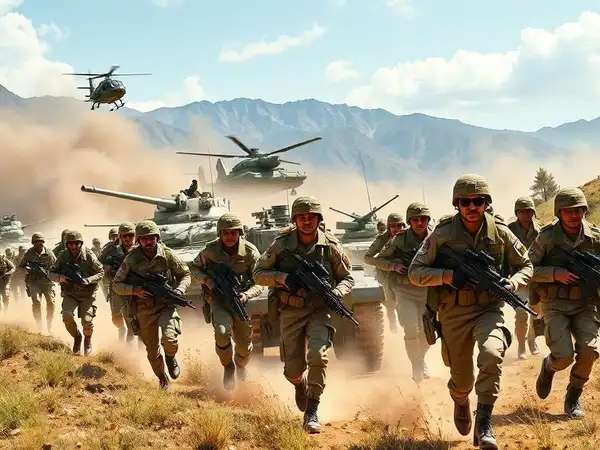
July 29, 2025 — In response to growing collusive threats from China and Pakistan, the Indian Army is enhancing its operational readiness by implementing a major restructuring under its Integrated Battle Group (IBG) doctrine. The force has begun establishing specialized “Rudra” brigades and “Bhairav” commando battalions aimed at ensuring swift and effective responses along India’s northern and western borders.
The move comes in the wake of insights gained during Operation Sindoor, a large-scale military exercise that revealed critical gaps in India’s ability to respond to simultaneous two-front threats. The operation reaffirmed the need for agile and integrated combat formations that can mobilize and strike rapidly.
The ‘Rudra’ brigades are being designed as self-sufficient units comprising infantry, artillery, armored elements, engineers, and logistics. These formations will be capable of launching fast-paced offensive operations in varied terrain, especially in high-altitude regions near the Line of Actual Control (LAC) and the Line of Control (LoC).
Complementing these brigades will be the newly raised ‘Bhairav’ commando battalions, tasked with executing specialized missions such as deep infiltration, high-risk assaults, and surgical strikes behind enemy lines. These elite units are being equipped with advanced weapon systems, unmanned aerial vehicles (UAVs), and AI-enabled battlefield management tools to enhance situational awareness and precision targeting.
Senior military officials have emphasized that the integration of these new formations under the IBG model represents a significant shift in India’s conventional warfighting strategy. Unlike traditional military divisions that rely on staggered mobilization, IBGs are designed for immediate deployment and independent operations, enhancing India’s deterrent posture.
The recent rise in joint provocations by China and Pakistan, including coordinated movements along the LAC and increased cross-border infiltration in Jammu & Kashmir, has raised concerns among India’s security establishment. Experts say the new measures are necessary to maintain a credible deterrence against any collusive action by the two neighbors.
“The induction of Rudra brigades and Bhairav commandos shows India is preparing for short, intense conflicts that require rapid reaction and integrated force application,” said a senior defense analyst.
The Army’s modernization efforts also align with the Atmanirbhar Bharat (self-reliant India) initiative, with many of the new systems and platforms being procured from indigenous defense manufacturers. These include domestically produced rifles, drones, surveillance systems, and high-altitude gear designed specifically for deployment along India’s difficult border terrain.
According to sources in the Ministry of Defence, several IBGs have already been positioned in strategically sensitive zones, with full-scale implementation expected within the next two years.
With regional tensions remaining high, the Indian Army’s restructuring marks a proactive step toward bolstering national security and combat effectiveness. By adapting to the demands of modern warfare, the force aims to remain prepared for all eventualities along India’s borders.

