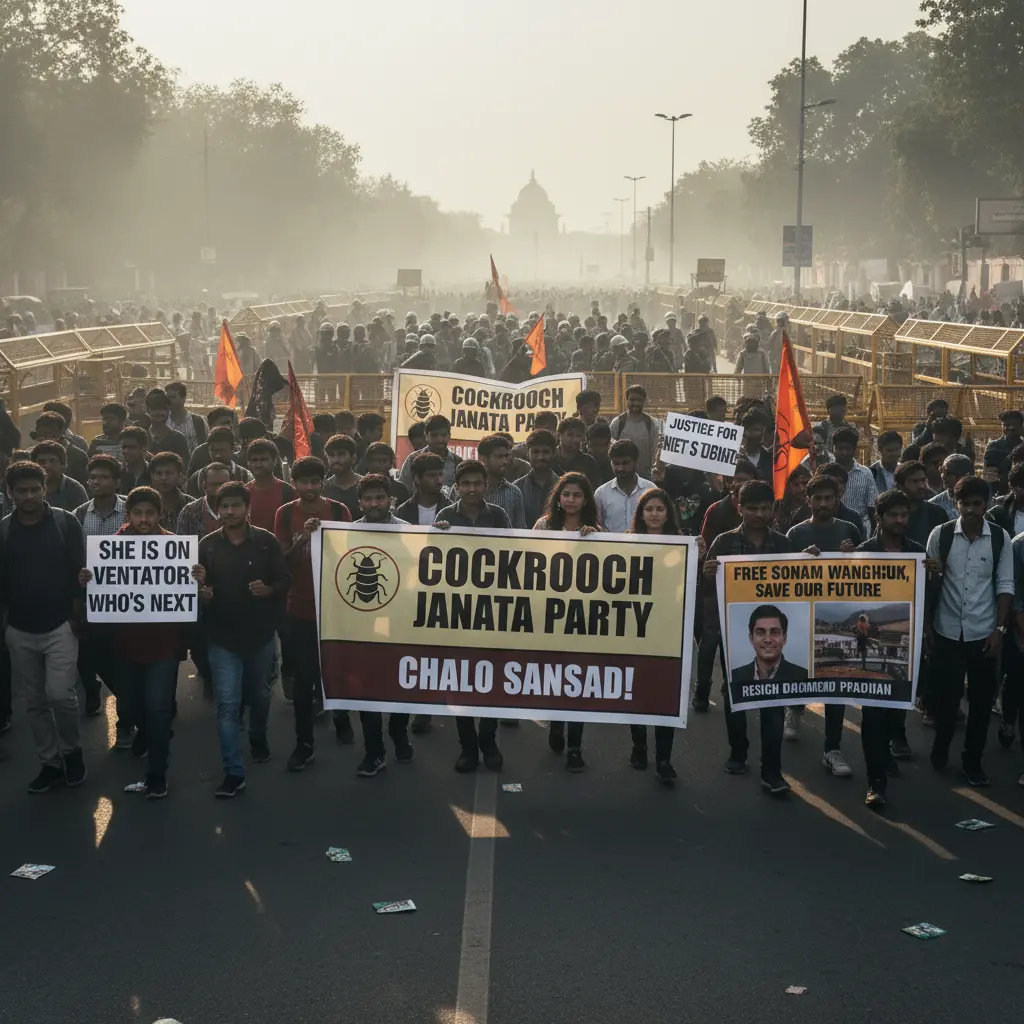
For nearly two months, Jantar Mantar in New Delhi was the epicentre of a protest nobody quite expected to matter. A group of students calling themselves the Cockroach Janata Party — a name born out of mockery, after Chief Justice Surya Kant reportedly compared unemployed young people and social media activists to “cockroaches” and “parasites” — turned an insult into a rallying cry. This week, that movement notched a result few saw coming: the resignation of Union Education Minister Dharmendra Pradhan.
It’s a striking turn for a group that started, by its own founder’s admission, as satire. Abhijeet Dipke, the 30-year-old digital strategist behind the Cockroach Janata Party, launched it online in May as a cheeky response to the judge’s remark. Within weeks, what had been memes and hashtags spilled onto the street. By early June, hundreds of young protesters were camped at Jantar Mantar, one of the few spots in Delhi where large-scale demonstrations are legally permitted. Their demand was specific and pointed: Pradhan’s resignation over the 2026 NEET paper leak and irregularities in CBSE’s on-screen marking process — failures that, for millions of students, meant months of anxiety over exams they’d spent years preparing for.
The protest might have stayed a local story if not for Sonam Wangchuk. The Ladakhi engineer-turned-activist, already a household name in India for his education reform work and his advocacy for Ladakh’s constitutional status, joined the demonstrators at Jantar Mantar in late June and began an indefinite hunger strike in solidarity. He called himself an “honorary cockroach.” His fast dragged on for over three weeks, and as his health visibly deteriorated, police forcibly removed him from the protest site and admitted him to a hospital — a move that, rather than defusing the movement, seemed to pour fuel on it. Crowds at Jantar Mantar swelled dramatically in the days that followed.
Then came July 20, a day the movement’s supporters have since described in stark terms. Tens of thousands marched toward Parliament in a “Chalo Sansad” push, only to be met by baton charges, tear gas, and internet shutdowns across parts of central Delhi. Delhi Police said roughly 180 people were hurt in the clashes — 60 protesters and 118 security personnel — while organisers put the number of injured demonstrators far higher, citing beatings that left some seriously hurt. Videos of officers striking peaceful marchers circulated widely, even as Delhi Police denied any “sporadic use of violence.” In the aftermath, CJP leaders made the difficult call to stop marching through the streets altogether, citing fears for their supporters’ safety, while vowing the pressure campaign itself would continue.
That pressure, it turned out, didn’t need more marches to work. On July 24, Wangchuk announced he was ending his 26-day fast after receiving assurances that the government would hold the education system’s failures to account. A day later, Pradhan resigned. At Jantar Mantar, Dipke reportedly dropped to his knees when the news broke, then rose with his fist raised, telling supporters simply: “We have done it.”
Pradhan’s exit is being read in Delhi as more than a single resignation. He was widely seen as close to Prime Minister Narendra Modi, and analysts say his departure marks a real setback for the ruling Bharatiya Janata Party, arriving at a moment when frustration over jobs, living costs, and a strained education system has been building among India’s enormous youth population — the country has an estimated 367 million people between 15 and 29. Sociologists studying the protests have pointed to education as a rare unifying issue, one that cuts across the caste, class, and regional lines that usually divide Indian politics.
What happens next for the Cockroach Janata Party is less clear. Spokespeople for the group say they intend to broaden their focus well beyond exam reform, floating the idea of town-hall style conversations with ordinary citizens to identify the next set of issues worth fighting for. Whether that evolves into a formal political party remains an open question — one organisers admit they haven’t fully answered themselves. For now, though, the movement that began as a joke about cockroaches has forced out a sitting Cabinet minister, and Jantar Mantar, for the first time in weeks, has gone quiet.
India’s ‘Cockroach’ Movement Claims Its Biggest Victory Yet as Education Minister Steps Down.