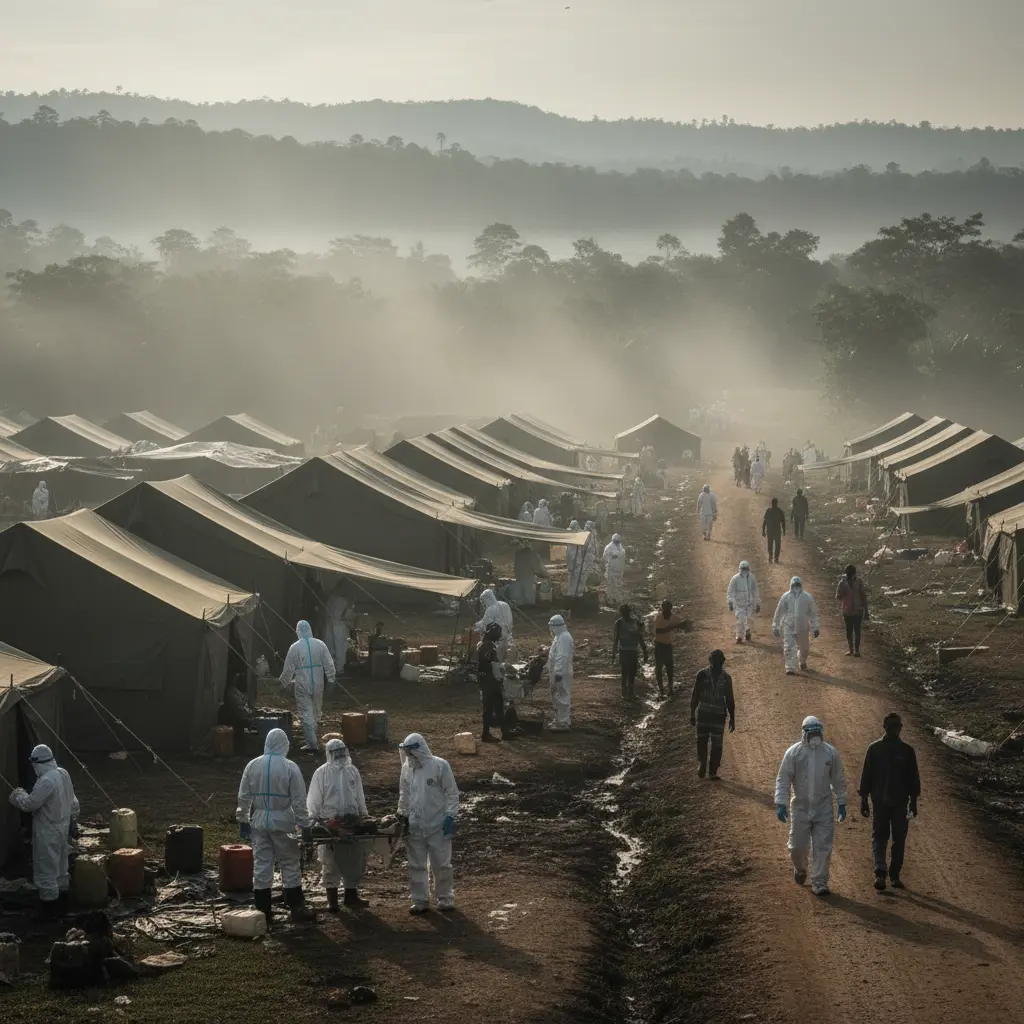
An Ebola outbreak sweeping through the Democratic Republic of Congo has grown into the third-largest in the disease’s history, and it’s still accelerating. Health officials say the virus, caused by the rare Bundibugyo strain, is spreading faster than any previous outbreak on record, and a wave of attacks on hospitals and burial teams is making an already difficult response even harder. This is one of the most serious African health emergencies in years, and it’s now spilled across borders into Uganda and beyond.
A Rapid Outbreak
The DRC’s 17th Ebola outbreak was declared on May 15, 2026, after health workers in Ituri Province started dying from an unknown illness. Lab testing quickly confirmed the culprit: Bundibugyo virus, a lesser-known but still dangerous species of Ebola with historical fatality rates ranging between 30 and 50 percent. Unlike the more familiar Zaire strain, there’s no licensed vaccine or approved treatment for Bundibugyo, which has left responders relying almost entirely on early supportive care, isolation, and contact tracing to keep the outbreak contained.
That lack of a vaccine appears to be part of why this outbreak has moved so quickly. Government figures put the case count above 2,100 confirmed infections and roughly 800 deaths as of mid-July, spread across dozens of health zones in five provinces — Ituri, North Kivu, South Kivu, Tshopo, and Haut-Uele. For comparison, the 2018-2020 eastern Congo outbreak, the second-largest in history, took about ten months to reach 2,000 cases. This one got there in a fraction of that time, which is part of why the World Health Organization has already labeled it a public health emergency of international concern, its highest alert level.
Violence Complicating an Already Hard Job
Containing Ebola requires trust — communities need to accept isolation, allow safe burials, and cooperate with contact tracers. In parts of Ituri and North Kivu, that trust has broken down. Multiple hospitals and Ebola treatment centers have come under attack from crowds, in some cases angry over the death of a loved one or the hospital’s refusal to allow traditional burial practices, which are restricted during outbreaks because they carry high transmission risk.
One of the most disruptive incidents happened when an angry crowd stormed a hospital in Ituri province after a woman died following the facility’s refusal to perform a blood transfusion, a procedure barred during the outbreak. Patients and health workers fled during the chaos, and an aid organization operating a nearby Ebola treatment center pulled its own staff out for safety, leaving some patients too sick to escape without care. Similar episodes have played out at other facilities in the region, including repeated attacks on the same hospital over consecutive days. Burial teams have also been targeted, echoing the violence seen during the 2018-2020 outbreak, when more than two dozen health workers were killed amid similar unrest.
Health workers on the ground say part of the problem is denial — some community members simply don’t believe the illness is Ebola, and want to reclaim the bodies of suspected or confirmed victims for traditional burial rites. Combine that with general distrust of authorities in a region long destabilized by armed conflict, and the result is a response effort that’s constantly losing ground it can’t afford to lose.
Crossing Borders
The outbreak hasn’t stayed contained to the DRC. Uganda has confirmed around 20 cases and two deaths after the virus crossed the border, though the country recently discharged its last known patient, starting the 42-day countdown health officials use before declaring an area Ebola-free. A case was also confirmed in France, linked to a doctor who had recently returned from the DRC, and an American aid worker tested positive before being medically evacuated to Germany for specialized treatment. None of this suggests a global spread is imminent, but it underscores how quickly a regional outbreak can generate cases thousands of miles away once international travel gets involved.
Where Things Stand
The WHO’s response has included rapid deployment teams, expanded lab testing capacity, and stepped-up surveillance across the affected provinces, but officials have acknowledged they’re playing catch-up after early detection delays let the virus establish itself in multiple communities before containment measures kicked in. Some public health experts believe the real case count could be significantly higher than official figures suggest, given the difficulty of tracking cases in areas affected by insecurity and population displacement.
For now, the picture remains grim. Cases and deaths continue climbing week over week, hospital attacks keep disrupting care in some of the hardest-hit zones, and the absence of an approved vaccine leaves responders without one of their most effective tools. Health officials say bringing the outbreak under control will depend heavily on rebuilding community trust and getting ahead of transmission chains before they spread into new health zones — a race that, so far, the outbreak has largely been winning.