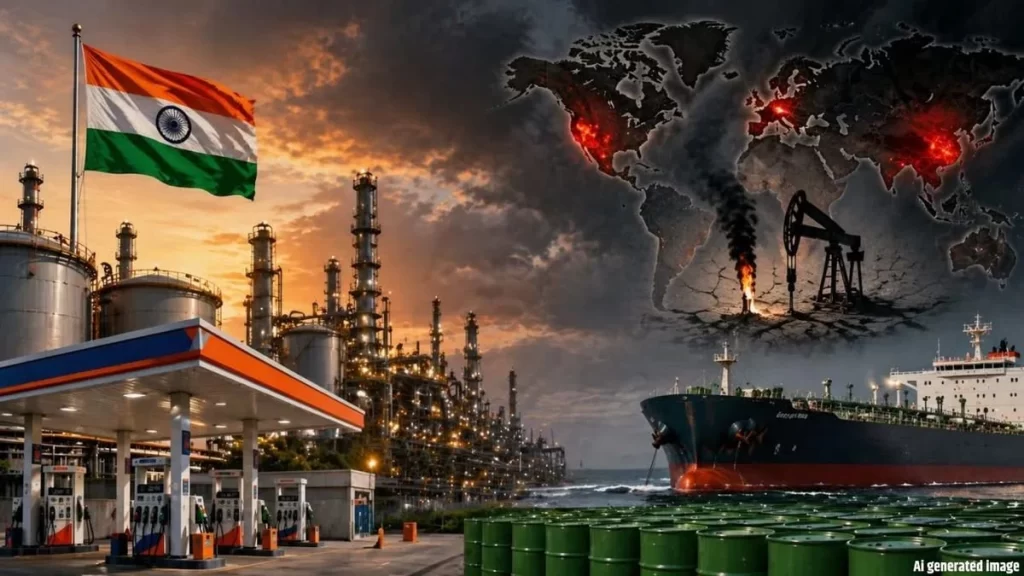
India’s economy is humming on imported oil, but renewed flare-ups in West Asia are turning the hum into a rumbling of dread. Brent crude traded about $116 a barrel in early May 2026, forcing the country to pay higher import expenses and confronting inflationary pressures and a sharp reminder of its significant reliance on uncertain global supply.
West Asia’s Powder Keg Explodes Again
The clashes of last year did not settle down tensions in West Asia, they boiled over. In late February 2026, U.S.-Israeli strikes against Iran, codenamed Operation Epic Fury and Operation Lion’s Roar, set off a chain reaction. Iran retaliated with Operation True Promise IV, shooting missiles and drones against U.S. bases in Qatar, Bahrain and Kuwait, and Israel striking Hezbollah targets in Lebanon.
Iran’s games have shaken the Strait of Hormuz, that tight choke-point through which nearly 20% of the world’s oil flows. Drones target Saudi, Qatari oil fields, raising fears of supply snarls. By April, the confrontation had extended, with Iran shooting ballistic missiles at the UAE – most of them intercepted, but the message was clear: energy routes are fair game.
This is not some distant drama for India. More than 80% of its crude is imported and in the past the Gulf supplied the bulk – Iraq, Saudi Arabia, UAE leading the list. Today, roughly 52% of India’s 5 million barrels per day still passes through the Hormuz Strait. One single escalation and petrol prices at Indian pumps might skyrocket overnight. What do you do when one drone affects the math of your everyday commute?
India’s Achilles Heel: Oil Dependence Exposed
Look at the numbers and India’s fragility stares back. Domestic output lags, crude imports reach 88.6% of total oil needs in first 10 months of FY26 Data from January 2026 shows Russia at 19.3% ($1.98 billion), Saudi Arabia at 17.5%, Iraq at 16.6%, with the UAE and others making up the rest.
Sanctions and diversification efforts helped erode Russia’s share from 2024 levels of more than 30% but Gulf countries clawed their way back. Petroleum Secretary Neeraj Mittal, however, termed the issue as an exposure of “chinks in our armour” and asked for a rethink of infrastructure. Imports from 40 countries help. 70% now bypassing Hormuz. U.S., Argentina for LPG. Even Nigeria coming up.
But demand is growing. Home production fell and consumption of petroleum products was up 1.6% year-on-year. Self-sufficient? Only 11.4% “This set-up challenges growth at times of shocks,” cautions RBI panel member Nagesh Kumar.
Price volatility exacts its price
The erratic ride of global crude only deepens the suffering. Brent’s rise to $116 from $99 lows in late April to May 5 underscores worries over supplies. India’s Wholesale Price Index up 0.9% on 10% oil increase, CPI on track for 5%.
The tab is terrible for India. Higher bills deepen the current-account imbalance, hurt the currency and fuel inflation in everything from diesel to plastics. Input prices make industries grind longer. Consumers experience it at the grocery and fuel pump. Like in 2018, subsidies increased, with LPG alone costing billions.
Import bill increases, squeezes FX reserves
The rupee weakened and future buying became expensive.
Inflation hits consumers, who cut back spending.
Long crisis? ForumIAS Growth is slowing down, impacting output and commerce. Markets wobble too as oil rise hurts company profitability.
Government Moves Quickly to Strengthen Defenses
New Delhi is not being idle. Strategic Petroleum Reserves (SPR) gets a fast-track increase. Phase one contains 5.33 million tonnes at Visakhapatnam, Mangalore, Padur. Now the plans include 90+ days of imports, combining public and private sites.
Oil companies hoard. Refineries run at full blast. Diplomacy works wonders: PM Modi’s outreach ensures flows Diversification is the star: Russian crude solid despite drops, US and Latin American volumes climb.
RBI looks at domestic exploration, greater reserves, clean energy transition. Petroleum Ministry: 70% of supply is non-Hormuz It’s pragmatic maneuvers in turmoil.
Renewables: Silver Lining in the Long Run
India’s green push buys some breathing room. Renewable capacity increase hit a record 51 GW in FY26 (ex-large hydro), with solar jumping 44.6 GW to above 150 GW altogether. Non-hydro renewables total 223 GW by March 2026.
Battery storage surged 26% to 547 MWh. Wind, hydro add to the mix. This reduces thermal coal imports, reduces oil dependence indirectly via electrification.
But oil rules transport, and although electric automobiles are ramping up, trucks and planes are lagging. Can solar farms actually disconnect India’s thirst for oil anytime soon?
Ripples of Daily and Higher Stakes
The situation has a bite outside Delhi corridors. Mumbai factories pay extra for petrochemicals; Punjab farmers fear diesel for tractors. Inflation chews off savings . Prices go up , exports fall behind . Gulf diaspora—millions strong—looks home amid instability.
It’s a wake-up call worldwide. Cuts by OPEC+ continue, Saudi-Russia output cut. India, 3rd biggest importer, pushes auctions for marginal fields, bioenergy bets
Resilient Way Forward
Storm in West Asia tests India’s grit, lays bare old frailties in energy security “Diversified sourcing, growing SPRs, and renewable surges signal determination, but 88% import dependence calls for greater steps—drill deeper at home, electrify faster, store smarter.”
Crude at $116, pressure on the currency and the threat of inflation, one wonders if this jolt would bring real autonomy or another set of patches. New Delhi’s plan is a mix of urgency and vision: exploration speeds up, green capacity surges, global linkages deepen. If continued, India might emerge tougher and less tied to faraway choke points. In the next few months we shall see whether the conversation moves to durable shielding against the storms of tomorrow.
India’s Energy Security at Risk: West Asia Turmoil and Rising Oil Prices Raise Alarms