There is something quietly powerful about watching a discipline that began thousands of years ago on the banks of Indian rivers take center stage in a modern competitive arena. The inaugural World Yogasana Championship, held in the heart of Ahmedabad, delivered exactly that — a spectacle that was equal parts athletic, cultural, and historic. And when the final scores were counted and the last medal draped around the last neck, it was India that stood tallest, its athletes having dominated the competition in a way that sent a message to the rest of the sporting world: yogasana has arrived, and India intends to lead it.
For those who have followed the quiet but steady push to bring yogasana into the mainstream of competitive sport, this championship felt like a long time coming — and very much worth the wait.
What Just Happened in Ahmedabad
The Ahmedabad event was no small gathering. Athletes from multiple countries made the journey to Gujarat, each bringing their own interpretation of a practice that, until recently, most of the world associated with wellness studios and Sunday morning routines rather than podiums and scoreboards. The range of participating nations reflected something genuinely significant — that yogasana as a competitive sport has been gaining traction across continents, from Europe to Southeast Asia, far beyond its traditional home.
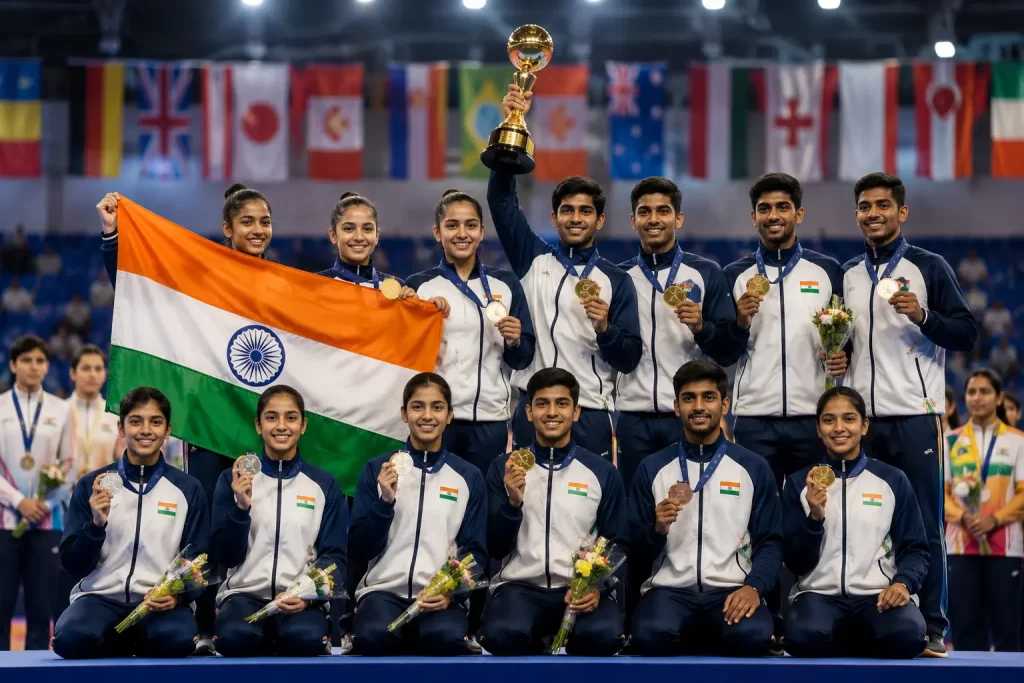
But it was India’s athletes who defined the championship. The medal tally that the Indian contingent raked up across the various categories was not just impressive – it was dominant in the truest sense of the word. Discipline after discipline, the Indian competitors stepped onto the mat with a composure and technical precision that left judges and spectators alike in little doubt about their preparation. Gold medals, silver medals, bronze medals — India collected them with the kind of consistency that separates genuine strength in depth from a lucky run at a single event.
This was not luck. This was the product of years of structured training, institutional support, and the kind of cultural familiarity with the practice that cannot be manufactured in a gym or coached into existence overnight.
More Than Sport — A Homecoming Of Culture For India To appreciate why India’s performance in the World Yogasana Championship matters beyond the medal tally, one needs to understand what yogasana means for India — what it has meant for a long, long time.
Yoga in its various forms is part of the Indian way of life. Its roots run through ancient Sanskrit texts, through the teachings of sages whose names are still spoken with reverence, through the daily routines of millions of Indians who practice not for competition but as a form of living. When India champions yogasana on the world stage, it is not simply winning a sports competition — it is, in a very real sense, bringing something home.
That context gives the Ahmedabad event a dimension that a standard international sports championship does not carry. Every gold medal won by an Indian athlete here was also, in a small but meaningful way, a reaffirmation of something ancient and enduring. The fact that competitors from around the world came to compete in this discipline — on Indian soil, in an Indian city — added a layer of symbolism that was not lost on anyone in attendance.
The Growing World of Competitive Yoga
What the World Yogasana Championship also demonstrated, perhaps more clearly than any previous event, is that the international appetite for yogasana as a competitive discipline is real and growing. The participation of athletes from multiple countries was not a diplomatic formality — these were serious competitors who had trained with specific goals in mind, who understood the technical demands of competitive yogasana, and who pushed India’s athletes to perform at their very best.
That competition matters. Any sport grows stronger when its field of competitors grows wider and deeper. The fact that nations across different continents are now investing in yogasana training programs, coaching infrastructures, and competitive pathways is a development that should be welcomed by everyone who wants to see this discipline flourish globally.
For India, this means the era of easy dominance may have a natural lifespan. The countries that participated in Ahmedabad went home having learned from the best. They will train harder, recruit better, and come back to the next championship more prepared than they arrived. That is exactly how sport is supposed to work.
What Comes Next for Indian Yogasana
The success of India’s athletes at the inaugural World Yogasana Championship raises a natural and exciting question: what now? The infrastructure that produced this medal haul needs to be sustained and expanded. Young athletes across India who watched the Ahmedabad event unfold need pathways into the sport — access to qualified coaching, competitive opportunities at regional and national level, and the kind of recognition that inspires the next generation to take the practice seriously as an athletic pursuit.
There is also the broader project of international recognition to keep building. The more nations compete, the more media coverage the sport attracts, the closer yogasana moves toward the kind of institutional legitimacy that opens doors to larger platforms — including, eventually, the conversation about global multi-sport events.
For now, though, the moment belongs to the athletes who stood on the podium in Ahmedabad, to the coaches who prepared them, and to a discipline that spent thousands of years being practiced in quiet before finally, spectacularly, stepping into the spotlight.
India hosted it. India shaped it. And on the day, India won it — in the most complete way possible.