
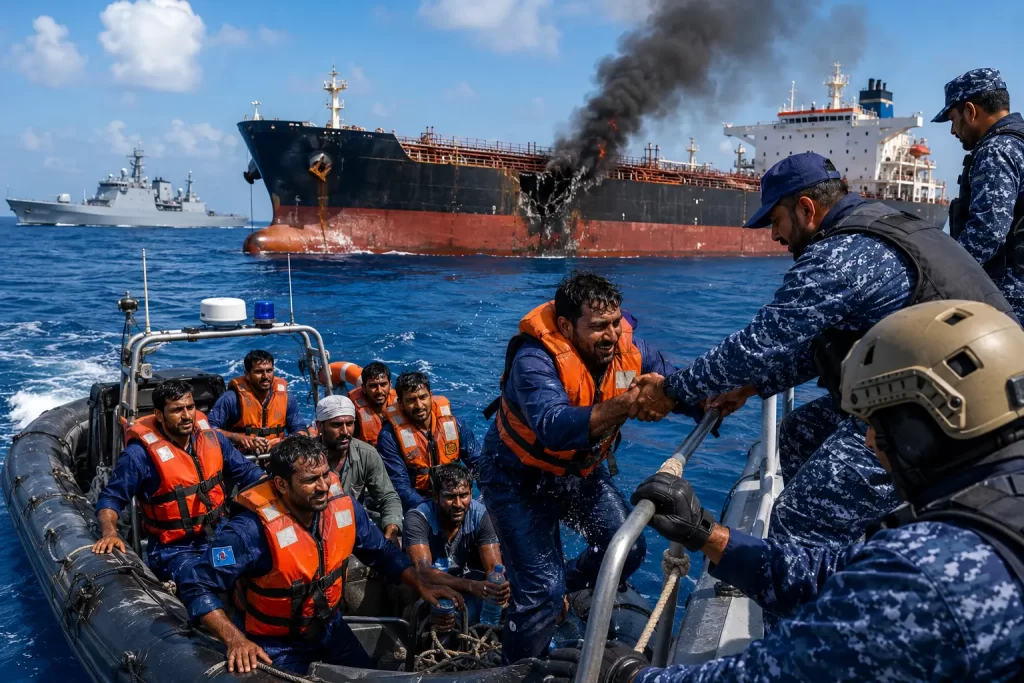
Somewhere in the Arabian Sea, twenty-four men went to work on a Tuesday like any other — checking gauges, running routine maintenance, doing what merchant sailors do on long hauls across open water. By the time their shift should have ended, their vessel was stricken, the sea around them was anything but calm, and the only thing standing between them and catastrophe was the speed of a rescue operation they had no guarantee was coming.
It came. All twenty-four Indian crew members aboard the tanker MT Marivex were rescued following a missile strike that struck the vessel in one of the world’s most strategically sensitive shipping corridors. They are alive. That, for now, is the part that matters most — and the part that can get lost when the conversation quickly turns, as it always does, to geopolitics, investigations, and the broader implications of yet another attack on a commercial ship in the Arabian Sea.
The Rescue: Swift Action in Dangerous Waters
When distress signals went out from the MT Marivex, the response was rapid. Maritime authorities coordinated alongside the Oman Navy to reach the stricken vessel and ensure the safe evacuation of all crew members on board. All 24 Indian sailors were rescued, with no loss of life, which speaks volumes about the professionalism of the rescue teams involved and the emergency protocols that worked, in this case, exactly as they were meant to.
The role of the Oman Navy in the rescue effort underscores the kind of regional maritime cooperation that doesn’t get the headlines in normal times, but becomes absolutely essential when emergencies occur at sea. Oman is strategically located at a critical point near the Strait of Hormuz, one of the most important chokepoints in global shipping, and its naval forces are playing an increasing role in the larger security architecture of the region.
For India, the safe return of its nationals triggered an immediate wave of relief, followed swiftly by the harder questions. How did this happen? Who was responsible? And what does it mean for the hundreds of Indian sailors who crew merchant vessels through these waters every single day?
MT Marivex and the Rising Threat to Shipping Lanes
The tanker attack on the MT Marivex is not an isolated incident — and that is precisely what makes it so alarming. Over the past few years, there has been a disturbing pattern of strikes, seizures and harassment of commercial vessels in the Arabian Sea and the wider Persian Gulf region. Mines attached to hulls in port.
Drones and missiles launched at tankers mid-voyage. Armed boarding of ships. The tools and tactics have varied; the effect on maritime security has been cumulative and corrosive.
The Arabian Sea sits at the intersection of some of the world’s most critical energy trade routes. Vast quantities of oil and liquefied natural gas move through these waters daily, from Gulf producers to markets in Asia, Europe, and beyond. Some 20% of the world’s oil supply passes through the Strait of Hormuz alone. It is not just a shipping lane, but a pressure point for the global economy as a whole. When a missile strikes a tanker like the MT Marivex in these waters, the shock waves reverberate far beyond the vessel itself.
Shipping companies recheck their routes straight away. Insurance premiums for vessels operating in the region climb. Freight costs rise. And somewhere down that chain, consumers and economies absorb the consequences.
Who Is Behind It — and Why It’s Complicated
Authorities are actively investigating the circumstances of the MT Marivex missile strike, and officially, attribution remains a matter under examination. In practice, analysts and maritime security experts are watching the situation against a backdrop of ongoing regional tensions that have made the Arabian Sea a theatre of asymmetric confrontation.
The Houthi movement in Yemen has claimed responsibility for multiple tanker attacks in recent months, framing its maritime campaign as pressure tied to the conflict in Gaza. Iran-backed groups operating across the region have also been connected to various incidents targeting commercial shipping. Pinning specific attacks to specific actors remains difficult — by design. The ambiguity is part of the strategy, making decisive international response harder to coordinate and sustain.
What is not ambiguous is the impact on the humans at the center of these incidents. Merchant sailors — the overwhelming majority of them from countries like India, the Philippines, Myanmar, and Ukraine — are not combatants. They are workers. They signed on to carry cargo, not to navigate missile strikes. The fact that the crew of MT Marivex made it home is cause for genuine relief. The fact that their ship was struck at all is cause for genuine anger.
India’s Sailors and the Quiet Danger of Global Trade
India is one of the world’s largest suppliers of merchant mariners. Hundreds of thousands of Indian nationals work aboard commercial vessels across every ocean, their labor forming an invisible but essential thread in the fabric of global trade. The attack on the MT Marivex is one such incident, a sobering reminder that the work, so often romanticized and too often ignored, is done in conditions that can turn dangerous at any moment.
India has been consistently raising the issue for better international arrangements to protect its citizens working in high-risk maritime zones. The MT Marivex rescue will likely add fresh urgency to those calls, as New Delhi renews pressure on international maritime bodies and coalition partners to do more to keep these waters safe.
A Corridor That Cannot Be Left Unguarded
The Arabian Sea and the Persian Gulf are not going to become less important anytime soon. If anything, their strategic importance is only going to grow as global energy demand changes and trade routes shift. That makes the current pattern of tanker attacks not a temporary disruption to be managed, but a structural challenge that demands a structural response.
Multinational naval coalitions already operate in the region — but questions remain about their mandate, their rules of engagement, and their long-term sustainability. What happened to MT Marivex and its crew is a reminder that maritime security is not an abstraction. It is the difference between twenty-four men coming home and twenty-four families receiving news no family should ever have to hear.
They came home. The investigation continues. And in the Arabian Sea, the ships keep moving — because they have to.

