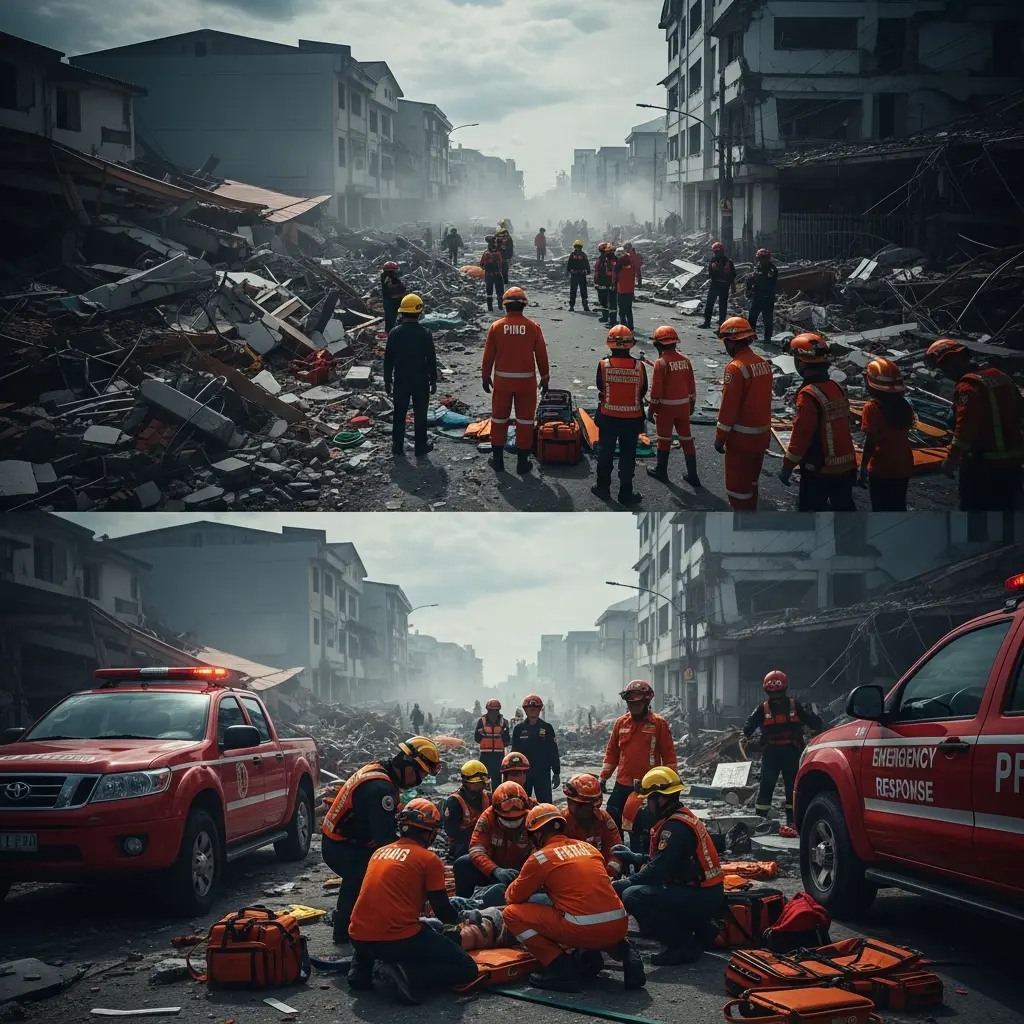
It’s over in seconds. One minute life is normal—children are going to school, fishermen are heading to the docks, families are sitting down to breakfast. Then the earth moves and everything is different. The 7.8-magnitude earthquake that struck the Philippines was exactly that kind of moment: sudden, violent, and devastating in ways that will take months, perhaps years, to fully measure.
For a nation that has absorbed more than its share of natural disasters, the tremors were a grim reminder that living in one of the world’s most seismically active zones is not a choice — it is simply the reality of life in the Philippines.
The Moment the Earth Shook
A magnitude 7.8 is not a routine event. On the Richter scale, the difference between a 6.0 and a 7.8 is not a matter of degrees — it is a matter of the kind of force that buckles roads, collapses bridges, and reduces concrete structures to rubble in under a minute. By the time the shaking stopped, reports of casualties had already begun filtering in, and the scale of infrastructure damage was becoming grimly clear.
Buildings crumbled. Power lines went down. Whole neighborhoods in some communities lost electricity, clean water or any way to communicate with the outside world. Families searched through debris for missing relatives. Hospitals — some themselves damaged — scrambled to receive the injured. It was chaos of the kind that tests not just emergency systems, but the spirit of a people.
And yet, as has happened so many times before, that spirit held.
Emergency Response: Racing Against Time
Within hours of the Philippines earthquake, emergency response teams were on the move. Local disaster risk reduction units — practiced, unfortunately, in exactly this kind of mobilization — began coordinating search and rescue operations across affected areas. Military personnel were deployed to assist in clearing debris and reaching communities cut off by damaged roads. Coast guard ships were headed for the coast, where landslides or tsunami alerts made a bad situation even more urgent.
The Philippine government has activated its national disaster response protocols and authorities are working to assess the full extent of damage in affected provinces. Evacuation centers were opened, relief goods pre-positioned, and medical teams dispatched to areas where hospitals had been compromised.
What makes the emergency response in disasters like this so difficult is not a lack of will — it is geography. The Philippines is an archipelago of more than 7,000 islands. Getting help to the right place, quickly, when roads are damaged and communications are disrupted, is a logistical challenge even under ordinary circumstances. After a major seismic event, it becomes exponentially harder.
International agencies were quick to signal their readiness. Organizations monitoring seismic activity and humanitarian conditions around the world began coordinating potential support packages, with the United Nations and regional partners preparing to step in where local capacity is stretched thin. The outpouring of concern from neighbouring countries throughout the Asia-Pacific region was a reflection of both solidarity and an understanding that disasters of this scale rarely remain purely local in their consequences.
A Nation Built on Fault Lines
To understand why these things keep happening – and why the Philippines earthquake feels so close to home – you need to understand where the Philippines sits on the map of global geology.
The archipelago sits right on the Pacific Ring of Fire, the vast, horseshoe-shaped area of seismic and volcanic activity that encircles much of the Pacific Ocean. This is where the vast majority of the world’s earthquakes and volcanic eruptions happen. The Philippines alone experiences thousands of earthquakes every year, most of them minor and unnoticed. But the tectonic forces that create those minor tremors are also capable of producing events like this — sudden, powerful releases of energy that transform landscapes and lives in moments.
The vulnerability of earthquake-prone areas of Southeast Asia is not new to scientists, disaster managers, or the communities that face this reality on a daily basis. What remains a challenge is translating that knowledge into infrastructure, early warning systems, and community preparedness programs that are robust enough to truly reduce casualties when the next big event occurs. Building codes matter. Urban planning matters. Public education about earthquake drills and evacuation routes matters.
The Philippines has made real progress on all of these fronts in recent decades. But progress and perfection are not the same thing, and a 7.8-magnitude earthquake will find the gaps in any system.
The Long Road After the Shaking Stops
Once the immediate emergency response phase passes, a different and in some ways harder challenge begins. Displaced families need temporary shelter that doesn’t become permanent. Infrastructure needs to be rebuilt — and ideally rebuilt better than it was before. Psychological trauma, often invisible in the immediate aftermath, surfaces weeks and months later in communities that have lost homes, livelihoods, and loved ones.
International experience with disaster recovery consistently shows that the first week draws the most attention and resources. Sustaining that support through the months of reconstruction is where the real test of commitment lies — for governments, for aid agencies, and for the global community watching from a distance.
For the Philippines, a country that has faced typhoons, volcanic eruptions, and earthquakes with a resilience that genuinely deserves the word, recovery will come. It always does. But the cost — in lives interrupted, futures altered, and communities that will never quite be the same — is real, and it deserves to be acknowledged as such.
Asia news cycles move fast. The Philippines earthquake will eventually give way to the next headline. The people living in its aftermath will not have that luxury.