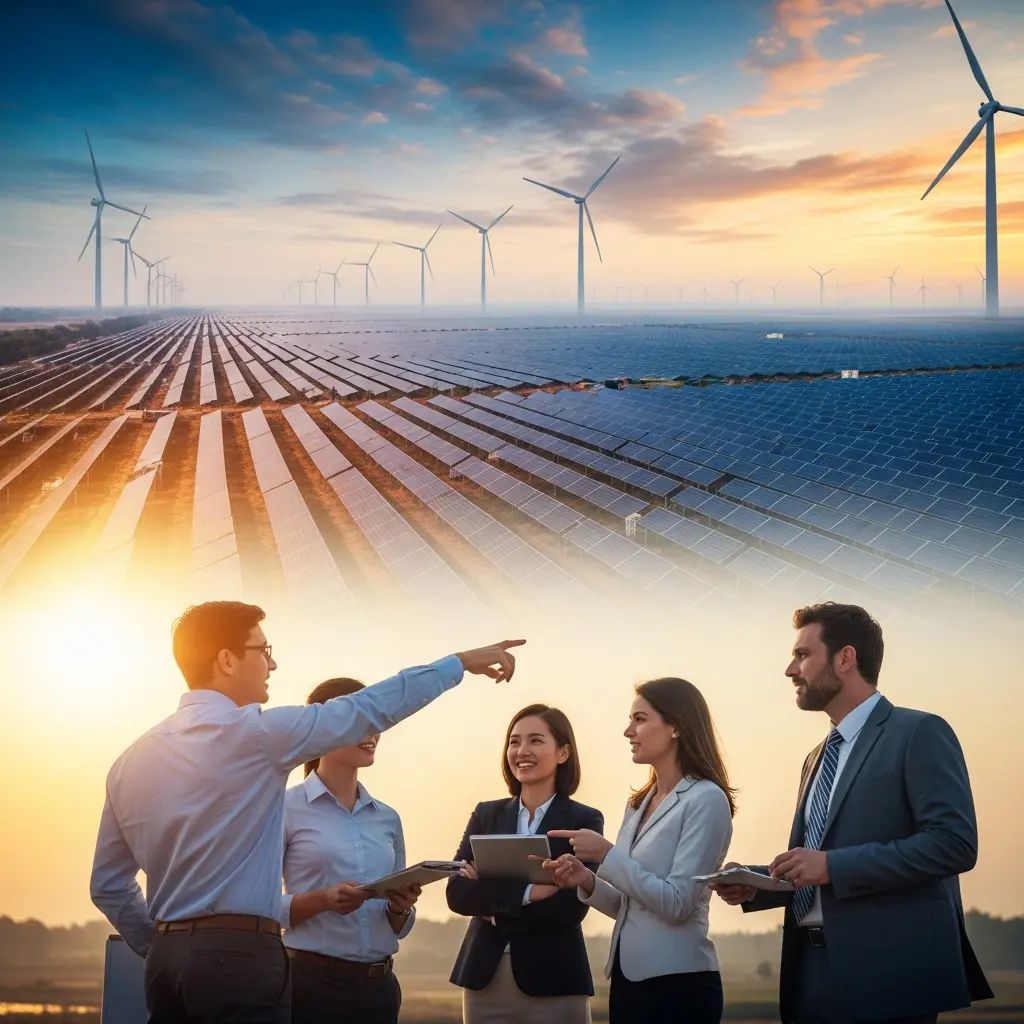
There’s a version of India’s energy story that gets told a lot — the one about coal dependence, air quality crises, and the difficult trade-offs a rapidly industrialising economy has to make between growth and sustainability. That story has truth in it. But it’s increasingly incomplete.
Because alongside that narrative, a different one has been quietly building — one about solar farms stretching across Rajasthan’s desert landscape, about green hydrogen corridors being mapped across industrial coastlines, about international capital flowing into clean energy projects at a pace that would have seemed implausible a decade ago. India’s renewable energy ambition has moved from aspiration to architecture. And the world is starting to pay serious attention.
From Targets to Tangible Progress
India’s renewable energy expansion didn’t happen by accident. It has been driven by deliberate policy — ambitious national targets, production-linked incentive schemes for solar manufacturing, and a consistent diplomatic effort to place clean energy cooperation at the heart of international economic conversations.
The numbers reflect this intent. India has become one of the fastest-growing renewable energy markets globally, with solar capacity additions accelerating year on year and wind energy development picking up momentum along both its southern and western coastlines. The country’s installed renewable energy capacity has grown dramatically, and the pipeline of projects under development suggests that trajectory isn’t slowing.
What’s changed most recently is the institutional embedding of green energy into India’s broader economic planning. Sustainable infrastructure investment is no longer a parallel track to mainstream development – it’s being integrated into the design and financing of highways, industrial corridors, ports and urban centres. Policymakers have recognised that building clean from the start is cheaper and more durable than retrofitting later.
Green Manufacturing: The Industrial Bet
One of the more underappreciated dimensions of India’s clean energy strategy is its focus on green manufacturing — building domestic supply chains for the components that renewable energy depends on.
Solar panels, batteries, electrolysers for green hydrogen production, EV components — India has made a strategic decision that it doesn’t just want to be a consumer of these technologies. It wants to be a producer. The logic is sound: a country that manufactures its own clean energy infrastructure is less exposed to supply chain disruptions, retains more economic value domestically, and can eventually become an exporter to markets that need what India can make.
Production-linked incentive programmes targeting solar module manufacturing have already begun yielding results, with several large-scale facilities coming online and more in the pipeline. This is a long game, and the supply chain depth required to compete with established global manufacturers won’t materialise overnight. But the intent is clear — India is building for self-sufficiency in green manufacturing — not dependence.
This industrial strategy also has important consequences for employment. Clean energy manufacturing creates jobs that are distributed across geographies, accessible to workers without advanced degrees, and linked to industries with genuine long-term growth prospects. It’s a socially and economically attractive package for a country still absorbing millions of new workers into its labour market every year.
International Investors Are Taking Notice
For global capital looking for credible, large-scale clean energy investment opportunities, India increasingly ticks the boxes that matter.
The market size is real — India’s energy demand will continue growing substantially as its economy expands and living standards rise. The policy environment has improved meaningfully, with clearer frameworks for renewable energy procurement, better grid infrastructure, and more predictable regulatory conditions than existed even five years ago. And the returns on clean energy projects in India have become increasingly competitive with alternative investments.
International investors — sovereign wealth funds, infrastructure-focused private equity, multilateral development finance institutions — have been deepening their exposure to India’s clean energy market. Green bonds, blended finance structures, and bilateral clean energy partnership agreements are all multiplying as global sustainability goals push institutional capital toward markets that can absorb large-scale investment productively.
India’s climate policy positioning has also helped. India’s commitments under international climate frameworks, and its active participation in coalitions such as the International Solar Alliance, of which it is a co-founder, enhances its credibility as a serious actor in global clean energy transition conversations. That credibility translates into access to concessional financing and technical cooperation that commercial markets alone wouldn’t provide.
The Challenges That Remain Real
None of this means the path is smooth. Grid integration of variable renewable energy remains technically complex, and India’s transmission infrastructure needs significant investment to carry renewable power efficiently from generation sites to demand centres. Land acquisition for large solar and wind projects continues to create friction. And the financing costs for clean energy in emerging markets, while improving, remain higher than in developed economies — a gap that better risk-sharing instruments and stronger policy frameworks need to continue closing.
Coal’s role in India’s energy mix will also diminish more gradually than climate advocates would prefer. The pace of that transition will be determined by the speed at which renewables can reliably replace baseload capacity — a technical and economic challenge, not a political choice.
These are real constraints, not reasons for pessimism. Every major energy transition in history has involved managing legacy infrastructure, navigating incumbent interests, and solving hard engineering problems in real time. India is doing all of that — while simultaneously trying to grow an economy and lift hundreds of millions of people into energy security.
A Green Economy in the Making
What’s most striking about India’s renewable energy moment isn’t any single project or policy. It’s the accumulation — the sense that clean energy thinking has genuinely permeated how India’s policymakers, entrepreneurs, and investors are approaching the future.
Solar expansion, sustainable infrastructure, low-carbon development pathways, green hydrogen as an industrial fuel – these are no longer fringe conversations. They’re central to how India plans to grow. And in a world urgently searching for large-scale clean energy transition success stories, that matters enormously.
India’s green economy isn’t finished. It’s just getting built. And the opportunity — for the country, and for the world — is very much still on the table.
India’s Green Energy Push Is Becoming the World’s Opportunity.