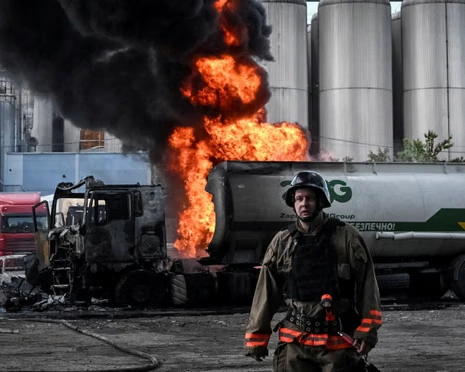
Ukrainian President Volodymyr Zelenskyy has signaled a sharper response to Russia’s war on Ukraine, saying Kyiv is justified in striking Russian energy and military targets after a wave of missile attacks that killed 24 people in Kyiv. The comments underline how the war is entering yet another cycle of retaliation, with both sides now targeting infrastructure far beyond the front line.
What Zelenskyy Said
Zelenskyy framed the issue as one of self-defense and consequence, saying Ukraine will ensure that every strike killing Ukrainians “has consequences for the aggressor.” In reporting on his meeting with senior military and security officials, Ukrainian media said he discussed new long-range strike targets in response to Russian attacks on Ukrainian cities and villages.
He also said Ukraine is already targeting parts of Russia’s oil industry, military production, and people involved in war crimes against Ukrainians. That statement matters because it shows Kyiv is not treating these attacks as isolated battlefield actions, but as part of a broader strategy to raise the cost of Russia’s offensive.
Kyiv Under Fire
The immediate backdrop is the latest deadly assault on Kyiv, where Russian missile and drone strikes caused heavy civilian losses. The death toll of 24 has intensified public anger in Ukraine and added pressure on the government to respond forcefully.
In conflict terms, the attack fits a pattern that has become grimly familiar: Russian strikes hit Ukrainian urban centers, Ukraine responds against Russian energy or military assets, and both governments then argue that the other side is escalating. For ordinary Ukrainians, though, the language of escalation is not abstract. It is air raid sirens, destroyed homes, and the constant fear that the next strike could land anywhere.
Why Energy Targets Matter
Energy infrastructure has become one of the war’s most sensitive pressure points. Oil refineries, gas processing plants, fuel depots, and electricity systems do more than power industry; they also support military logistics and the wider economy. That is why strikes on these assets carry both symbolic and strategic weight.
According to Ukrainian reporting, recent attacks have already disrupted Russian industrial facilities, including the Astrakhan gas processing plant, which halted production of automotive fuel after a drone strike. Ukrainian officials and media also said strikes on Russian oil refineries have caused billions of dollars in losses since the beginning of the year. Whether one views those numbers as a battlefield success or a dangerous widening of the war, the effect is clear: energy has become a target, not just a resource.
The Strategic Logic
From Kyiv’s perspective, hitting Russian energy and military targets serves several goals at once. It signals that Russia cannot bomb Ukrainian cities with impunity, it forces Moscow to defend assets deep inside its own territory, and it may complicate the supply chains that keep Russia’s war machine running.
The strategy also has a psychological dimension. Wars are not won only by territory captured on maps; they are also shaped by morale, endurance, and the ability to absorb pain. If Ukraine can keep Russia’s energy sector under pressure, the Kremlin may have to spend more on air defenses, repairs, and internal security. That raises a difficult question: how much can a country absorb before its home front starts to feel like a second battlefield?
Risks For Both Sides
There is, of course, a cost to this kind of escalation. Expanded strikes on energy targets can invite even harsher retaliation from Russia, especially against Ukrainian cities and power infrastructure. That danger is especially serious ahead of another winter, when attacks on electricity and heating systems can have real humanitarian consequences.
The other risk is political. Western partners continue to support Ukraine, but they also watch closely for signs that the conflict is becoming harder to contain. Strikes that are seen as legitimate military pressure in Kyiv may still raise concern in European capitals if they appear to push the war deeper into Russian territory. That tension has been present for months, and it is not going away anytime soon.
Wider War Context
This latest exchange comes amid a broader phase of attritional warfare. Recent reports have described repeated Russian attacks, Ukrainian counter-attacks and continued fighting even during moments meant to ease tensions. One recent report noted that Russia breached a short ceasefire, while battlefield clashes and drone attacks continued almost immediately afterward.
In practical terms, that means the war is now defined less by single dramatic offensives and more by steady pressure: drones, missiles, refinery fires, logistics strikes, and civilian casualties. It is an exhausting rhythm, and one that makes it harder to see a clean diplomatic off-ramp. The front line may be in Ukraine, but the strategic contest increasingly stretches across borders and industries.
Zelenskyy Says Ukraine Is Justified in Hitting Russian Energy Targets After Deadly Kyiv Strikes