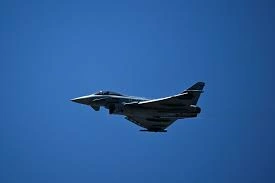
Suspected drone incursions over Finland and Latvia triggered overnight alerts, forced temporary disruptions, and put NATO air policing on high alert, underscoring how the Russia-Ukraine conflict continues to spill into neighboring airspace. The incidents did not escalate into a direct attack on NATO territory, but they added fresh urgency to an already tense security picture in Northern Europe.
Overnight alerts across the Baltic
The Finnish Air Force deployed Hornet fighter jets after authorities received reports of suspected drones in the area between Helsinki and Porvoo, while residents in parts of southern Finland were told to stay indoors and airport operations at Helsinki were briefly suspended. In Latvia, officials issued an air emergency alert for eastern districts including Rēzekne, Ludza, Balvi, and Krāslava, and NATO Baltic Air Policing fighter jets were scrambled in response.
The scale of the response shows how quickly even uncertain drone activity can trigger military and civil-defense procedures. It also highlights a hard truth for NATO planners: the frontline logic of the Russia-Ukraine war now extends far beyond the battlefield itself.
Why this matters now
Drone activity near NATO borders has become a recurring security concern, especially around the Baltic states and Finland, which sit close to Russia and the wider war zone. In this case, Finnish officials later said the threat no longer posed a danger and reopened Helsinki-Vantaa Airport, while Latvia also later declared the alert over. Still, the overnight scramble reflected the fragility of airspace security in the region.
What happens when a drone warning becomes routine? That is the uncomfortable question hanging over the Baltic region right now, because each new alert normalizes a situation that Europe would have considered extraordinary only a few years ago. For NATO members on Russia’s doorstep, every incident becomes a test of readiness, communication, and public trust.
Finland’s response
Finnish authorities treated the suspected drone activity as a serious but contained incident. The Helsinki City Rescue Department advised people in the Uusimaa region to remain indoors, and flights at Helsinki Airport were temporarily halted before restrictions were lifted in the morning. Finnish Air Force Hornet jets were sent into the area as part of the response, and officials later said there was no direct military threat.
The fact that the suspected activity reached as far as southern Finland, rather than staying close to the border, made the episode especially notable. Estonia’s defense forces later said the drones had strayed much farther inland than similar recent incidents, suggesting both the evolving range of drone operations and the difficulty of tracking them in real time.
Latvia’s air defense posture
Latvia’s reaction was equally telling. Authorities issued an overnight warning for communities near the eastern border and advised residents to stay indoors, close windows, and follow the “two-wall principle,” a civil-protection measure meant to add a layer of safety during aerial threats. NATO Baltic Air Policing jets were scrambled, and Latvia later said it had reinforced its eastern border air-defense capabilities with additional military units.
That reinforcement matters because Latvia has become one of the NATO states most exposed to spillover risks from the war in Ukraine. Even when no hostile aircraft or confirmed foreign object is found, the need to mobilize aircraft and issue public warnings shows how thin the line is between precaution and panic in a border crisis.
The wider NATO problem
The bigger story is not just one night of alerts. It is the growing challenge NATO faces in dealing with drones, false alarms, and airspace violations in an environment where the difference between accident, spillover, and deliberate provocation can be hard to prove quickly. Estonian defense officials noted that NATO countries do not yet have a fully unified standard for issuing threat alerts, even though their civil-protection systems and military cooperation are closely linked.
That lack of uniformity matters because fast-moving drone incidents leave very little time for debate. If one country warns too early, it risks alarm fatigue; if it waits too long, it risks missing the moment when civilians need shelter or airports need to close. The balance is delicate, and this week’s events showed just how quickly that balance can be tested.
Ukraine war spillover
Officials and analysts have been increasingly concerned that the war in Ukraine could produce spillover effects in neighboring NATO states, especially as drones and electronic warfare expand the geographic reach of combat. In Finland’s case, authorities did not publicly identify the origin of the suspected drones, though they acknowledged intelligence from Ukraine suggesting drone activity might affect Finnish territory. In Latvia, earlier drone incidents were reported to have crossed in from Russian territory, adding another layer of concern.
This is where the security picture becomes politically sensitive. NATO does not want to overreact to every unidentified drone, but it also cannot afford to underreact if a real border breach is underway. That is especially true in the Baltic region, where geography leaves little room for error and public confidence depends on visible preparedness.
Civilian readiness and public trust
For civilians, the immediate impact of these alerts was disruption, uncertainty, and the familiar modern anxiety of waiting for official confirmation. Flights were delayed or diverted, residents were told to shelter, and schools in parts of the region faced interruption. In practical terms, this is what a new kind of border tension looks like: not tanks crossing frontiers, but airports shutting down and emergency apps lighting up at 4 a.m..
Still, the quick lifting of restrictions in Finland and Latvia may have reassured some residents that the systems worked as intended. The harder challenge is long-term confidence. If alerts keep coming, people may start to wonder whether every drone warning is a genuine threat or just another consequence of a war that now casts a shadow over NATO’s northeastern flank.
What comes next
The most likely outcome is not a single dramatic escalation, but a steady hardening of defenses, more air policing patrols, and greater investment in drone detection and response systems. The Baltic region has already seen repeated drone-related alarms in recent months, and officials appear increasingly determined to treat them as part of a broader security environment rather than isolated events. That means more joint coordination, more public-alert readiness, and probably more political debate over how to draw the line between precaution and overreaction.
For NATO, the lesson is straightforward but uncomfortable: airspace threats no longer arrive only in the form of bombers or missiles. Sometimes they arrive as small, uncertain objects in the night sky, forcing fighter jets into the air and governments into crisis mode before sunrise.
NATO fighter jets scrambled after drone alerts in Finland and Latvia as Ukraine war spillover rattles the Baltic region