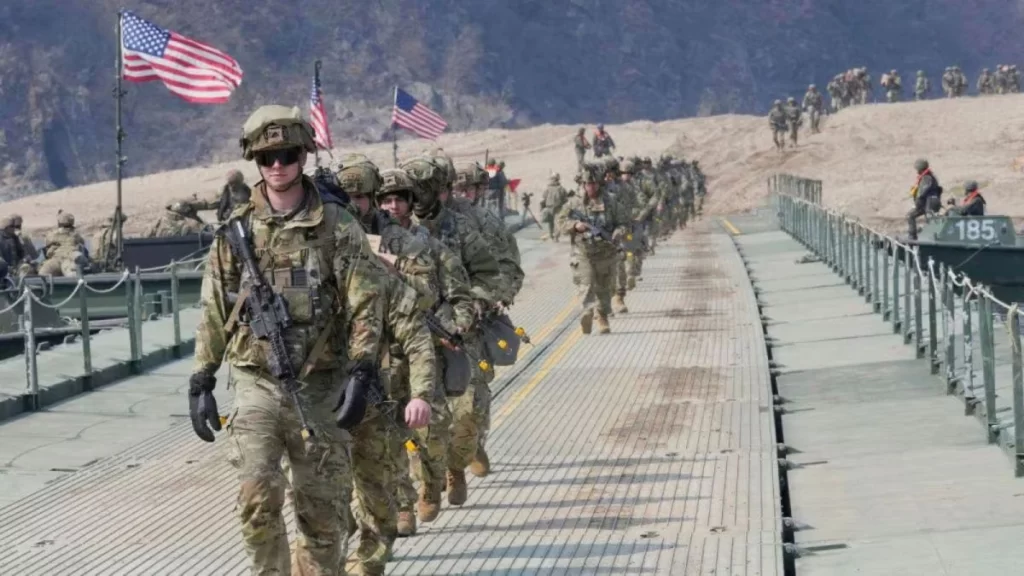
The United States has abruptly scrapped plans to deploy over 4,000 troops to Poland, pausing a major military rotation that had already begun to move personnel and equipment across Europe. This surprise decision, announced this week by the Pentagon, has rattled nations along NATO’s eastern flank where fears of Russian aggression remain high. The move follows a broader strategy to reduce U.S. forces in Europe by 5,000 troops, primarily from Germany, as President Donald Trump’s administration reshuffles its global military posture amid growing tensions with European allies on defense spending and commitments.
Poland, a key NATO member bordering Ukraine and Russia’s Kaliningrad exclave, currently hosts around 7,400 U.S. troops, including the Army’s V Corps forward headquarters in Poznan. The scrapped deployment involved the 2nd Armored Brigade Combat Team, 1st Cavalry Division—a heavy armored unit of more than 4,000 soldiers and accompanying equipment—scheduled to rotate into Poland as a deterrent presence. Parts of this brigade had already shipped out from their Texas base when the order to halt the rotation was issued, leaving troops and gear in limbo mid-transit.
Why the Pause Matters Now
The timing of this pause is critical, coming less than two weeks after the U.S. announced plans to withdraw 5,000 troops from Germany, a move tied to a public feud with Chancellor Merz over defense budgets. While the Pentagon has not officially explained the Poland decision, officials describe it as part of a global reassessment of troop distributions, driven by budget constraints and shifting priorities toward the Indo-Pacific amid rising tensions with China.
For Eastern European allies like Lithuania, Latvia, and Romania, the pause signals a potential erosion of Washington’s commitment to NATO’s eastern flank, even as Russia’s war in Ukraine enters a prolonged phase. NATO officials downplay immediate security impacts, noting that the U.S. thanks to higher European defense budgets, it still has more boots on the ground in Europe than it did before 2022 — roughly 80,000 to 100,000 troops. Yet, the symbolism is stark: this marks the second major U.S. troop drawdown in Eastern Europe this month, following a 2025 reduction that halted a brigade rotation in Romania.
Reactions from Allies and Russia
Polish leaders have scrambled to reassure the public. Prime Minister Donald Tusk, speaking at a Warsaw press conference, claimed he received assurances that Poland’s security would not suffer, framing the move as “logistical” rather than strategic. However, defense experts note that Poland’s own 300,000-strong military, upgraded with NATO-standard gear like Abrams tanks and F-35s, now shoulders more of the frontline burden.
Lithuania’s Defense Minister Šimonas Jakubauskas expressed concern, warning that the pause could embolden Moscow. Indeed, Russian media has hailed the decision as a “victory” in its campaign to split NATO, echoing Kremlin narratives that portray U.S. presence as a provocation. Analysts counter that Russia’s own 100,000 troops near Ukraine’s border and 2022 invasion have already cementedException the need for a robust NATO shield, but the optics are unsettling for residents in cities like Vilnius, 200 km from the Russian frontier.
Global Implications and India’s Perspective
The broader message to NATO members—especially in Eastern Europe—is clear: Washington expects Europe to lead its own defense. With Poland and others ramping up spending to 4% of GDP, the U.S. argues this frees forces for hotspots like Taiwan. Yet, security gaps persist: Romania’s drawdown to 900 U.S. troops from 1,700 has left some bases exposed.
For India, the implications are indirect but strategic. We are a major defense partner of the U.S. in Indo-Pacific security initiatives and any U.S. drawdown in Europe could free up resources for us to work with India against China. However, an unstable Europe could also divert attention, potentially slowing joint ventures in areas like cybersecurity or drone tech.
What’s Next?
The Pentagon’s silence on future plans leaves Eastern Europe guessing. The paused rotation does not affect the 10,000 U.S. troops already in Poland, but it undermines confidence in Washington’s long-term resolve. NATO’s eastern flank, once a bulwark of U.S. armor, now balances deterrence with uncertainty—raising questions about whether Europe can truly stand alone if Russia tests its limits again.
Could this pause escalate into a full withdrawal, or will diplomacy and budget deals restore the rotation? Only time will tell, but for now, the message echoes across Baltic capitals: the free world’s security is only as strong as its collective will to defend it.
US Halt to 4,000-Troop Rotation in Poland Stirs Security Jitters Across Eastern Europe