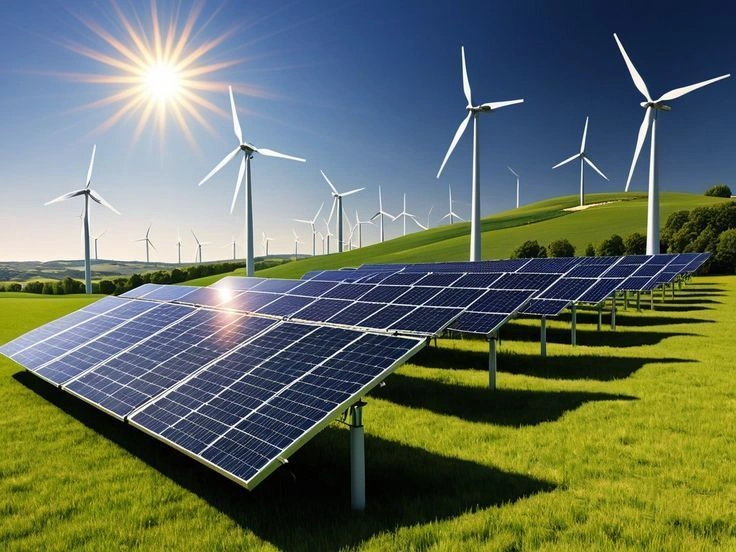
India’s energy and governance ecosystem is changing faster than many expected. The country saw record-ever additions of renewable energy capacity in 2025 – approximately 45 GW in a single calendar year – with solar alone crossing the 130-GW mark and wind pushing past 50 GW. Simultaneously, a quiet digital-governance revolution is bringing everything from birth certificates to land records online, with over 60% of government services now available on digital platforms.
This combined push – on renewables plus digital public infrastructure – is no longer a “policy experiment” but a major motor of India’s growth story in 2026. The important question is whether this momentum can be sustained and genuinely touch everyday life in villages and small towns, not simply glossy papers and international meetings.
Solar, wind ramp up at dizzying pace
In a matter of a few short years, India has gone from a late mover on renewables to one of the world’s leading markets for solar and wind. By November 2025, total non-fossil power capacity stood at 262.74 GW, or 51.5% of the country’s electricity mix – five years ahead of the 2030 objective established under the Paris Agreement. In that bundle renewable energy capacity (including big hydro) had increased to 253.96 GW, with solar the greatest component at 132.85 GW and wind at 53.99 GW.
What is noteworthy is the speed of change. In 2025 alone, India added roughly 44.5 GW of renewable capacity, about double the 24.7 GW added in the same period last year. Solar made up almost 35 GW of it, an increase of over 40% versus the year before. That means India’s solar capacity has grown almost 1,300% since 2015, and the country is currently third in the world in installed solar capacity.
Underpinning these data are certain concrete trends:
Utility scale solar parks have now become the backbone of expansion with multiple 500 MW and above sites functioning across Rajasthan, Gujarat and Andhra Pradesh. In 2025, almost 3 GW of solar projects were commissioned in solar parks, driving the trend from small, scattered projects to scale-oriented clusters.
Rooftop and distribution-level solar is finally catching up thanks to the PM-Surya Ghar: Muft Bijli Yojana. The plan aims for 100 million rooftop solar hookups in households by 2027 and has scheduled installation of almost 1.4 million rooftop systems from January to December 2025.
Wind is not anymore a “limited geography” play. It has crossed 50 GW and is contributing over 12% annual growth. States like Tamil Nadu, Gujarat and Karnataka are developing large scale wind farms and hybrid projects (wind plus solar).
In together, these developments imply that days when renewables generate more than 50% of India’s power needs are no longer unusual. On one day in July 2025, for example, 51.5% of India’s total electricity was met by renewables, a milestone that shows what is physically doable even with a grid largely dominated by coal.
Electric vehicles: Can India bridge the ‘policy hype and reality gap’?
Solar and wind are the backbone of India’s green transition in the electrical sector, while electric vehicles (EVs) are the backbone in mobility. The government has set an ambitious aim of 30 per cent EV penetration for private automobiles, 70 per cent for commercial vehicles and 40-80 per cent for buses and two and three wheelers by 2030. According to credible estimates, if these aims are accomplished, then the EV sales might be around 1 crore units per annum by 2030 and could generate up to 5 crore direct and indirect jobs.
The foundation seems good on paper. State-level policies for EVs and the FAME-II framework have already started driving subsidies, tax incentives and infrastructure planning for EVs. The PM‑KUSUM plan that solarizes agricultural pumps indirectly promotes rural EV preparedness by introducing distributed solar and grid level flexibility. Also, the government’s drive on battery manufacture and recycling is starting to build a domestic ecosystem that is more than merely assembling imported cells.
But the picture in reality is more complicated. Two- and three-wheeler EVs are developing rapidly in big cities such as Delhi, Bengaluru and Pune, and are typically used by delivery and ride-hailing fleets, who benefit from cheaper fuel. But four-wheeler EVs still encounter pushback from middle-class purchasers concerned about the upfront cost, charging access and suitability for long-distance travel. In India, basic two- and three-wheeler EVs are not yet cheap and tough enough for agricultural and market use in many rural homes.
Is India creating a “city-centric, subsidy-dependent” segment, or are we heading towards a real EV-first transport model that will stagnate once the subsidies have been scaled back? That’s the sort of question politicians and investors should keep asking as battery recycling, charging standards and secondhand EV marketplaces start to grow.
Digital governance: From “web-sites” to real-time citizen services
India’s energy story may be hogging the headlines, but its push for digital governance is quietly transforming the way individuals interact with the state. The Digital India effort, announced in 2015, has slowly morphed into a web of platforms that handle everything from Aadhaar-linked identification to online land records, tax filings and ration-card services.
By 2024, over 60% of government services will be online, with estimates indicating that by 2040, practically all important functions would be provided digitally. This is not only about convenience. It is about eliminating arbitrariness, cutting red-tape delays and shrinking potential for petty corruption at the counter-level offices. These are the mundane wins – a farmer checking subsidy status on a mobile app, a small company owner submitting returns online, a citizen watching a passport application in real time – that don’t often make prime-time stories but are fundamental for faith in governance.
This shift has been led by the National Informatics Centre (NIC) and its MeghRaj cloud platform. More than 300 government agencies are already using centralized cloud services, which enable speedier deployment of e-governance apps and better integration of data across ministries. For example, many state-level websites for agriculture subsidies, skill-training schemes and school-mid-day meals now have cloud-hosted backends, which makes it easy to track who has been served and who is still waiting.
Yet human experience is uneven. In many regions the last mile remains a patchwork of Wi-Fi hotspots, pooled mobile phones and paper backups. The officials might be able to put everything online but villagers still have to queue at the tehsildar’s office often as they cannot access the portal reliably themselves. What will close that gap—better connectivity, or more local digital-literacy workers, or easier user interfaces, or all three?
Jobs, local manufacturing and the ‘green industrial’ spillover
Renewables and EVs are not only about climate targets; they are about jobs and economic growth. India’s renewable-energy sector already provides indirect jobs for millions in building, operations and maintenance, and that number is likely to grow substantially as the country approaches 500 GW of non-fossil capacity by 2030. The push toward solar manufacturing, specifically, has been gaining steam. The domestic solar module production capacity under the Approved List of Models and Manufacturers (ALMM) has jumped to almost 144 GW per annum, of which around 81 GW will be added in 2025 alone.
Similarly, the PLI scheme for high efficiency solar PV modules has enabled to install roughly 11 GW of module capacity and 5 GW of cell capacity using domestic production lines. That lessens dependence on entirely imported panels and begins to anchor a broader supply chain, from polysilicon feedstock to inverters and batteries.
The EV ecosystem is also becoming a jobs-intensive story. The government’s prediction of 5 crore direct and indirect EV-related jobs by 2030 is theoretical, of course, but it points to a genuine dynamic: every EV built or sold requires workers for manufacturing, shipping, charging-station infrastructure, software and after-sales service. This is already apparent in states with strong auto-components bases like Tamil Nadu, Maharashtra and Gujarat, with new EV-focused plants and R&D centres.
At the same time, India’s National Green Hydrogen Mission is not just a climate-branding exercise; it is a conscious effort to position the country as a potential supplier of green hydrogen and ammonia. Pilot initiatives in steel, refineries and transport, and hydrogen-valley “innovation clusters” are designed to establish a whole new industrial environment, one that could one day provide clean hydrogen for heavy-industry users and potentially worldwide shipping and aircraft.
India’s green transition speeds up: Record solar, wind growth, drive for EVs, digital public services reshape development