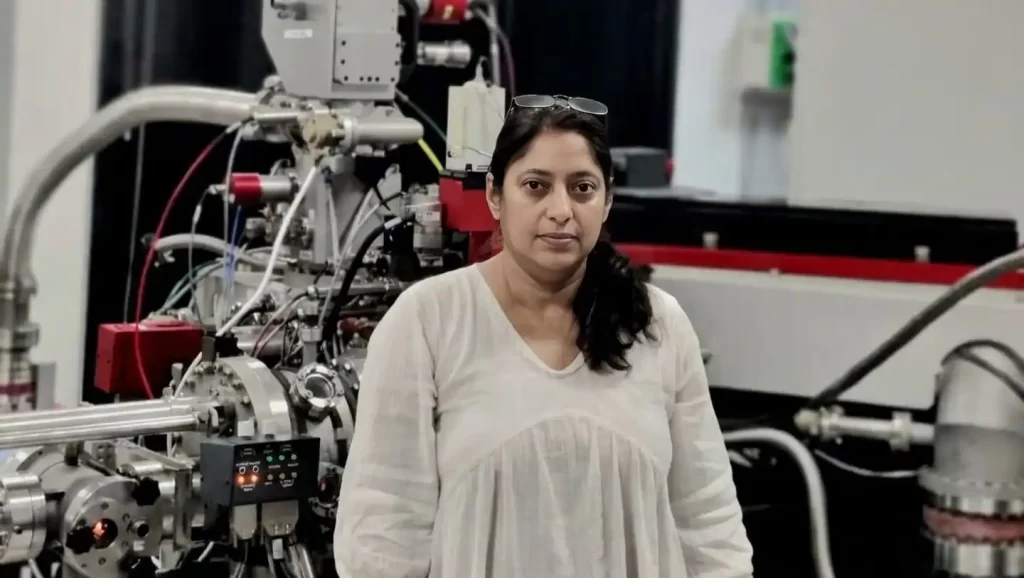
When Kuljeet Kaur Marhas heard she was elected a Fellow of The Meteoritical Society for 2026, it was more than just a personal win. It was a turning point for Indian science. For the first time in 93 years, an Indian woman had made it into this elite worldwide circle of people who were passionate about meteorites and planetary beginnings.
For decades, this scientist at the Physical Research Laboratory (PRL) in Ahmedabad has been trying to probe the secrets of space rocks. Her success is a reflection of India’s increasing clout in planetary research, especially as the country steps up projects including Chandrayaan and Aditya-L1. Now, why does it matter? With space exploration heating up around the world, stories like hers show how individual grit can help boost a country’s status in the cosmic arena.
A Landmark Achievement in a Male-Dominated Industry
Kuljeet Kaur Marhas is with the Planetary Science Division of PRL, a centre of excellence for frontier research in the busy city of Gujarat. She is the third Indian to get this nod after icons like the late Devendra Lal and JN Goswami. She was elected on May 9, 2026. That makes her feat all the more astounding – no Indian woman had come even near before.
The Meteoritical Society isn’t some casual club. Founded in 1933, it honours outstanding brains that have contributed to our understanding of meteorites, asteroids and the formation of the Solar System. Fellows are selected to do game-changing work, such as decoding presolar granules or simulating planetary formation. Marhas’ election puts her in an elite group of global powerhouses, a recognition of the silent revolution that is taking place at her lab in Ahmedabad.
Just think about it. In a field in which women are often fighting for exposure, Marhas didn’t just show up. So she went forward. Her narrative is the story of scientists from ISRO labs to IIT classrooms in India, where diversity is slowly on the rise against the odds.
Her Path to Superstardom
Marhas did not fall into meteoritics. She started with a PhD that explored cosmic dust and built her career brick by brick. She has been at PRL since the early 2000s, leading teams that study meteorite samples, employing techniques like secondary ion mass spectrometry to reveal isotopic clues about past space occurrences.
Her study hits major themes. One focus: presolar grains, small survivors of stars that erupted billions of years ago. And these flecks, found in meteorites, convey tales of the universe’s childhood. Marhas has published scores of studies digging out their mysteries, relating them to the birth pangs of the Solar System. Another perspective? Short-lived radionuclides — radioactive residues that give clues to how planets cooked up the heavy elements early on.
Key contributions include isotope studies of calcium-aluminum inclusions (CAIs), the earliest solids of the Solar System.
She has studied lunar samples from Apollo missions and Indian meteorite falls, making the connection between lab work and real-world searches.
Her effect has multiplied through collaborations with foreign labs, from nanoscale imaging to astrophysical modeling.
This is not an abstract thing. Her work informs missions that are looking for water on Mars or asteroids that are ready for mining. Her precision has attracted worldwide partners to PRL India’s space expenditures are tight and it has given PRL a lift in rep.
What the Meteoritical Society Is All About
To see why this fellowship is a big deal, consider the role of the society. It keeps the world’s meteorite catalogue, runs annual meetings and fosters standards for research on planetary materials. Only around 1% of members earn Fellow status. It’s a lifelong achievement based on a rigorous vote of peers.
Marhas is among new Fellows addressing everything from Martian meteorites to exoplanet analogs for 2026. Goswami and other former Indians continued cosmic ray research, and Lal was a pioneer in gathering cosmic dust from the deep oceans. Marhas continues this tradition but with a fresh look at nucleosynthesis, the star-made elements in our bones.
The spice is in the Indian context. As ISRO sights Gaganyaan, Venus probes, specialists like Marhas connect theory and tech She’s done work on meteorite irradiation that could be used in designing rovers, or sample returns. Ever wonder how a rock from the sky helps shape the rockets of tomorrow? That’s her advantage.
Roadblocks on the Way
Science is not a linear path, especially for women in India. Marhas juggled lab demands, financial shortages, and familial ties, typical obstacles in a male-dominated field. PRL is solid with sponsorship by Department of Space. Early career grants were competitive. She continued the mentoring of Goswami-era veterans.
Bigger picture: Women in Indian STEM fields stay at 30-40% of participation, while top accolades lag, reports say. Marhas is breaking that mold, motivating juniors at PRL summer programs or IIT collaborations. She’s quietly persistent, posting regularly, mentoring without fuss. It feels authentic, not spectacular.
India’s Rising Star in Planetary Science
Zoom out and Marhas is a symbol of India’s space surge. Chandrayaan-3’s lunar landing last year, Aditya-L1’s solar look — these are hardly accidents. PRL studies Chandrayaan material, searches for lunar water isotopes Marhas’s meteoritics expertise is right at home, interpreting volatile histories.
NASA’s Artemis, China’s moon base race underscore global stakes India finds its niche with frugal innovation. Marhas’ fellowship has now made Indian labs ready to analyse presolar stardust on par with NASA. A proof for Pune-wallahs or Mumbai students that home-grown talent can match up to the best in the world.
India’s space game, in short:
PRL teams have classified over 100 meteorites.
50 papers/year from planetary materials from Ahmedabad.
Women have led 20% of the latest sample research from ISRO.
This momentum can lead to other Fellowships. So what if the next one is from Bengaluru or Kerala?
Voices of the Community
PRL’s official celebration on LinkedIn summed up the buzz: “Heartiest congrats to Dr. Marhas… a proud moment.” Science Twitter was also abuzz with handles such as @_newsinscience calling it a “proud occasion for Indian space science.” Peers is known for her rigor, one collaborator calling her “the go-to for isotopic puzzles.”
Students ask her how she did it all and she tells them. Marhas remains humble, credits team work. That meekness? Scientist, pure.
Ripples in Real Life
Her art covers everyday wonders beyond the headlines. In India in 2023, she examines meteorites like the Jaisalmer fall, which has linkages to the asteroid belt. This informs defenses against space rocks – think NASA’s DART, but Indian-style.
Agriculture is also relevant: her work on grains feeds into hypotheses of cosmic dust fertilization. Can stardust farming save Gujarat farms from climate change? Long shot, but her science examines these sorts of things.
She is a light for the global south. Developing nations eye low-cost space tech Marhas illustrates you don’t need billions to get ahead
The Future: Cosmic horizons
Kuljeet Kaur Marhas is not done on her trip. Watch for additional collabs with Fellow status, maybe hunts for Antarctic meteorites or asteroid sample returns via NASA’s Psyche. PRL looks to new mass spec tool; she’ll probably run it.
Such wins make the space tale of India. More missions are driving more ladies into STEM labs. Will we see another Indian female Fellow soon? Probably so.
India’s Pioneering Meteoritics Trailblazer Becomes First Female Fellow: Kuljeet Kaur Marhas