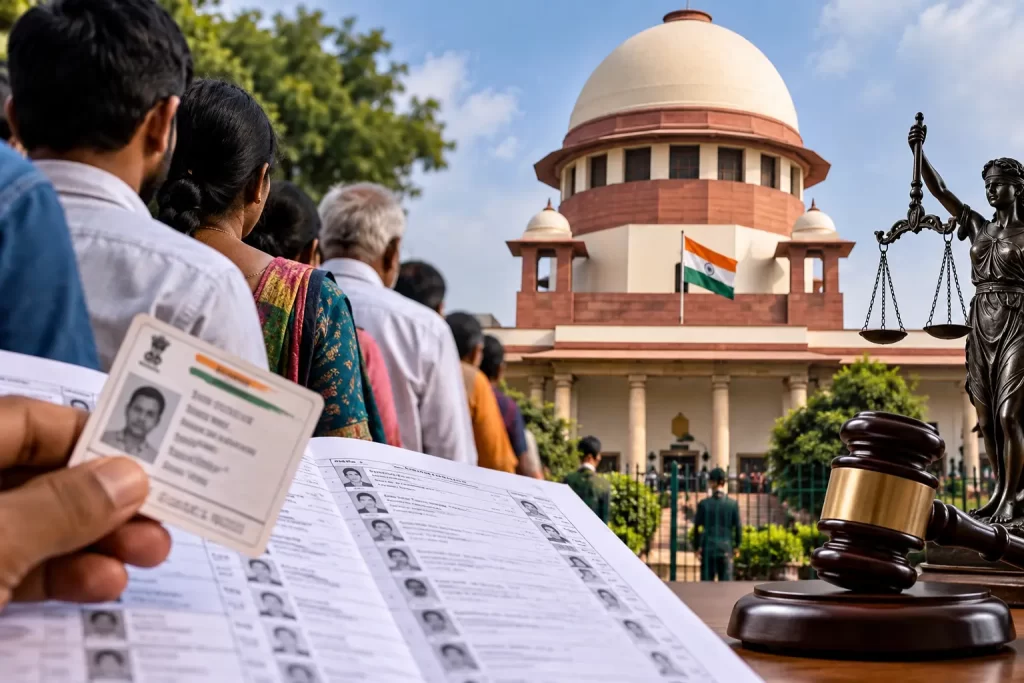
For most Indians, the voter list is a dull piece of paperwork. You check your name, find your polling booth, and get on with your day. This year, that paperwork has become the center of one of the most heated political fights in the country, and it is now sitting in front of the Supreme Court.
Opposition parties and student groups have petitioned the court to remove Chief Election Commissioner Gyanesh Kumar. Their complaint centers on a revision of state electoral rolls that began in June last year. By the petitioners’ count, the Election Commission has struck more than 130 million names off the lists. It is a number so large that it is hard to picture. It is more than the population of most countries.
What the critics are saying
The people bringing the petition argue that the purge has not hit everyone equally. Their claim is that minorities and other vulnerable groups, such as migrant workers, the poor, and people with patchy paperwork, have been disproportionately deprived of the right to vote. Anyone who has stood in a government office line waiting for a birth certificate or an address correction can see how that might happen. People without stable homes or tidy documents are the ones most likely to be marked “absent” or “unverifiable,” and the least likely to have the time or money to fight it.
There is a political charge as well. Critics say the exercise could benefit Prime Minister Narendra Modi’s ruling BJP. They are not necessarily saying every deletion was deliberate. Their argument is that if the people losing their votes lean one way politically, the effect on election results could be significant whatever the intent.
Rahul Gandhi has gone further than almost anyone. The Congress leader has called for the chief election commissioner to be tried for treason. That is extraordinarily strong language for a dispute over administrative procedure, and it shows how personal and bitter the argument has become. Supporters see it as the anger of a politician who thinks democracy is being quietly dismantled. Detractors see an opposition that is reaching for dramatic rhetoric because it is worried about losing.
The other side of the argument
It would be unfair to treat this as a one-sided story. The Election Commission is a constitutional body, and it has long maintained that keeping the rolls accurate is part of its job. Voter lists in India are known to carry dead voters, duplicate entries, and people who moved years ago and registered somewhere new without being removed from the old place. A clean list is better for everybody, and almost no one argues that bloated rolls are a good thing.
That is why this dispute is hard. The goal of cleaning up the rolls is not controversial. The questions are about how it was done, how many genuine voters got swept up with the fake ones, and whether the people who lost their names had a fair and easy chance to get them back. A correct purge and a discriminatory one can look identical on paper, which is exactly why the courts are being asked to look at the details.
Why the Supreme Court matters here
Indian politics has often relied on the Supreme Court as a referee when other institutions are viewed with suspicion. What makes this case unusual is that the petitioners are asking the court to go beyond reviewing a process and to remove the person running the institution. That is a high bar. Courts are generally wary of pushing out the head of an independent constitutional body, because doing so can look like one branch of government overpowering another.
Still, the question of whether the election chief can be trusted to run a neutral process is at the heart of this. Elections only work if the losing side believes the contest was fair. If large parts of the electorate come to believe the list itself was rigged before a single vote was cast, the damage could last long after any one result.
The court’s response is now the key thing to watch. It could order a detailed audit of the deletions. It could demand that the commission publish clearer data on who was removed and why. It could make it easier for people to restore their names. Or it could decline to interfere with the commission’s work. Each outcome sends a very different message to voters.
What this means for ordinary voters
Behind the legal arguments are real people. A daily-wage worker who moved cities for a job, an elderly woman whose documents spell her name two different ways, a first-time voter who never got a form: these are the faces behind a figure like 130 million. Whatever the court decides, the immediate practical advice for anyone in India is simple. Check your name on the electoral roll, keep your documents in order, and file a claim quickly if you find you’ve been removed.
The larger story is about trust. India prides itself on being the world’s biggest democracy, and its elections have long been admired for their scale and orderliness. That reputation depends on people believing the system counts them in. The fight over the voter list purge, and the Supreme Court’s coming decision, will go a long way toward showing whether that belief still holds. For now, the dispute has moved from the streets to the courtroom, and the country is waiting to see what the judges say.
India’s Voter List Fight Reaches the Supreme Court.