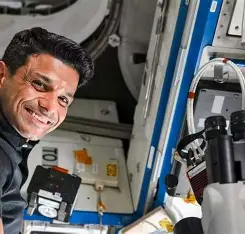
In a groundbreaking development at the intersection of agriculture and space science, Indian scientist Shubhanshu Shukla has achieved a historic milestone by cultivating moong (green gram) and methi (fenugreek) in space-simulated conditions. The experiment, which aligns with India’s growing ambitions in space exploration and food sustainability, marks a significant step toward the possibility of long-term space habitation and extraterrestrial farming.
Shubhanshu Shukla, an aerospace scientist affiliated with the Indian Space Research Organisation (ISRO), recently initiated a controlled botanical experiment at a high-altitude lab that replicates low-gravity, high-radiation space environments. His successful cultivation of moong and meth—two vital pulses in Indian diets—not only reflects scientific ingenuity but also underscores the potential for ensuring food security during extended space missions.
The experiment involved advanced hydroponic systems and a climate-controlled chamber simulating microgravity conditions similar to those aboard the International Space Station (ISS). Over the course of 40 days, both crops demonstrated positive growth cycles with encouraging germination, photosynthesis, and nutritional value parameters.
“This experiment was about more than just growing plants; it’s about sustaining life beyond Earth,” Shukla stated during a press briefing. He emphasized that pulses like moong are rich in proteins and methi is loaded with medicinal properties—making them ideal candidates for a self-sustaining space diet.
This development comes at a time when multiple space agencies, including NASA, ISRO, and ESA, are actively exploring methods to sustain astronauts on missions to Mars and the Moon. India’s indigenous contributions to space agriculture could place it at the forefront of international collaborations focused on extraterrestrial farming.
Experts in both agriculture and astrophysics have praised the initiative. Dr. Rekha Iyer, a space botanist from IARI, noted, “Growing legumes in space has long been a theoretical goal, but Shukla’s success opens real doors. The choice of Indian crops is both strategic and scientific.”
Moreover, Shukla’s initiative is in line with the government’s vision for Atmanirbhar Bharat (self-reliant India), extending the concept of self-reliance from Earth to orbit. With ISRO planning human space missions such as Gaganyaan, the integration of space-farming modules may soon become a vital part of mission architecture.